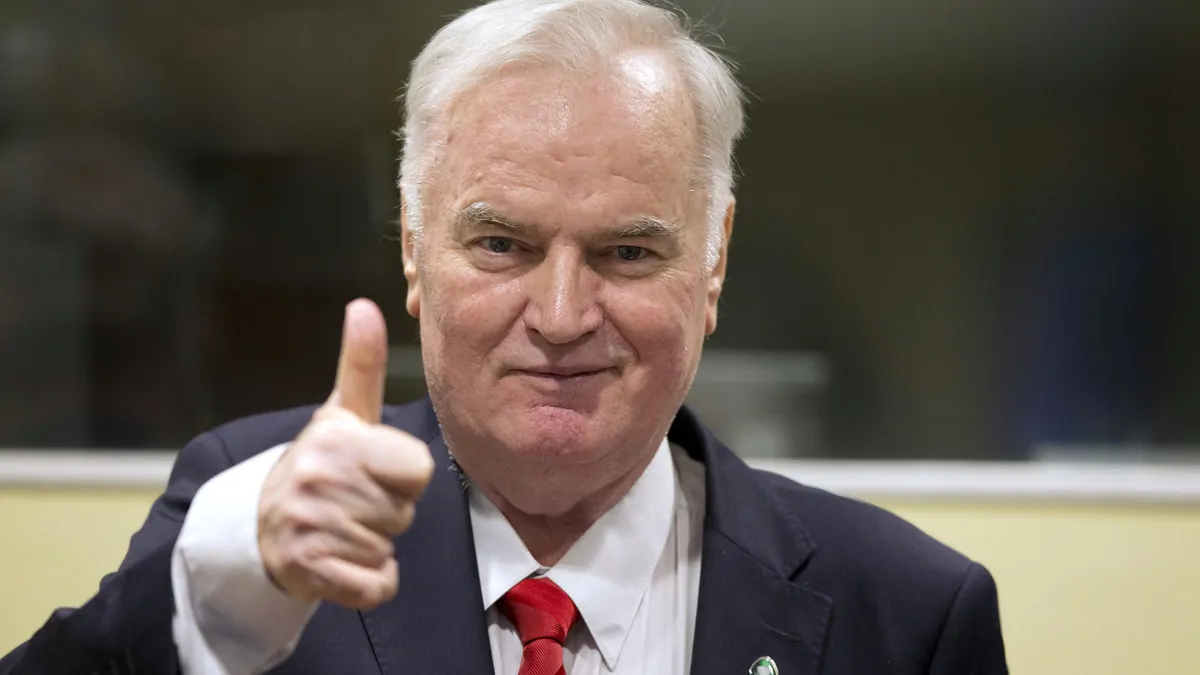
Ratko Mladić, 'Butcher of Bosnia', Dies in Hague Prison
Ratko Mladić, the Bosnian Serb general convicted of genocide and war crimes, has died at the age of 84 while serving a life sentence in The Hague. His death was confirmed by a UN tribunal, ending his incarceration for orchestrating atrocities during the Bosnian War, including the Srebrenica massacre.
Key Highlights
- Ratko Mladić, infamous 'Butcher of Bosnia', has died.
- He was serving a life sentence for genocide and war crimes.
- Mladić died in a UN prison hospital in The Hague.
- He was convicted for orchestrating the 1995 Srebrenica massacre.
- His death was confirmed by a UN international tribunal.
- Mladić was 84 at the time of his death.
Ratko Mladić, the former Bosnian Serb military commander infamously known as the 'Butcher of Bosnia,' has died at the age of 84. He passed away while serving a life sentence in a UN prison hospital in The Hague, Netherlands. The confirmation of his death came from a UN international tribunal.
Mladić was convicted in 2017 by the International Criminal Tribunal for the former Yugoslavia (ICTY) for genocide, war crimes, and crimes against humanity for his role in the Bosnian War (1992-1995). His most egregious crimes include orchestrating the 1995 Srebrenica massacre, where over 8,000 Bosnian Muslim men and boys were killed, an event widely recognized as Europe's worst atrocity since World War II. He also oversaw the brutal, years-long siege of Sarajevo, which resulted in the deaths of approximately 10,000 civilians. The ICTY found that without Mladić's direct command, these crimes would not have been committed as they were.
Born on March 12, 1942, in Božanovići, in what was then the Independent State of Croatia (modern-day Bosnia and Herzegovina), Mladić was a career military officer in the Yugoslav People's Army before leading the Army of Republika Srpska (VRS) during the Yugoslav Wars. He evaded capture for 16 years after the war, eventually being arrested in Serbia in 2011. Throughout his trial and incarceration, Mladić maintained his innocence, often displaying defiance and self-pity, and never expressed remorse for his actions.
In recent months, Mladić had suffered several strokes, leading his family and Serbian officials to appeal for his release on humanitarian grounds. However, these requests were repeatedly rejected by the Hague tribunal, with a judge noting on August 26, 2026, that the interests of justice did not warrant release even with the expectation of imminent death.
Mladić's conviction was upheld on appeal in 2021. His death brings a form of closure for many victims and survivors, though some express a desire for greater accountability and acknowledgment of the crimes. The UN secretary-general, through his spokesman, expressed solidarity with the victims and survivors. Despite his convictions, Mladić is still viewed as a hero by some nationalists in Serbia and in Republika Srpska, highlighting the ongoing complexities and divisions stemming from the Bosnian War.
The news of Mladić's death was first reported by Serbian state broadcaster RTS. The war in Bosnia and Herzegovina, from 1992 to 1995, resulted in approximately 100,000 deaths and displaced over 2 million people, making it Europe's deadliest conflict since World War II until the 2022 Russian invasion of Ukraine.
The International Residual Mechanism for Criminal Tribunals has ordered a full inquiry into the circumstances of Mladić's death.
Frequently Asked Questions
Who was Ratko Mladić?
Ratko Mladić was a Bosnian Serb military officer who commanded the Army of Republika Srpska (VRS) during the Bosnian War (1992-1995). He was infamously known as the 'Butcher of Bosnia' for his role in orchestrating widespread atrocities.
What were Ratko Mladić's main convictions?
Mladić was convicted of genocide, war crimes, and crimes against humanity by the International Criminal Tribunal for the former Yugoslavia (ICTY). His convictions stemmed from his command responsibility over events like the Srebrenica massacre and the siege of Sarajevo.
Where did Ratko Mladić die?
Ratko Mladić died at the age of 84 in a UN prison hospital in The Hague, Netherlands, where he was serving a life sentence.
What was the Srebrenica massacre?
The Srebrenica massacre, which occurred in July 1995, involved the killing of over 8,000 Bosnian Muslim men and boys by Bosnian Serb forces under Mladić's command. It is considered the worst atrocity in Europe since World War II and a genocide.
What is the significance of Mladić's death for the victims?
For the victims and survivors of the Bosnian War, Mladić's death marks the end of his incarceration for the horrific crimes he committed. While it brings a form of closure, many emphasize that it does not erase the suffering caused and that justice also requires acknowledgment and remembrance.