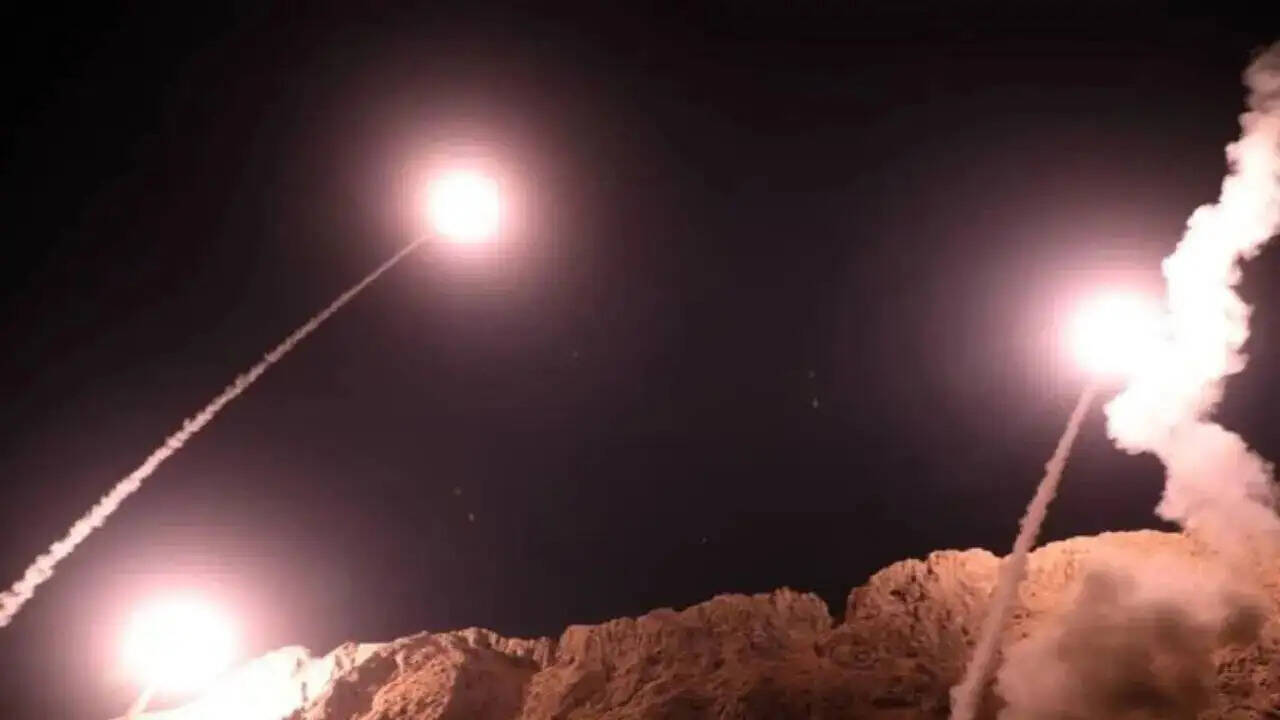
US Defeats Iran Missile, Drone Attacks Amid Escalating West Asia War
The US military announced it successfully thwarted Iranian missile and drone attacks across the Gulf on June 2-3, 2026, while conducting self-defense strikes on Iran's Qeshm Island. Iran's retaliatory strikes, which Tehran claimed hit US bases, were largely intercepted, though Kuwait's airport sustained significant damage.
Key Highlights
- US military confirmed defeating Iranian missile and drone attacks in Gulf.
- Iranian missiles aimed at Kuwait and Bahrain were largely intercepted.
- US conducted self-defense strikes on Iran's strategic Qeshm Island.
- Iran's Revolutionary Guard claimed hitting US bases, denied by CENTCOM.
- Kuwait International Airport damaged, one killed in Iranian drone attack.
- Ongoing US-Iran conflict continues to test a fragile regional ceasefire.
The United States military announced on June 3, 2026, that it had successfully defeated a series of Iranian missile and drone attacks launched across the Persian Gulf, a significant development in the ongoing 'West Asia war' that commenced in late February 2026. This confirmation came as the U.S. Central Command (CENTCOM) detailed the defensive operations and retaliatory strikes conducted on June 2nd and 3rd.
According to CENTCOM, Iran launched several ballistic missiles toward regional neighbors, but critically, all failed to hit their intended targets. Specifically, two Iranian missiles aimed at Kuwait either fell short or broke apart en route. Concurrently, three missiles targeting Bahrain, home to the U.S. Navy's Fifth Fleet, were swiftly intercepted by a combined effort of U.S. and Bahraini air defense forces. Additionally, the U.S. military reported shooting down an "additional wave of Iranian drones" that attempted to attack U.S. forces in Kuwait, with these drones also failing to reach their intended targets. Three other attack drones launched by Iran towards civilian mariners in regional waters were also successfully neutralized by U.S. forces.
In response to these aggressive actions, the United States military carried out self-defense strikes against an Iranian military ground control station located on Qeshm Island. Qeshm Island holds strategic importance due to its proximity to the Strait of Hormuz, a vital international shipping channel for global oil and gas supplies, which has been severely disrupted since the onset of the conflict.
Following the U.S. strikes, Iran's Revolutionary Guard Corps (IRGC) claimed to have launched its own attacks, asserting that they had struck the headquarters of the U.S. Navy's Fifth Fleet in Bahrain and a separate air base in the region. However, CENTCOM explicitly denied these claims, stating unequivocally that "All Iranian attacks on American forces failed" and that no U.S. personnel were harmed and no military assets were damaged by these alleged strikes.
The escalation of hostilities significantly impacted civilian infrastructure in the region. Kuwait International Airport's passenger building sustained considerable material damage, and tragically, at least one person was killed, with several others injured, due to Iranian drone and missile attacks early on June 3, 2026. Consequently, Kuwait suspended all commercial flights, further disrupting regional stability.
This latest exchange of strikes highlights the precarious state of a temporary ceasefire that has been in place since April 8, 2026, in the broader conflict involving the United States, Israel, and their allies against Iran and its proxies. The '2026 Iran war' itself began on February 28, 2026, following a period of heightened tensions primarily stemming from Iran's nuclear program, its ballistic missile capabilities, and its regional military influence. The conflict has already resulted in thousands of casualties and significant economic repercussions, including disruptions to global energy markets due to Iran's control over the Strait of Hormuz.
The veracity of the claims made in 'The Hindu' article's headline is confirmed by multiple independent and official sources. The events described are current and relevant to the date of verification (June 3, 2026), justifying the 'LIVE' designation. The reporting from The Hindu aligns with information from other credible international news agencies, solidifying its accuracy and demonstrating professional news coverage of a critical ongoing global event.
Frequently Asked Questions
What happened in the Persian Gulf on June 2-3, 2026?
The U.S. military reported successfully defeating multiple missile and drone attacks launched by Iran in the Persian Gulf on June 2-3, 2026. These attacks targeted regional neighbors like Kuwait and Bahrain, with most Iranian projectiles intercepted or failing to reach their targets.
Did the U.S. retaliate against Iran?
Yes, in response to the Iranian attacks, the U.S. military conducted 'self-defense strikes' on an Iranian military ground control station located on Qeshm Island, a strategically important location near the Strait of Hormuz.
Were there any casualties or damage from the Iranian attacks?
While U.S. Central Command stated no U.S. personnel or military assets were harmed, Iranian drone and missile attacks did strike Kuwait International Airport's passenger building, causing significant material damage and resulting in at least one fatality and several injuries. Kuwait subsequently suspended commercial flights.
What is the broader context of these recent hostilities?
These recent clashes are part of the ongoing '2026 Iran war' that began on February 28, 2026, involving the U.S., Israel, and their allies against Iran and its regional proxies. The conflict has seen a temporary ceasefire since April 8, 2026, but continuous exchanges of strikes are testing its fragile stability and have global economic implications, particularly concerning oil prices and shipping through the Strait of Hormuz.
What claims did Iran make regarding the attacks?
Iran's Revolutionary Guard claimed to have struck the headquarters of the U.S. Navy's Fifth Fleet in Bahrain and a separate air base in the region. However, U.S. Central Command denied these claims, asserting that all Iranian attacks on American forces failed.