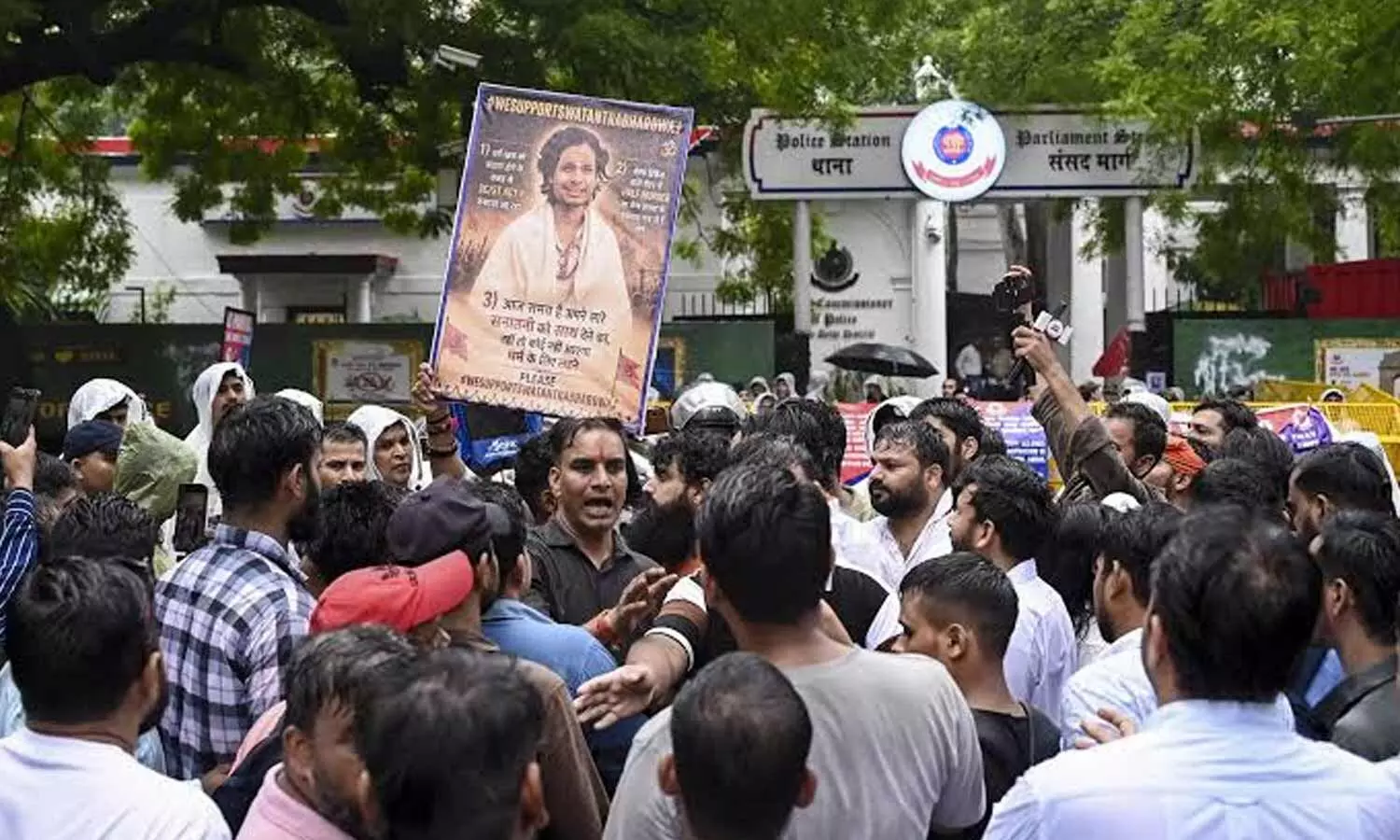
RSS Reacts to 'Cockroach Janta Party': Sees No Shock in Youth Movement
The Rashtriya Swayamsevak Sangh (RSS) has reacted to the 'Cockroach Janta Party' (CJP), with a senior leader stating that differing opinions and youth protests are a natural part of Indian democracy. This satirical youth movement, born from a controversial judicial remark, has gained significant traction, highlighting Gen Z's frustrations and impacting national politics.
Key Highlights
- Cockroach Janta Party (CJP) is a satirical Indian youth movement.
- Founded in May 2026, sparked by CJI's 'cockroach' remark on unemployed youth.
- The movement quickly gained massive online following and led to nationwide protests.
- CJP successfully forced Union Education Minister Dharmendra Pradhan's resignation.
- RSS views youth protests as normal democratic expression, not a 'shock'.
- RSS chief Mohan Bhagwat acknowledged Gen Z's grievances as genuine.
The 'Cockroach Janta Party' (CJP), a satirical yet impactful youth-based political movement in India, has garnered a significant reaction from the Rashtriya Swayamsevak Sangh (RSS), with the ideological parent of India's ruling party expressing a measured perspective on its emergence. The Hindustan Times reported on May 30, 2026, that a senior RSS leader did not see the movement as a 'shock', framing it as a natural part of a democratic society.
The CJP was founded on May 16, 2026, by Abhijeet Dipke, a political communications strategist and activist. Its creation was a direct response to controversial remarks made by Chief Justice of India, Surya Kant, on May 15, 2026. During a Supreme Court hearing, Kant referred to certain activists and unemployed youth as 'cockroaches' and 'parasites of society'. Although the Chief Justice later clarified his comments were directed only at individuals with fraudulent degrees, his initial remarks ignited widespread criticism and resonated deeply with India's Gen Z, who felt increasingly marginalized by the economic and political landscape.
The movement's name, 'Cockroach Janta Party' (Cockroach People's Party), is a wordplay parodying the ruling Bharatiya Janata Party (BJP). It adopted the derogatory term 'cockroach' as a badge of resilience and solidarity, with its slogan 'Main Bhi Cockroach' (I am also a cockroach) symbolizing the collective defiance of millions of struggling young citizens. The CJP rapidly gained immense popularity across social media platforms. Within days of its launch, it amassed over 22 million followers on Instagram, surpassing the online presence of major established political parties in India. The movement's official X (formerly Twitter) account was, however, withheld in India on May 21, 2026, under Section 69(A) of the Information Technology Act, 2000, illustrating the government's attempts to control its reach.
The CJP is not a registered political party but functions as a satirical political movement and public pressure coalition. It operates with zero corporate funding and is built entirely on volunteer efforts, internet culture, memes, and the collective frustration of a generation. The movement presented a five-point manifesto demanding systemic reforms, including preserving judicial impartiality by barring post-retirement political rewards for Chief Justices, ensuring electoral integrity by holding the Chief Election Commissioner accountable under the Unlawful Activities (Prevention) Act (UAPA) for deleted legitimate votes, increasing women's reservation to 50% in Parliament and Cabinet without increasing overall seat strength, regulating media monopolies, and implementing a twenty-year bar on defectors from contesting elections or holding public office.
The CJP quickly moved from online satire to real-world action, leading to significant protests across India, particularly in Delhi. These demonstrations primarily focused on irregularities in entrance examinations, notably the National Eligibility cum Entrance Test (NEET) for undergraduate medical studies, which affected millions of students due to paper leaks. The protests, which escalated after police crackdowns in New Delhi, culminated in a major victory for the CJP: the resignation of Union Education Minister Dharmendra Pradhan on July 25, 2026. This was a rare concession by the Modi government, marking only the second ministerial resignation due to public pressure in 12 years.
The RSS, through its Prachar Pramukh Sunil Ambekar, offered an early official response to the CJP. On May 30, 2026, Ambekar stated that differing opinions and public discussions are an inherent part of a democratic society and should not be viewed with 'shock'. He emphasized that Indian democracy possesses the capacity to accommodate all voices and emotions, and that 'Gen Z' has faith in the country. This stance suggests the RSS views the youth movement not as a threat but as a manifestation of democratic processes. This perspective was further elaborated by RSS chief Mohan Bhagwat in August 2026, who unequivocally backed the students protesting against NEET irregularities. Bhagwat stated that the 'grievances of the Gen Z are genuine' and described protest as a legitimate 'way of dialogue' in a democracy. He asserted that protesting does not make young people 'anti-national' and underscored the importance of listening, dialogue, and understanding youth concerns.
The rise of the CJP signifies a crucial shift in India's political landscape, highlighting the growing frustration and disillusionment among its massive youth population regarding issues like unemployment, education, and institutional credibility. The movement's ability to mobilize millions and force a significant government action demonstrates the potent power of digitally-driven, satirical activism in challenging established political narratives and demanding accountability. While the CJP's founder Abhijeet Dipke has faced threats and its online presence has been challenged, the movement has undeniably carved out a significant space in India's political discourse, forcing traditional power centers, including the RSS, to acknowledge and engage with the concerns of a new generation.
Frequently Asked Questions
What is the Cockroach Janta Party (CJP)?
The Cockroach Janta Party (CJP) is an Indian youth-based satirical political movement founded in May 2026 by Abhijeet Dipke. It emerged in response to controversial remarks by the Chief Justice of India, who referred to unemployed youth as 'cockroaches,' a term the movement reclaimed as a symbol of defiance. The CJP uses satire and digital mobilization to advocate for systemic reforms, particularly concerning education and governance.
How did the CJP gain prominence and what was its impact?
The CJP rapidly gained millions of followers on social media platforms and translated its online presence into widespread offline protests across India, especially regarding irregularities in national entrance examinations like NEET. Its most significant impact was successfully forcing the resignation of Union Education Minister Dharmendra Pradhan in July 2026, a rare achievement for a public pressure movement in India.
What was the RSS's reaction to the Cockroach Janta Party?
The Rashtriya Swayamsevak Sangh (RSS) reacted to the CJP through its Prachar Pramukh Sunil Ambekar, who stated that differing opinions and public discussions are a natural part of Indian democracy and should not be viewed as a 'shock'. RSS chief Mohan Bhagwat further supported this by acknowledging that Gen Z's grievances are genuine and that protest is a legitimate form of democratic dialogue, emphasizing that it does not make them 'anti-national'.
What are the core demands of the CJP's manifesto?
The CJP's manifesto outlines five core demands: ensuring judicial impartiality by preventing post-retirement rewards for Chief Justices, enforcing electoral integrity by holding election commissioners accountable for deleted votes, implementing 50% women's reservation in Parliament and Cabinet, regulating media monopolies, and imposing a strict bar on political defectors.
Why is the 'Cockroach Janta Party' significant for Indian politics?
The 'Cockroach Janta Party' is significant because it represents a powerful new form of youth-driven, digitally-native activism in India. It successfully mobilized a large number of disillusioned young people, highlighting their frustrations with unemployment, education, and governance, and demonstrated the capacity to influence national policy and force accountability from the political establishment, thereby reshaping political discourse.