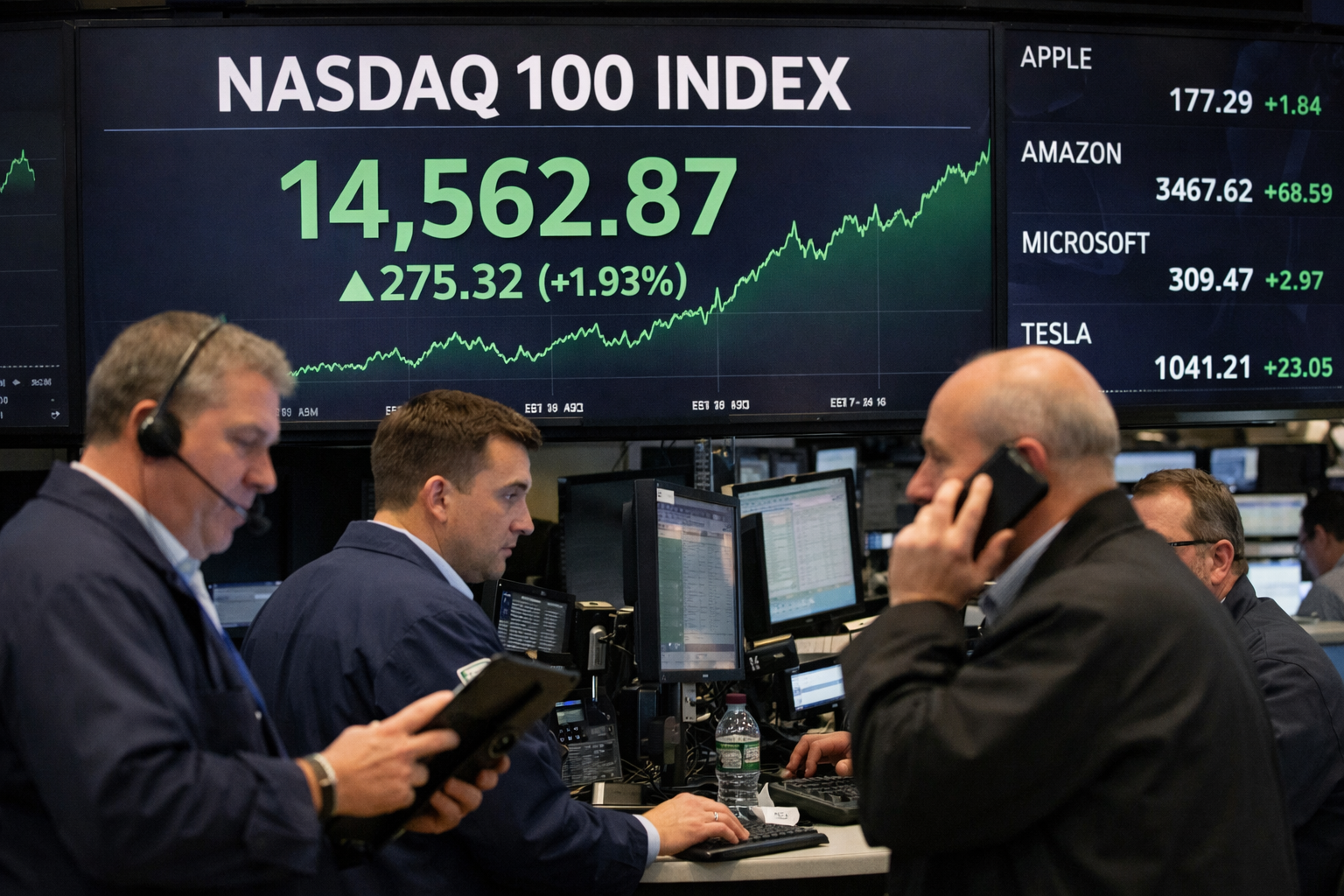
Nasdaq in correction as Wall Street slumps on escalating Middle East conflict
Global markets experienced a significant downturn as the Nasdaq Composite entered correction territory, driven by escalating geopolitical tensions in the Middle East. The U.S.-Israeli conflict with Iran triggered a sharp increase in oil prices and heightened inflation concerns, leading to widespread investor uncertainty and a notable slump across Wall Street's major indexes.
Key Highlights
- Nasdaq confirms correction, falling over 10% from recent peak.
- Wall Street indexes, including S&P 500 and Dow, slumped sharply.
- Escalating U.S.-Israeli conflict with Iran fuels market uncertainty.
- Oil prices soar due to Strait of Hormuz disruption fears.
- Global inflation concerns exacerbated by rising energy costs.
- Indian markets also impacted by crude prices and FII outflows.
Global financial markets experienced significant turmoil on Thursday, March 26, 2026, as the technology-heavy Nasdaq Composite officially entered correction territory, marking a decline of over 10% from its October 29 record high of the previous year. This widespread market slump, which saw Wall Street's main indexes fall sharply, was primarily attributed to escalating geopolitical tensions in the Middle East, specifically the U.S.-Israeli conflict with Iran.
A market correction is commonly defined as a price drop of 10% to 20% from a recent peak in an individual stock, bond, commodity, or an entire index. On this particular day, the S&P 500 index lost 1.74%, closing at 6,476.89 points, while the Nasdaq Composite plunged 2.34% to 21,416.27 points. The Dow Jones Industrial Average also fell by 1.04%, ending the day at 45,955.00 points. These declines were a direct response to investor anxieties regarding the potential for further escalation in the Middle East conflict.
The core of the uncertainty stemmed from the ongoing U.S.-Israeli military operations against Iran, which had expanded in late February and continued into early March. This conflict raised significant fears about disruptions to global energy supplies, particularly through the Strait of Hormuz. The Strait of Hormuz is a critical chokepoint for seaborne oil trade, typically handling approximately 20% of the world's oil, gas, and fertilizer-related shipments. The threat of its near-closure or disruption led to a sharp surge in oil prices, with U.S. crude futures settling up 4.6% and Brent futures advancing 5.7%. Brent crude oil prices had already surged over 13% since the conflict began, surpassing the $82 per barrel mark.
The soaring oil prices immediately exacerbated inflation concerns globally, putting central banks, including the U.S. Federal Reserve, in a difficult position regarding interest rates. Traders, who had previously priced in two rate cuts before the Iran conflict erupted, were no longer anticipating any easing from the U.S. Federal Reserve for the year. The Organisation for Economic Co-operation and Development (OECD) also warned that the Middle East conflict had derailed the global economy from a stronger growth trajectory, with the potential for higher inflation due to the threatened Strait of Hormuz.
President Donald Trump's statements regarding a potential deal with Iran added to the market's volatility. While initial hopes for de-escalation emerged after Trump mentioned productive talks, these were quickly tempered by Iran's denial of direct negotiations and its dismissal of a U.S. ceasefire proposal. This 'fog of war,' characterized by conflicting signals and uncertainty, prompted investors to offload equities, seeking safer assets.
The impact of these geopolitical events extended beyond the U.S. to global markets, including India. Geopolitical uncertainty has pushed the Indian stock market into a volatile phase, marked by elevated crude prices and significant foreign institutional investor (FII) outflows. The Nifty50 and Midcap indices, for instance, had corrected approximately 9% since the onset of the U.S.-Israel and Iran conflict. India, being a major importer of crude oil, is highly susceptible to global oil price fluctuations, which can widen its current account deficit and increase inflationary pressures, prompting the Reserve Bank of India (RBI) to tighten monetary policy. The ongoing Red Sea shipping disruptions and China-U.S. trade tensions further complicate the global economic landscape, affecting Indian exporters' costs and delivery timelines.
Historically, market corrections are a regular part of investing, often followed by periods of growth, though predicting their timing and eventual recovery is not guaranteed. While the current conflict presents near-term challenges and volatility, particularly for Asian economies heavily reliant on Middle Eastern energy supplies, some analyses suggest that a significant portion of the market decline might already be behind us, with recovery patterns beginning to emerge in some regions. However, the persistence of the conflict and its implications for energy supply chains, inflation, and central bank policies will continue to be closely monitored by investors worldwide.
Frequently Asked Questions
What is a stock market correction?
A stock market correction occurs when the price of a stock, bond, commodity, or an index drops by 10% to 20% from its recent peak. It's a common event in financial markets, often triggered by shifts in the economy, interest rate concerns, geopolitical tensions, or overvalued stocks.
How did the Middle East conflict impact global oil prices?
The escalating U.S.-Israeli war against Iran significantly impacted global oil prices by raising concerns about disruptions to oil shipments through the Strait of Hormuz, a crucial transit point for a large portion of the world's oil supply. This uncertainty led to a sharp increase in crude oil prices, with Brent futures rising by 5.7%.
What are the implications of the Middle East conflict for the Indian stock market?
The Middle East conflict poses significant implications for the Indian stock market, primarily through elevated crude oil prices and foreign institutional investor (FII) outflows. As a major oil importer, India faces increased inflationary pressures and potential widening of its current account deficit, which can lead to monetary policy tightening by the RBI and impact equity valuations.
What role does the Strait of Hormuz play in global energy markets?
The Strait of Hormuz is a vital maritime chokepoint connecting the Persian Gulf to the open ocean. It is one of the world's most strategically important waterways for oil, gas, and fertilizer shipments, handling approximately 20% of the world's petroleum liquids consumption. Any disruption in this strait can trigger significant global energy supply shocks and price volatility.