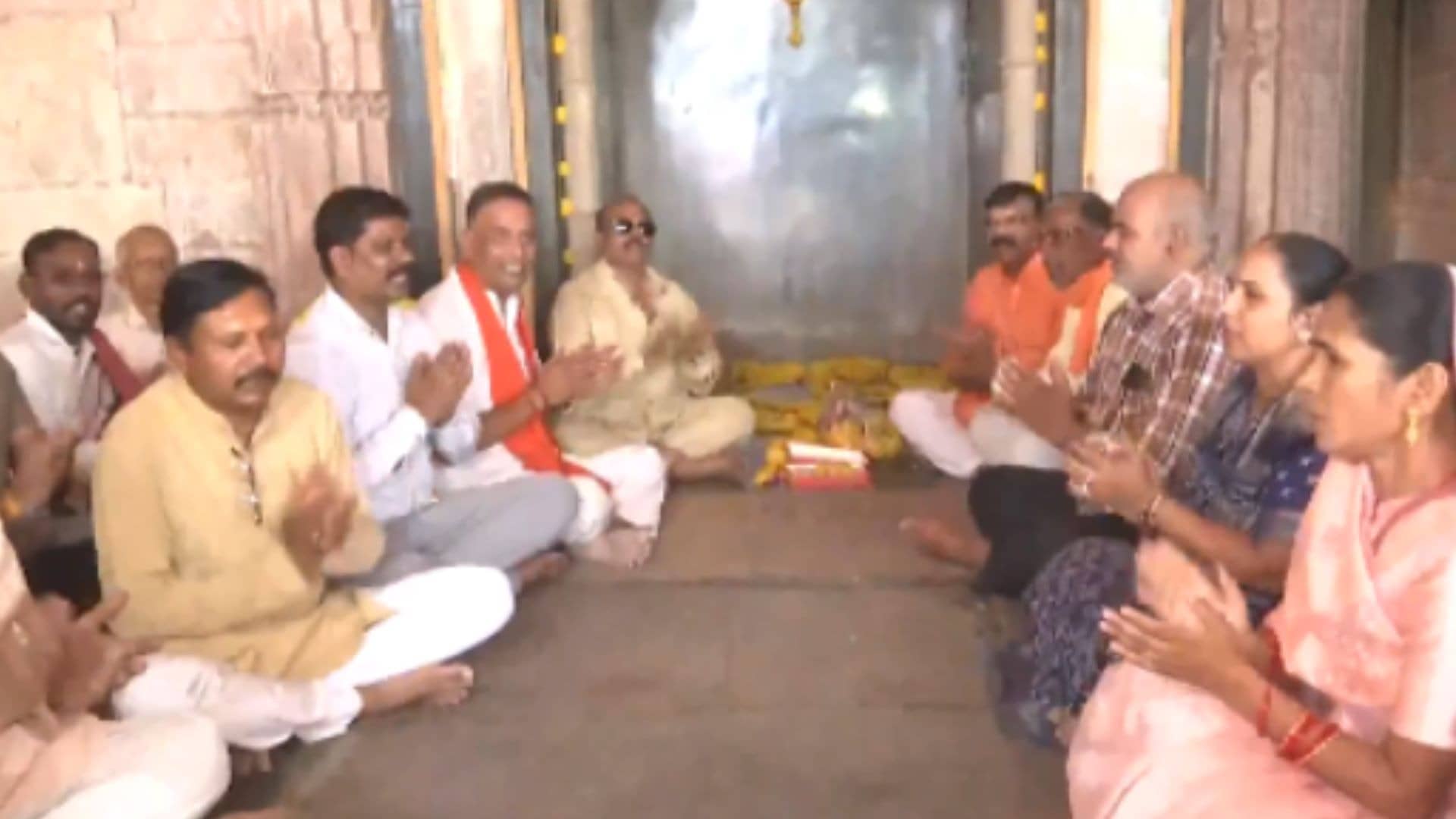
AIMPLB to challenge MP High Court's Bhojshala temple verdict in Supreme Court
The All India Muslim Personal Law Board (AIMPLB) announced its intention to challenge the Madhya Pradesh High Court's ruling in the Bhojshala-Kamal Maula Mosque dispute before the Supreme Court. The High Court declared the complex a Saraswati temple, overturning a previous order that allowed Muslim prayers.
Key Highlights
- AIMPLB to challenge MP High Court's Bhojshala verdict.
- High Court declared Bhojshala complex a Saraswati temple.
- AIMPLB cites disregard for historical evidence and records.
- The case is being compared to the Ayodhya verdict principles.
- The Places of Worship Act, 1991, is a key point of contention.
The All India Muslim Personal Law Board (AIMPLB) has declared its intention to challenge the Madhya Pradesh High Court's recent verdict concerning the Bhojshala-Kamal Maula Mosque complex in Dhar, India, by appealing to the Supreme Court. This announcement comes in the wake of the High Court's ruling that designates the historical site as a temple dedicated to Goddess Vagdevi (Saraswati) and overturns a prior Archaeological Survey of India (ASI) order from 2003 that had permitted Muslims to offer prayers at the complex [3, 4, 6, 7, 15].
The AIMPLB, through its spokesperson SQR Ilyas, has strongly rejected the High Court's judgment, asserting that it disregards crucial historical evidence, official revenue records, colonial-era documents, gazetteers, and the long-standing religious association of Muslims with the site [3, 5, 12, 14]. The Board further contends that the verdict directly conflicts with the spirit and constitutional mandate of the Places of Worship (Special Provisions) Act, 1991, which aims to maintain the religious character of places of worship as they existed on August 15, 1947 [3, 10, 12, 15, 16].
Key arguments presented by the AIMPLB include the assertion that the High Court placed undue reliance on traditions associated with Raja Bhoj, the legacy of Sanskrit learning, and ASI survey findings, while overlooking continuous religious usage, official documentation, and the ASI's previous acknowledgment of the site's shared religious character [3, 5, 13]. For decades, ASI records and signboards reportedly identified the site as 'Bhojshala / Kamal Maula Mosque,' signifying official recognition of its disputed and shared status [3, 12, 14, 16]. The 2003 administrative arrangement, which allowed Hindus to perform puja on Tuesdays and Muslims to offer Friday prayers, is seen by the AIMPLB as clear acknowledgment of both communities' historical claims and worship rights [13, 14, 17]. Therefore, the termination of this arrangement by the High Court is viewed as a departure from the ASI's earlier stance [13, 14].
The Madhya Pradesh High Court's ruling itself is noted to have drawn upon principles from the Supreme Court's 2019 Ayodhya judgment [4, 8]. The High Court's bench, comprising Justices Vijay Kumar Shukla and Alok Awasthi, concluded that historical literature and architectural references establish the site's character as Bhojshala, a center of Sanskrit learning associated with Raja Bhoj, indicating the existence of a temple dedicated to Goddess Saraswati [4, 6, 11, 17]. The court quashed the 2003 ASI order and suggested that the state government consider allotting separate land within the Dhar district for a mosque, echoing a similar provision in the Ayodhya verdict [4, 6]. The court also noted the continuity of Hindu worship at the site [6, 7].
While the High Court did not explicitly decide the title of the property, its declaration of the Bhojshala's religious character as a Saraswati temple and the setting aside of the ASI order allowing Muslim prayers are the central points of contention for the AIMPLB [8, 12, 15, 17]. The Board emphasizes that the mere presence of non-Islamic architectural remains should not legally extinguish the centuries-old status of a mosque, nor can remnants of an earlier structure be conclusive proof of the present religious identity of a site [16].
The broader implications of this verdict are significant, with some observers noting similarities to the Ayodhya case and raising concerns about the potential impact on judicial credibility, minority rights, and religious freedom in India [3]. The Jamiat president Mahmood Madani stated that such disputes, when revisited disregarding the Places of Worship Act, 1991, could affect India's constitutional identity [3]. The AIMPLB's decision to challenge the verdict underscores the ongoing complexities and sensitivities surrounding historical religious sites in India, and the legal battle is expected to continue in the Supreme Court.
Frequently Asked Questions
What is the Bhojshala-Kamal Maula Mosque dispute about?
The dispute concerns the historical complex in Dhar, Madhya Pradesh, known as Bhojshala to Hindus and Kamal Maula Mosque to Muslims. Hindus believe it to be a temple of Goddess Saraswati (Bhojshala), while Muslims consider it a mosque. The Madhya Pradesh High Court recently declared it a Saraswati temple, overturning a previous arrangement that allowed prayers from both communities.
Why is the AIMPLB challenging the High Court's verdict?
The AIMPLB claims the High Court's verdict disregards historical facts, official records, archaeological evidence, and the centuries-old Muslim association with the site. They also argue it conflicts with the Places of Worship (Special Provisions) Act, 1991, which seeks to maintain the religious character of places as of August 15, 1947.
What was the previous arrangement at the Bhojshala complex?
An order by the Archaeological Survey of India (ASI) in 2003 allowed Hindus to perform puja on Tuesdays and Muslims to offer Friday prayers at the Bhojshala-Kamal Maula Mosque complex. This arrangement has now been quashed by the Madhya Pradesh High Court.
How is this case related to the Ayodhya verdict?
The Madhya Pradesh High Court's ruling in the Bhojshala case has referenced principles laid down by the Supreme Court in its 2019 Ayodhya verdict. Similar to the Ayodhya case, the court has suggested allotting alternative land for the Muslim community for a mosque.