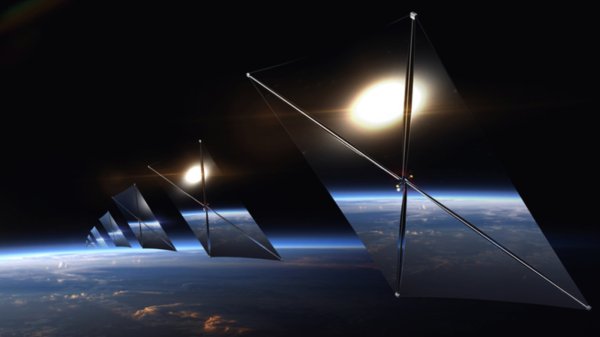
US Approves Reflect Orbital's Space Mirror Amidst Global Astronomy Backlash
The US FCC has approved Reflect Orbital's Eärendil-1 demonstration satellite, designed to beam 'sunlight on demand' to Earth. This decision faces significant backlash from astronomers and environmentalists over concerns about light pollution and disruption to natural cycles. The 60-foot mirror aims to extend daylight for various applications.
Key Highlights
- US FCC greenlights Reflect Orbital's Eärendil-1 demonstration satellite.
- Satellite features a 60-foot mirror for 'sunlight on demand' technology.
- Astronomers globally express severe concerns over light pollution and impacts.
- Proposed uses include powering solar farms, emergency lighting, and agriculture.
- Reflect Orbital plans a future constellation of up to 50,000 satellites.
- Critics cite risks to astronomy, wildlife, and human circadian rhythms.
The United States Federal Communications Commission (FCC) has granted approval for Reflect Orbital, a California-based startup, to launch its Eärendil-1 demonstration satellite. This satellite is designed with an 18-meter (approximately 60-foot) steerable mirror to reflect sunlight onto specific areas of Earth, offering what the company terms 'sunlight on demand'.
The primary purpose of Eärendil-1 is to test the technology for beaming light to areas experiencing darkness, with Reflect Orbital envisioning various commercial and humanitarian applications. These include extending the operational hours of solar farms, providing illumination for construction and agricultural work, and offering crucial lighting during emergencies or disaster relief efforts in locations lacking conventional power.
Despite the FCC's approval, the project has ignited widespread controversy and faced significant backlash from the scientific community, particularly astronomers and environmental groups globally. Concerns revolve around the potential for severe light pollution, which could have devastating consequences for ground-based astronomical observations. Scientists warn that a full constellation of such satellites could increase the natural night-sky background brightness by 200% to 300%, effectively making ground-based astronomy impossible.
The American Astronomical Society (AAS) and other scientific organizations have voiced strong opposition, highlighting risks such as potential eye damage to amateur astronomers observing through telescopes, temporary 'flash blinding' of pilots and drivers, and negative impacts on scientific research conducted by federally funded astronomical facilities. Beyond astronomy, environmental experts and biological-rhythm organizations have raised alarms about the disruption of natural cycles of darkness, which are vital for regulating animal behavior, plant activity, and human sleep. Light pollution affects circadian rhythms and can be detrimental to human health, as well as negatively impacting the navigation, migration, foraging, and reproduction of numerous species.
Reflect Orbital's Eärendil-1 is a single prototype, roughly the size of a dorm refrigerator, that will unfurl its 60-foot mirror once in low Earth orbit. The reflected light is expected to illuminate a circular patch about three miles (five kilometers) wide on Earth's surface. However, the company has far more ambitious long-term plans, aiming to deploy a vast constellation of up to 50,000 satellites by 2035. Future mirrors in this proposed constellation could be significantly larger, potentially reaching up to 180 feet (55 meters) wide and producing illumination comparable to that of 100 full moons.
The FCC, in its decision, acknowledged the concerns raised but stated that evaluating these risks was beyond its scope, as its mandate primarily concerns the authorization of radio frequency spectrum. The commission emphasized its role in encouraging the provision of new technologies and services that could advance American leadership in space. Reflect Orbital, for its part, has stated it is commissioning independent research, engaging with the astronomy community, and developing safeguards. These include transparently sharing satellite positions, avoiding reflecting light near observatories or protected sites, and designing the technology for control and discretion to minimize visibility when not actively providing service.
Historically, the concept of space mirrors is not entirely new. In 1993, Russia launched the Znamya 2 mirror, which briefly swept a patch of reflected sunlight across Europe as an experiment to extend daylight hours in Arctic Siberia, though the project was later abandoned. What distinguishes Reflect Orbital's endeavor is the attempt to commercialize orbital illumination on an unprecedented scale.
This approval marks a crucial step for Reflect Orbital to gather real-world data from Eärendil-1, which will inform the design of future satellites and the company's operational practices. The mission's initial results will focus on visible effects rather than immediate commercial service, allowing for measurements of its apparent magnitude, light spill, and brightness changes. The broader debate, however, centers on the environmental, scientific, and ethical implications of transforming the natural night sky into a commercially managed resource, a prospect that deeply worries astronomers and environmental advocates worldwide.
Frequently Asked Questions
What is Reflect Orbital's Eärendil-1 satellite and its primary goal?
Eärendil-1 is a demonstration satellite developed by Reflect Orbital, featuring an 18-meter (60-foot) mirror. Its primary goal is to test the technology for reflecting sunlight onto specific areas of Earth, creating 'sunlight on demand' for purposes like powering solar farms, assisting emergency services, and illuminating work sites at night.
Which regulatory body approved the launch of Eärendil-1 and when?
The United States Federal Communications Commission (FCC) authorized the radio operations for Reflect Orbital's Eärendil-1 satellite. This approval was granted around July 9-11, 2026.
Why are astronomers and environmentalists concerned about this space mirror project?
Astronomers and environmentalists are deeply concerned about potential light pollution, which could severely hinder ground-based astronomical observations and disrupt the natural night sky. They also worry about risks such as temporary 'flash blinding' for pilots and drivers, and the disruption of natural circadian rhythms in humans and wildlife, impacting ecosystems globally.
What are Reflect Orbital's future plans beyond the Eärendil-1 demonstration?
Reflect Orbital has ambitious long-term plans to deploy a large constellation of up to 50,000 satellites by 2035. Future mirrors in this constellation could be much larger, up to 180 feet wide, designed to provide significantly brighter illumination for various commercial and humanitarian services.
Has the concept of reflecting sunlight from space been explored before?
Yes, the idea of space mirrors dates back to the 1920s. In the 1990s, Russia conducted experiments with a space mirror called Znamya 2, which briefly reflected sunlight onto parts of Europe. However, Reflect Orbital's project aims to commercialize orbital illumination on an unprecedented scale.