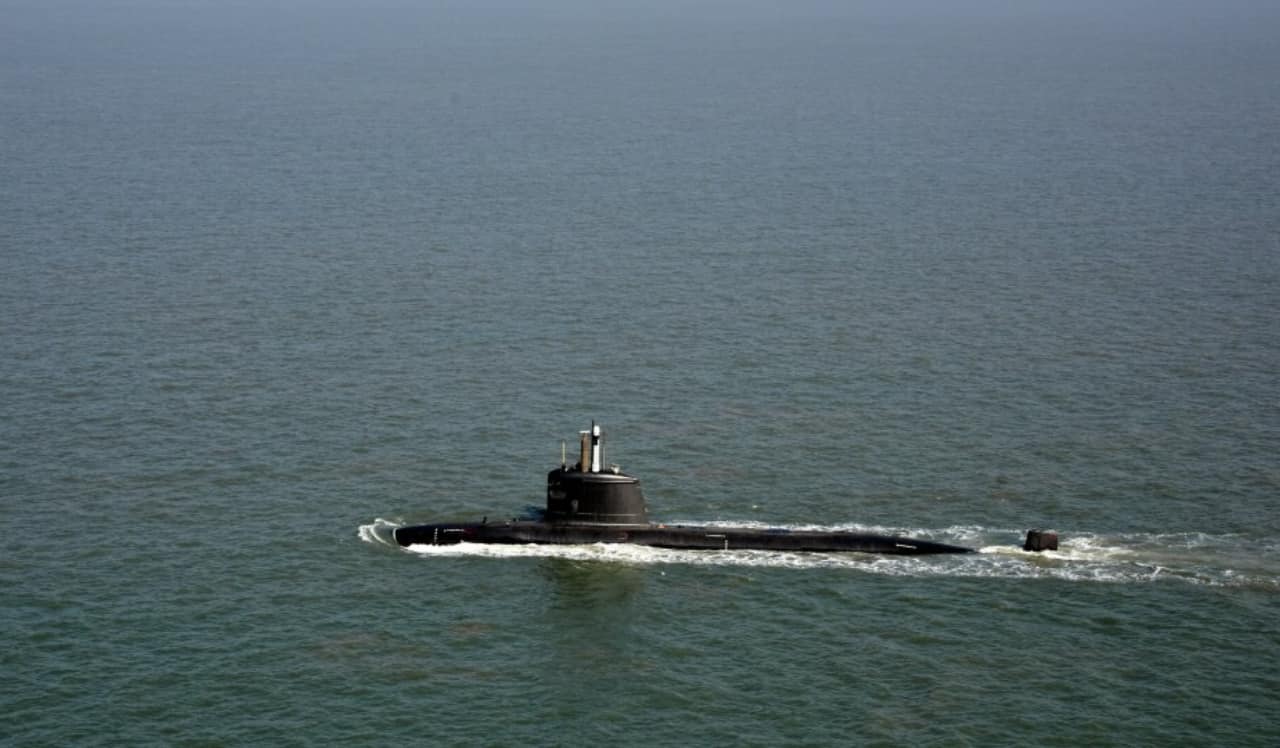
India to commission INS Aridhaman, third indigenous nuclear submarine, by April-May
India is poised to significantly enhance its maritime nuclear deterrence with the upcoming commissioning of INS Aridhaman, its third indigenous nuclear-powered ballistic missile submarine (SSBN). Expected by April-May, INS Aridhaman will boost India's second-strike capability and bring it closer to achieving continuous at-sea nuclear deterrence.
Key Highlights
- Third indigenous nuclear submarine INS Aridhaman to be commissioned by April-May.
- Submarine enhances India's sea-based nuclear deterrent and second-strike capability.
- INS Aridhaman is larger than its predecessors, carrying more advanced missiles.
- Commissioning brings India closer to continuous at-sea nuclear deterrence.
- The submarine is part of India's broader naval modernization drive.
India is set to significantly bolster its strategic defense capabilities with the impending commissioning of INS Aridhaman, the third indigenous nuclear-powered ballistic missile submarine (SSBN) of the Arihant class. Expected to join the Indian Navy by April-May, the submarine is currently in the final stages of sea trials. This development marks a crucial step in strengthening India's sea-based nuclear deterrent and advancing its strategic autonomy.
INS Aridhaman, designated S4, is a larger and more capable vessel than its predecessors, INS Arihant and INS Arighaat. Displacing approximately 7,000 tonnes, it is a 7,000-tonne platform built under the Advanced Technology Vessel (ATV) project at the Ship Building Centre in Visakhapatnam [2, 5]. The submarine is designed to carry a more potent missile payload, including up to 24 K-15 Sagarika submarine-launched ballistic missiles (SLBMs) with a range of 750 km, and eight K-4 SLBMs with an extended range of 3,500 km [2, 5, 8]. The K-4 missiles are capable of reaching most parts of Asia, significantly enhancing India's strike capability [2]. In comparison, INS Arihant and INS Arighaat have four launch tubes and can carry twelve K-15 Sagarika missiles or four K-4 missiles [4]. The future integration of K-5 SLBMs with a potential range of 6,000 km is also planned, further bolstering its offensive potential [3].
The operationalization of INS Aridhaman will enable India to have three operational ballistic missile submarines at sea simultaneously for the first time. This milestone brings India significantly closer to achieving 'Continuous At-Sea Deterrence' (CASD), a strategic objective where at least one nuclear-armed submarine is perpetually on patrol, ensuring a credible and survivable second-strike capability. This capability is a cornerstone of India's nuclear doctrine, which emphasizes a 'no-first-use' policy, relying on retaliation after an initial nuclear attack [2, 5].
INS Aridhaman is powered by an 83 MW pressurized water reactor, developed indigenously [2, 5, 8]. It also features advanced sonar systems, including the indigenous USHUS and Panchendriya sonar suites, along with improved acoustic damping through anechoic tiles to reduce its detectability [2, 5, 11]. These enhancements contribute to its stealth capabilities, making it harder for adversaries to track and target.
The induction of INS Aridhaman is part of a broader modernization and expansion drive within the Indian Navy's submarine arm. This includes the planned induction of an Akula-class nuclear-powered attack submarine (SSN) from Russia, codenamed Chakra III, expected by 2027-28 [2]. Furthermore, India is in the final stages of negotiating a significant deal with Germany to build six advanced, conventional diesel-electric submarines equipped with Air-Independent Propulsion (AIP) technology under Project-75(I) [2, 5]. These indigenous efforts are also a response to regional naval developments, such as Pakistan's acquisition of eight advanced Hangor-class submarines from China [2, 5].
The timeline for INS Aridhaman's commissioning has seen some evolution. While initial reports and statements from the Navy Chief Admiral D.K. Tripathi suggested commissioning within 2025 or early 2026 [2, 6, 15], the most recent reports pinpoint April-May 2026 as the expected timeframe [2, 18]. The submarine was launched in November 2021 and has since undergone extensive sea trials [2, 11]. The successful completion of these trials is a prerequisite for its formal induction into the navy.
The Arihant-class program itself represents a significant leap in India's indigenous defense capabilities, particularly in the complex domain of nuclear propulsion and submarine design. The project, which began decades ago under the Advanced Technology Vessel (ATV) project, has involved substantial investment and has seen increasing levels of indigenous content over the successive vessels [4]. The successful development and deployment of these SSBNs are crucial for India's strategic deterrence posture and its role in maintaining regional stability in the Indo-Pacific.
Frequently Asked Questions
What is INS Aridhaman?
INS Aridhaman is India's third indigenous nuclear-powered ballistic missile submarine (SSBN) and the second 'Arihant Stretch' variant. It is a significant addition to India's strategic nuclear triad, enhancing its sea-based deterrent capabilities.
When is INS Aridhaman expected to be commissioned?
INS Aridhaman is expected to be commissioned into the Indian Navy between April and May of 2026, following the completion of its final sea trials.
What are the key capabilities of INS Aridhaman?
INS Aridhaman is larger than its predecessors and is equipped to carry a significant payload of K-15 Sagarika (750 km range) and K-4 (3,500 km range) submarine-launched ballistic missiles. It features an indigenous nuclear reactor and advanced sonar systems, contributing to its stealth and second-strike capabilities.
Why is the commissioning of INS Aridhaman significant for India?
The commissioning of INS Aridhaman is significant because it brings India closer to achieving Continuous At-Sea Deterrence (CASD), ensuring a constantly operational sea-based nuclear deterrent. This reinforces India's 'no-first-use' nuclear doctrine by guaranteeing a credible retaliatory capability.