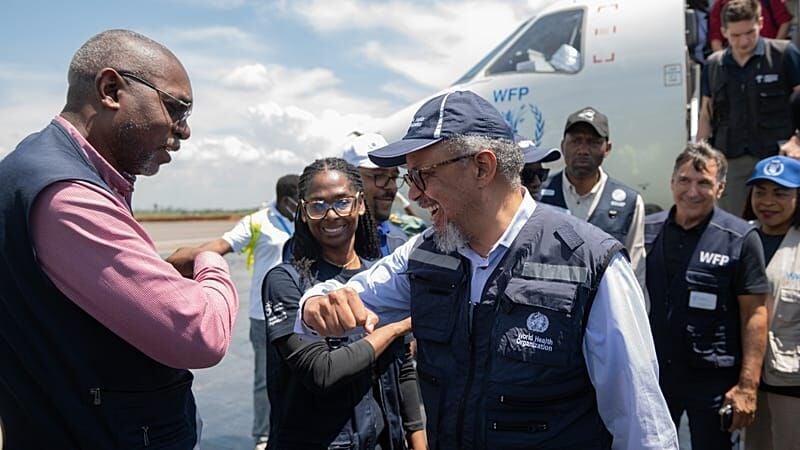
WHO Chief Urges Reconsideration of Travel Bans Amid DR Congo Ebola Outbreak
The WHO Director-General has called for countries to reconsider travel bans implemented due to the ongoing Ebola outbreak in the Democratic Republic of Congo and Uganda. He emphasized that such restrictions hinder response efforts and undermine transparency essential for containing the deadly Bundibugyo virus. The outbreak has recorded hundreds of suspected cases and deaths.
Key Highlights
- WHO chief urges nations to lift Ebola-related travel bans.
- DR Congo experiences its 17th Ebola outbreak, Bundibugyo strain.
- Travel restrictions complicate health response and reduce transparency.
- Over 900 suspected Ebola cases reported in DRC, 9 confirmed in Uganda.
- No approved vaccine or specific treatment exists for Bundibugyo Ebola.
- Outbreak declared a Public Health Emergency of International Concern.
World Health Organization (WHO) Director-General Tedros Adhanom Ghebreyesus has urgently called on countries to reconsider and lift travel bans and border closures imposed in response to the escalating Ebola outbreak in the Democratic Republic of Congo (DRC) and neighboring Uganda. Speaking at a press briefing in Bunia, the capital of Ituri Province in eastern Congo—the epicenter of the outbreak—on Saturday, May 30, 2026, Tedros stressed that such measures are counterproductive. He asserted that these restrictions complicate essential response efforts, discourage transparency from affected nations, and undermine the trust crucial for saving lives.
The current crisis marks the DRC's 17th Ebola outbreak since the virus was first identified in 1976. The outbreak, confirmed in May 2026, is caused by the Bundibugyo virus (Orthoebolavirus bundibugyoense), a rarer strain of Ebola for which there is currently no approved vaccine or specific treatment. However, patients can recover with timely and quality medical care.
The situation was declared a Public Health Emergency of International Concern (PHEIC) by the WHO on May 16, 2026, highlighting its potential for international spread. The outbreak is concentrated in the Ituri, North Kivu, and South Kivu provinces of the DRC, and has seen imported cases in Uganda's capital, Kampala. As of May 29, 2026, health authorities in the DRC have reported over 900 suspected Ebola cases and more than 220 suspected deaths. Neighboring Uganda has confirmed nine cases, including new infections in Kampala, with one reported death.
Tedros's visit to Bunia aimed at engaging directly with affected communities and strengthening support for response efforts in the hardest-hit areas. He emphasized the importance of community ownership and trust in bringing the rapidly evolving outbreak under control. The WHO Director-General's call for reconsideration of travel restrictions is rooted in the organization's long-standing stance that such measures can have negative public health consequences by penalizing countries that transparently report outbreaks, thereby discouraging early reporting and effective global cooperation.
Several countries, including Canada and the United States, have imposed travel restrictions and visa suspensions on residents from Congo, Uganda, and South Sudan. Rwanda and Uganda have also limited travel from Congo, with Rwanda prohibiting entry to foreign nationals who have traveled through Congo in the last 30 days. These actions, according to Tedros, are ineffective in preventing the spread and instead complicate humanitarian and public health responses.
The outbreak's response is further complicated by ongoing conflict, insecurity, population displacement, food shortages, and community mistrust in the affected regions. These factors create challenges in contact tracing, follow-up, and the implementation of isolation and care protocols. Despite these difficulties, the DRC Health Minister Roger Kamba has expressed a goal to contain and end the outbreak within four to six months, leveraging the country's extensive experience with past Ebola epidemics and strengthened laboratory testing capacity.
The WHO and its partners are actively scaling up support to the governments of the DRC and Uganda, focusing on strengthening surveillance, contact tracing, clinical preparedness, and community engagement. Efforts are also underway to pursue clinical trials for candidate treatments and vaccines specifically targeting the Bundibugyo strain. This concerted international effort, alongside local community involvement, is deemed crucial to bring the 17th Ebola outbreak in the DRC under control and mitigate its regional and global impact.
Frequently Asked Questions
What is the current Ebola outbreak and where is it occurring?
The current Ebola outbreak, the 17th for the Democratic Republic of Congo (DRC), is caused by the Bundibugyo virus. It is primarily affecting the Ituri, North Kivu, and South Kivu provinces in the DRC, with cases also confirmed in neighboring Uganda, particularly in its capital, Kampala.
Why is the WHO Director-General urging countries to reconsider travel bans?
WHO Director-General Tedros Adhanom Ghebreyesus argues that travel bans and border closures hinder effective Ebola response efforts, discourage transparency from affected nations, and erode the trust that is vital for saving lives. He believes these measures are counterproductive and can delay rather than prevent disease transmission.
Is there a vaccine or specific treatment for the Bundibugyo strain of Ebola?
No, there is currently no approved vaccine or specific treatment available for the Bundibugyo virus, the strain causing this particular Ebola outbreak. However, the WHO notes that patients can recover with timely and quality medical care, and clinical trials for candidate treatments and vaccines are underway.
How many cases and deaths have been reported in this Ebola outbreak?
As of May 29, 2026, the Democratic Republic of Congo has reported over 900 suspected Ebola cases and more than 220 suspected deaths. Neighboring Uganda has confirmed nine cases, including new infections in Kampala, with one reported death.
Which countries have imposed travel restrictions due to the outbreak?
Several countries have imposed travel restrictions and border closures, including Canada and the United States, which have instituted visa suspensions for residents from Congo, Uganda, and South Sudan. Rwanda and Uganda have also limited travel from Congo, with Rwanda specifically prohibiting entry to foreign nationals who have traveled through Congo in the last 30 days.