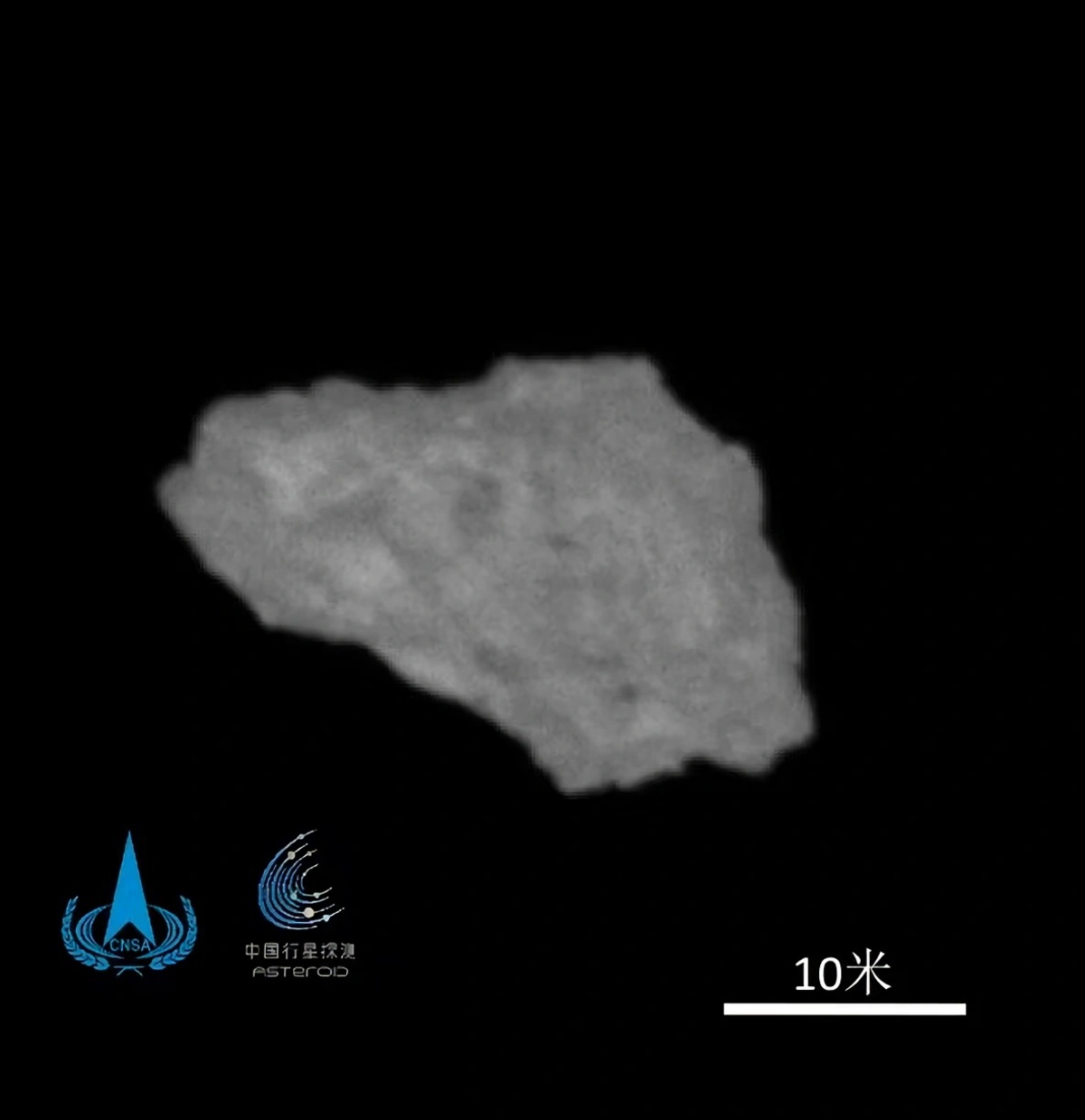
China's Tianwen-2 Spacecraft Reaches Earth's Quasi-Moon Kamoʻoalewa
China's Tianwen-2 probe has successfully reached Earth's quasi-moon Kamoʻoalewa after a billion-kilometer journey, commencing scientific exploration and preparing for sample collection. Launched in May 2025, this mission aims to unlock secrets about the Solar System's early days and potentially the Moon's origin.
Key Highlights
- Tianwen-2 successfully rendezvoused with quasi-moon Kamoʻoalewa.
- The probe traveled approximately one billion kilometers in 400 days.
- Mission begins scientific exploration and prepares for sample collection.
- Kamoʻoalewa is a near-Earth asteroid, a rare Earth quasi-satellite.
- Samples to be returned in 2027, followed by comet exploration.
- This mission aims to study early Solar System composition and lunar origin.
China's ambitious Tianwen-2 spacecraft has successfully reached its primary target, the near-Earth asteroid 2016 HO3, also known as Kamoʻoalewa, which is recognized as one of Earth's elusive quasi-satellites. This significant milestone was achieved after a journey of approximately one billion kilometers (or 621 million miles) spanning about 400 days since its launch on May 29, 2025.
The China National Space Administration (CNSA) announced the probe's successful rendezvous, reporting that Tianwen-2 closed to within 20 kilometers (12.4 miles) of Kamoʻoalewa around July 2-4, 2026, marking the official commencement of its scientific exploration phase.
The Tianwen-2 mission represents China's first asteroid sample-return endeavor and is the second mission in its broader Planetary Exploration Program, following the successful Tianwen-1 Mars mission. The spacecraft was launched from the Xichang Satellite Launch Center aboard a Long March 3B/G2 rocket. During its interplanetary cruise, Tianwen-2 performed several deep-space maneuvers and mid-course corrections to accurately align with its target. It first detected Kamoʻoalewa on June 6, 2026, and by June 7, it executed a capture control maneuver at a distance of 30,000 kilometers, achieving co-orbital flight. By June 19, the probe had further closed the distance to within 2,000 kilometers, setting the stage for its final approach.
Kamoʻoalewa (also known as 2016 HO3) is a fascinating celestial body. It is classified as an Earth quasi-satellite, meaning it orbits the Sun but remains in a stable, resonant dance with Earth, maintaining a relatively close average distance of about 9 million miles (0.1-0.3 astronomical units) from our planet. Discovered in 2016 by the Pan-STARRS telescope in Hawaii, its Hawaiian name translates to 'oscillating celestial fragment,' apt for its unique orbit. Scientists suspect that Kamoʻoalewa might actually be a fragment of Earth's Moon, potentially ejected by a major impact, such as the one that created the Giordano Bruno crater. Spectral analysis in 2021 indicated a composition similar to lunar rocks, and a 2024 study further supported the lunar origin hypothesis. The Tianwen-2 mission aims to definitively confirm or refute this theory by collecting samples.
The spacecraft is equipped with a comprehensive suite of 11 scientific instruments, including cameras, spectrometers, a magnetometer, and radar, to conduct detailed observations. These instruments will characterize the asteroid's shape, surface morphology, material composition, and internal structure, providing crucial data for selecting optimal sample collection sites. Tianwen-2 boasts an innovative sampling system with three modes—hovering, touch-and-go, and anchoring-and-attachment—to ensure successful collection regardless of the asteroid's surface conditions. The mission aims to collect between 20 and 100 milligrams of material.
Following its survey and sample collection from Kamoʻoalewa, Tianwen-2 is scheduled to return to Earth in April 2027, where it will eject a return capsule containing the precious samples for recovery by November 2027. After this, the main probe will perform a gravity-assist maneuver using Earth's gravity to propel itself towards its secondary target: the main-belt comet 311P/PanSTARRS, which it is expected to reach by January 2035. This dual-target approach demonstrates China's growing capabilities in long-duration deep-space missions and aims to gather invaluable insights into the early Solar System's material composition, formation processes, and evolutionary history from both an asteroid and a comet.
This mission's success contributes significantly to global space exploration efforts, especially in understanding near-Earth objects and planetary defense strategies. For an audience in India, this news is highly relevant, reflecting advancements in space technology from a neighboring country and offering comparative insights into deep space missions, particularly in asteroid sample return, an area of increasing international interest.
Frequently Asked Questions
What is Kamoʻoalewa and why is it called an 'Earth's quasi-moon'?
Kamoʻoalewa, also known as 2016 HO3, is a near-Earth asteroid that orbits the Sun. It's called an 'Earth's quasi-moon' or quasi-satellite because its orbit around the Sun is synchronized with Earth's, keeping it relatively close to our planet, though it doesn't directly orbit Earth.
What are the primary objectives of China's Tianwen-2 mission?
The primary objectives of the Tianwen-2 mission are to conduct detailed scientific observations of Kamoʻoalewa, collect samples from its surface, and return them to Earth for analysis. Subsequently, the probe will journey to and explore the main-belt comet 311P/PanSTARRS.
When was Tianwen-2 launched and when are samples expected to return to Earth?
Tianwen-2 was launched on May 29, 2025. After collecting samples from Kamoʻoalewa, the mission plans to return a sample capsule to Earth by November 2027.
Why is studying Kamoʻoalewa significant for scientists?
Studying Kamoʻoalewa is significant because its unique orbit and spectral characteristics suggest it might be a fragment of Earth's Moon, ejected by an ancient impact. Analyzing samples from it could provide crucial insights into the Moon's formation, the origins of Earth's quasi-satellites, and the early composition and evolution of the Solar System.
What is the next phase for the Tianwen-2 spacecraft?
Following its arrival and initial close approach, the Tianwen-2 probe will now begin a more detailed phase of scientific investigation. This involves characterizing the asteroid's shape, surface composition, and internal structure, using its array of scientific instruments, to prepare for the upcoming sample collection operations.