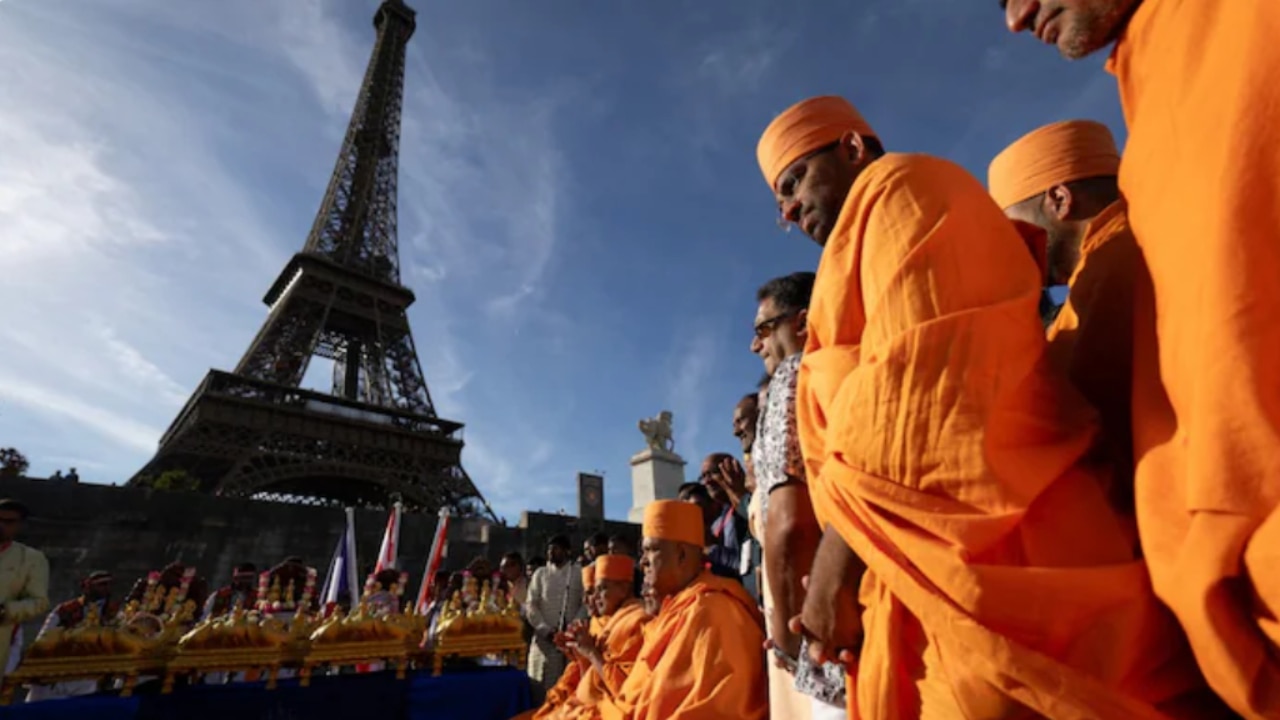
Eiffel Tower Staff Strike Over Hindu Group's Visit, BAPS Apologizes
The Eiffel Tower faced a staff strike and temporary closure after a visit by the BAPS Hindu group led to allegations of female employees being sidelined. The group apologized, while French authorities launched an investigation into the incident.
Key Highlights
- BAPS visit to Eiffel Tower prompted staff strike over alleged gender discrimination.
- Female employees reportedly asked to leave workstations for BAPS delegation.
- BAPS monks' celibacy vows cited as reason for limited interaction with women.
- Eiffel Tower management admitted error in accommodating BAPS's request.
- French authorities condemned the incident and launched an investigation.
- India's MEA stated the issue was purely between the entities concerned.
The iconic Eiffel Tower in Paris experienced a one-day closure on Monday, September 7, 2026, due to a staff strike ignited by allegations of female employees being sidelined and instructed to remain out of sight during a private visit by a delegation from the Bochasanwasi Akshar Purushottam Swaminarayan Sanstha (BAPS), an influential Hindu socio-spiritual organization.
The BAPS delegation, comprising approximately 100 members, visited the Parisian landmark on Saturday, September 5, 2026. Staff union representatives, such as Diane Davoine, reported that female workers were explicitly asked to leave their workstations, move to other areas, or make themselves 'invisible' as the delegation passed. In some instances, male employees reportedly replaced their female counterparts.
This controversial request stemmed from the strict celibacy vows observed by BAPS monks (sadhus), which include prohibitions against physical contact, private conversations, and even direct eye contact with women. The Société d'Exploitation de la Tour Eiffel (SETE), the company managing the Eiffel Tower, confirmed that the BAPS delegation had requested that the visit be organized to limit 'interactions with women'.
Following widespread outrage among employees, who felt 'humiliated' by the directives, a staff strike was initiated, leading to the Eiffel Tower's closure for a day before reopening on Tuesday, September 8, 2026.
SETE promptly acknowledged its error, stating that 'these conditions should not have been accepted' as they were inconsistent with the company's values and the fundamental principles of gender equality. Ariel Weil, President of SETE, described the incident as 'totally shocking and unacceptable' and announced an internal investigation to identify those responsible and prevent future occurrences. The management also issued apologies to its staff.
BAPS, in a statement posted on X, offered its 'sincere apologies to anyone who may have been hurt or inconvenienced by this situation.' However, the apology did not explicitly address the allegations of female employees being sidelined, instead emphasizing that the visit was coordinated with Eiffel Tower teams due to the delegation's size to minimize disruption.
The incident drew strong condemnation from French political leaders. Paris Mayor Emmanuel Grégoire promised a swift investigation, asserting that such conditions are 'unacceptable' and that 'equality between women and men will never stop at the foot of our historical monuments, nor anywhere in this city.' France's Equality Minister, Aurore Bergé, echoed these sentiments, stating that 'no religion is above the laws of the country' and 'in France, we do not ask women to erase themselves.'
In India, the Ministry of External Affairs (MEA) responded to the controversy by stating that the matter was 'purely between the entities concerned' (BAPS and the Eiffel Tower management). This event occurred shortly after BAPS inaugurated a new Hindu temple in Paris, an event that was virtually addressed by Indian Prime Minister Narendra Modi, highlighting the cultural ties between India and France. The row has sparked a broader debate on religious accommodation, workplace equality, and cultural diplomacy in a secular nation.
Frequently Asked Questions
Why did Eiffel Tower staff go on strike?
Eiffel Tower staff went on a one-day strike because female employees were allegedly asked to leave their workstations or be out of sight during a private visit by a delegation from the BAPS Hindu group, which they considered a discriminatory practice.
What was the BAPS group's reason for the request regarding female staff?
The BAPS organization's monks (sadhus) adhere to strict vows of celibacy, which prohibit them from having interactions with women, including physical contact, private conversations, and direct eye contact. The request to limit interactions was made in accordance with these religious practices.
How did the Eiffel Tower management respond to the incident?
The Eiffel Tower's operating company (SETE) acknowledged that they had accepted the BAPS delegation's request to limit interactions with women but admitted that these conditions 'should not have been accepted' as they violated the company's values and principles of gender equality. They apologized to staff and launched an internal investigation.
What was the reaction of French authorities to the controversy?
French authorities, including Paris Mayor Emmanuel Grégoire and Equality Minister Aurore Bergé, strongly condemned the alleged actions. They emphasized that gender equality is non-negotiable in France and launched an investigation into the incident, stating that no religion is above the country's laws.
What was the Indian government's stance on the issue?
India's Ministry of External Affairs (MEA) stated that the matter concerning the Eiffel Tower and the BAPS visit was 'purely between the entities concerned,' declining to comment further on the specifics of the controversy.