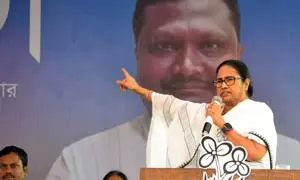
Mamata Slams PM Modi Over 'Swami' Prefix for Ramakrishna
West Bengal CM Mamata Banerjee criticized PM Narendra Modi for using the prefix 'Swami' for Sri Ramakrishna Paramahamsa, calling it culturally insensitive. She emphasized that Ramakrishna is traditionally addressed as 'Thakur,' while 'Swami' is reserved for his disciples like Vivekananda.
Key Highlights
- Mamata Banerjee slammed PM Modi for using 'Swami' prefix for Ramakrishna Paramahamsa.
- She termed PM's action as 'cultural insensitivity' in a post on X.
- Ramakrishna Paramahamsa is traditionally known as 'Thakur' in Bengal.
- 'Swami' prefix is meant for his monastic disciples, not the Master himself.
- The controversy erupted on Ramakrishna Paramahamsa's birth anniversary.
- Incident adds to ongoing political tensions between TMC and BJP.
West Bengal Chief Minister Mamata Banerjee has strongly criticized Prime Minister Narendra Modi for using the prefix 'Swami' when referring to the revered 19th-century mystic, Sri Ramakrishna Paramahamsa, in a tribute post on his birth anniversary. The controversy erupted on Thursday, February 19, 2026, when PM Modi posted his homage on X (formerly Twitter), addressing the saint as 'Swami Ramakrishna Paramahansa'.
Mamata Banerjee, in her own social media post on X, labeled the Prime Minister's action as an 'unprecedented and improper prefix' and accused him of 'aggressively displaying his cultural insensitivity to great figures of Bengal.' She emphasized that in Bengal's spiritual and cultural traditions, Sri Ramakrishna Paramahamsa is widely revered and affectionately known as 'Thakur,' which literally translates to 'God.' She further clarified that the honorific 'Swami' is customarily reserved for the monastic disciples of Sri Ramakrishna who founded the Ramakrishna Math and Ramakrishna Mission, with Swami Vivekananda being the most prominent example.
Banerjee detailed the traditional 'holy trinity' of the Ramakrishna Order, which consists of 'Thakur' (referring to Sri Ramakrishna Paramahamsadeva), 'Ma' (referring to his wife and spiritual consort, Sarada Devi), and 'Swamiji' (referring to Swami Vivekananda). Her argument hinges on maintaining this established cultural and spiritual nomenclature, which she believes the Prime Minister disregarded. She concluded her critique by urging the Prime Minister 'kindly not to discover new prefixes and suffixes for the great Renaissance figures of Bengal who shaped modern India.'
The Prime Minister's tribute, posted in Hindi, stated, 'Humble tributes to Swami Ramakrishna Paramahansa on his birth anniversary. The way he established spirituality and meditation as a vital life force will continue to benefit humanity in every era. His noble thoughts and messages will forever remain a source of inspiration.' This incident is not the first time PM Modi has used the 'Swami' prefix for Ramakrishna Paramahamsa, with similar tributes noted in previous years.
The controversy has been widely reported by major Indian news outlets, including The Times of India, NDTV, Telegraph India, Daijiworld, India Today, The Indian Express, Ommcom News, Telangana Today, and Deccan Herald, among others. These reports largely corroborate the central claims: Mamata Banerjee's objection to the 'Swami' prefix and her reasoning based on Bengali cultural and spiritual tradition. No significant misinformation or exaggeration has been identified in the reporting of this incident. The news articles accurately convey the strong language used by the Chief Minister in her criticism.
This exchange further intensifies the political rivalry between the Trinamool Congress (TMC), led by Mamata Banerjee, and the Bharatiya Janata Party (BJP), which governs at the Centre. West Bengal often sees cultural identity and historical figures becoming focal points in political discourse, especially with upcoming elections. The incident underscores the deep-rooted cultural sensitivities in West Bengal, particularly concerning its revered spiritual leaders and intellectual giants. While Ramakrishna Paramahamsa is universally respected as one of India's most influential mystics and spiritual guides, his specific appellation in Bengal holds significant cultural weight.
Sri Ramakrishna Paramahamsa, born Gadadhar Chattopadhyay on February 18, 1836, in Kamarpukur, West Bengal, dedicated his life to spiritual pursuits and taught the unity of religions. The Ramakrishna Math and Mission, headquartered at Belur Math, were founded by his chief disciple, Swami Vivekananda, to propagate his teachings and engage in humanitarian service. The distinction between addressing the Master as 'Thakur' and his monastic followers as 'Swami' is a well-established tradition within the Ramakrishna Order and among devotees in Bengal.
This debate highlights how cultural nuances can become subjects of political contention, especially when national leaders engage with regional traditions. The incident is not merely about a prefix but touches upon the broader themes of cultural respect, regional identity, and political messaging in India's diverse landscape. The fact that the debate revolves around a figure as universally esteemed as Sri Ramakrishna Paramahamsa makes it particularly resonant for an Indian audience, especially in West Bengal. The recurring nature of such cultural-political spats suggests that these issues remain sensitive points in the political arena.
Frequently Asked Questions
Why did Mamata Banerjee criticize PM Modi?
Mamata Banerjee criticized PM Modi for using the prefix 'Swami' before the name of Sri Ramakrishna Paramahamsa in his tribute on the saint's birth anniversary. She deemed it culturally insensitive and an 'improper prefix'.
What is the traditional way to address Sri Ramakrishna Paramahamsa in Bengal?
In Bengal's cultural and spiritual tradition, Sri Ramakrishna Paramahamsa is widely and affectionately referred to as 'Thakur,' meaning 'God.'
Who is the 'Swami' prefix typically reserved for in the Ramakrishna Order?
The prefix 'Swami' is traditionally reserved for the ascetic disciples of Sri Ramakrishna Paramahamsa, such as Swami Vivekananda, who founded the Ramakrishna Math and Mission, not for the Master himself.
When did this controversy occur?
The controversy occurred on Thursday, February 19, 2026, coinciding with the birth anniversary (Janmatithi) of Sri Ramakrishna Paramahamsa.
What is the broader significance of this dispute?
This dispute highlights cultural sensitivities in West Bengal, particularly concerning revered spiritual figures. It also adds to the ongoing political sparring between the ruling Trinamool Congress and the Bharatiya Janata Party, often involving regional identity and cultural traditions.