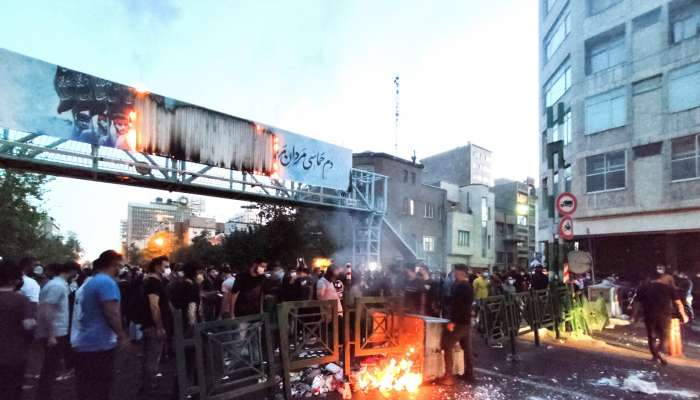
Iran Warns Protesting Students, Escalating US Tensions Mount
Iran's government has affirmed students' right to protest while simultaneously issuing a stern warning about 'red lines' that must not be crossed, amidst renewed campus demonstrations. This comes as international tensions with the US persist, leading India to advise its citizens to leave Iran.
Key Highlights
- Iranian government acknowledges students' right to protest but sets 'red lines'.
- Renewed student protests observed across Iranian universities since the weekend.
- 'Sanctities and the flag' cited as examples of unacceptable boundaries for protests.
- India issued an advisory for its citizens to leave Iran due to evolving situation.
- US-Iran tensions remain high, with military build-up and diplomatic warnings.
- Global concerns rise regarding potential for wider conflict in the Middle East.
The Hindustan Times article, published on February 24, 2026, reports on the Iranian government's official response to renewed student protests across several universities. The government, through its spokeswoman Fatemeh Mohajerani, stated that students have the right to protest but must understand and not cross 'red lines.' These 'red lines' were exemplified by 'sanctities and the flag,' which must be protected even during expressions of anger. This statement comes in the wake of demonstrations on campuses since the weekend of February 22-23, 2026, as evidenced by user-generated content verified by AFPTV teams.
The protests in Iran, although recurring, have seen varying degrees of intensity. Previous waves of protests, notably in late 2022 and early 2023 following the death of Mahsa Amini, saw significant unrest with hundreds of protesters killed, mass arrests, and internet restrictions. During that period, Iranian youth, particularly 'Generation Z,' played a crucial role, often expressing deep collective rejection of systemic injustice. While those large-scale demonstrations reportedly lost momentum by early 2023 due to severe government crackdown, including legal repercussions and executions, subtle forms of dissent continued. The current protests, highlighted by the Hindustan Times article, indicate a resurgence of student activism.
The broader geopolitical context of Iran-US tensions forms a significant backdrop to these domestic events. The relationship between the two nations has been marked by decades of rivalry, sanctions, proxy conflicts, and nuclear disputes since the 1979 Islamic Revolution. Recent developments, including a reported 12-day Iran-Israel war in mid-June 2025, significantly escalated regional tensions, drawing Washington into direct military confrontation with Tehran. Post-ceasefire, relations have been characterized by heightened rhetoric, military signaling, renewed sanctions pressure, and diplomatic efforts to avert a wider conflict. As of early 2026, the US reportedly conducted its largest airpower buildup in the Middle East since the 2003 invasion of Iraq, deploying significant naval and air assets. There have been ongoing diplomatic talks in Muscat, Oman, mediated by Oman, focusing on Iran's nuclear program and potential sanction easing.
The article also touches upon statements from US political figures and ongoing economic impacts. A retired US General reportedly suggested a 'historic opportunity' for the US and Israel to hasten the collapse of the Iranian regime. Former US President Trump has been quoted expressing curiosity as to why Iranians haven't 'capitulated' and frustration over 'limited' military leverage against Iran, and in January 2026, he reportedly threatened military intervention if the Iranian government did not halt its crackdown on protesters. Economically, gold prices have risen for a fifth day amid US tariff uncertainty and Iran tensions.
Internationally, there is a heightened sense of concern. India has issued an advisory urging all its citizens in Iran to leave the country immediately due to the 'evolving situation'. Other countries have also issued similar advisories. Iran, for its part, has warned of a wider conflict in case of escalation, a stance reiterated by its preference for diplomacy but also its readiness to use deterrence. An Israeli opposition leader was also reported to back strikes against Iran.
This confluence of internal dissent and external geopolitical pressure paints a picture of a volatile and closely watched situation in Iran, with significant implications for regional and global stability. The Iranian government's balancing act of acknowledging protest rights while enforcing 'red lines' highlights the delicate internal political landscape, while the ongoing tensions with the US and its allies continue to be a source of international concern.
Frequently Asked Questions
What is the current stance of the Iranian government on student protests?
The Iranian government acknowledges the right of students to protest but has issued a warning about 'red lines' that should not be crossed, explicitly mentioning 'sanctities and the flag' as examples of these boundaries.
Why did India issue an advisory for its citizens in Iran?
India issued an advisory urging its citizens to leave Iran due to the 'evolving situation' in the country, indicating heightened concerns over regional stability and safety.
What is the current state of US-Iran tensions?
US-Iran tensions remain high, influenced by a history of rivalry, ongoing sanctions, proxy conflicts, and recent military escalations, including a significant US military build-up in the Middle East. Diplomatic talks are also reportedly ongoing.
When did the latest wave of student protests in Iran begin?
Renewed student protests on campuses in Iran have been observed since the weekend leading up to February 24, 2026, prompting the Iranian government's official reaction.
What are the potential global implications of the situation in Iran?
The situation in Iran, marked by internal unrest and external geopolitical pressures, has global implications including rising gold prices, international travel advisories, and concerns from various nations about the potential for a wider conflict in the Middle East.