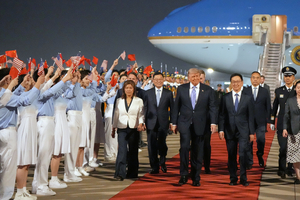
Xi Jinping, Trump Discuss 'Thucydides Trap' Amid US-China Rivalry
Chinese President Xi Jinping invoked the 'Thucydides Trap' during his May 2026 talks with then-US President Donald Trump in Beijing, highlighting the potential for conflict between a rising and a ruling power. The high-stakes summit aimed to navigate complex US-China relations, focusing on shared challenges, trade, and regional stability.
Key Highlights
- Xi Jinping used 'Thucydides Trap' during Beijing talks with Donald Trump.
- Concept describes war risk when rising power challenges existing hegemon.
- Summit addressed US-China strategic rivalry, trade, and Taiwan.
- Leaders aimed to avoid conflict, foster 'constructive strategic stability'.
- Thucydides Trap remains key framework for US-China relations.
- Geopolitical implications significantly impact India's foreign policy.
Chinese President Xi Jinping notably brought up the 'Thucydides Trap' during his high-profile talks with then-US President Donald Trump in Beijing on May 14, 2026. The meeting, which aimed to manage the increasingly complex and competitive relationship between the world's two largest economies, saw Xi emphasizing the critical need for both nations to avoid a historical pattern of conflict between a rising power and an established one. [3, 4, 15]
The 'Thucydides Trap' is a concept popularized by Harvard political scientist Graham Allison, who drew inspiration from the ancient Greek historian Thucydides' account of the Peloponnesian War. [2, 7] Thucydides observed that 'it was the rise of Athens and the fear that this instilled in Sparta that made war inevitable.' [2, 10] Allison adapted this to modern geopolitics, suggesting a significant likelihood of war when an emerging power (like China) threatens to displace an existing great power (like the United States) as a regional or international hegemon. His 2017 book, 'Destined for War: Can America and China Escape Thucydides's Trap?', explores 16 historical instances of such power transitions, with 12 of them resulting in war. [2, 8, 14]
During their discussions at the Great Hall of the People, President Xi Jinping posed a crucial question: 'Whether China and the United States can transcend the so-called Thucydides Trap and create a new normalization of relations between major powers; whether we can join hands to address global challenges and inject greater stability into the world.' [3, 12] He framed the future of China-US relations as one of the defining geopolitical questions of the 21st century, explicitly acknowledging the structural rivalry while signaling Beijing's desire to avoid direct confrontation. [4]
The summit between Trump and Xi on May 14, 2026, was a significant diplomatic event, marking Trump's first visit to China in approximately nine years since November 2017. [15, 16, 21] The agenda included critical issues such as trade conflicts, the Taiwan issue, Iran, supply chains, and technological competition. [6, 16, 17] Both leaders expressed a desire to manage bilateral ties stably amidst intensifying strategic rivalry. [13, 17] Trump, in his opening remarks, expressed optimism for the relationship, stating it would be 'better than ever.' [13, 16] Xi, on his part, stressed the importance of cooperation, advocating for the two countries to be 'partners, not rivals,' and to 'help each other succeed and prosper together.' [13, 21]
The concept of the Thucydides Trap has resonated widely in international relations circles, especially concerning US-China dynamics. [8] Analysts point to the ongoing trade wars, technology restrictions, military tensions in the Indo-Pacific, and the race for technological dominance as manifestations of the structural competition described by the theory. [3] While Allison's thesis has generated considerable debate and criticism regarding its methodological approach and interpretation of history, it remains an influential framework for understanding the potential for conflict between the two superpowers. [2, 5, 11]
For an audience in India, this news carries significant relevance. India maintains complex relationships with both the United States and China, characterized by elements of cooperation, competition, and potential conflict. [19, 22] India's foreign policy is significantly shaped by the dynamics of the U.S.-China strategic rivalry, with New Delhi increasingly viewing China as a security threat. [22] India seeks to manage China's rise, strengthening its bilateral and multilateral ties with the United States and its allies, partly to counter Chinese influence in the Indo-Pacific. [19, 27] A stable yet competitive US-China relationship is often preferred by India, as a direct conflict could destabilize the region and potentially force India to choose sides. [19, 25]
The summit outcomes, including the pursuit of 'constructive strategic stability' and renewed communication channels, were seen as an effort to manage differences and prevent tensions from escalating into a full-blown confrontation. [4] The ongoing debate around the Thucydides Trap continues to underscore the delicate balance required for global peace and prosperity, especially for nations like India navigating this complex geopolitical landscape. The question remains whether the US and China can indeed chart a new course, demonstrating that the 'Thucydides Trap' is not an inevitable fate. [8, 9]
Frequently Asked Questions
What is the 'Thucydides Trap'?
The 'Thucydides Trap' is a term coined by political scientist Graham Allison, inspired by ancient Greek historian Thucydides. It describes a historical pattern where war is likely when a rising power threatens to displace an established dominant power, driven by the fear the rising power instills in the existing hegemon. [2, 10]
When and where did Xi Jinping mention the 'Thucydides Trap' to Donald Trump?
Chinese President Xi Jinping mentioned the 'Thucydides Trap' during his talks with then-US President Donald Trump in Beijing on May 14, 2026, at the Great Hall of the People. [3, 12, 15]
Why is the 'Thucydides Trap' relevant to US-China relations?
The 'Thucydides Trap' is highly relevant to US-China relations because it provides a framework for understanding the structural tensions and potential for conflict between a rapidly rising China and the established global power, the United States. It highlights the challenges in managing competition without escalating to confrontation. [2, 3, 14]
What was the main goal of the Trump-Xi meeting in Beijing regarding this concept?
The main goal was to explore whether the US and China could avoid the 'Thucydides Trap' and establish a new paradigm for major-power relations, characterized by 'constructive strategic stability,' cooperation on global challenges, and the avoidance of direct conflict. [4, 12]
How does the 'Thucydides Trap' and US-China rivalry impact India?
The US-China rivalry significantly impacts India by shaping its foreign policy and security considerations. India navigates its relationships with both powers, seeks to manage China's rise, and often aligns with the US to balance Chinese influence in the Indo-Pacific, while aiming to prevent regional destabilization from escalating US-China tensions. [19, 22, 27]