Pakistan PM's Diplomatic Visit to US Amidst Typos and Gaza Peace Talks
Pakistan Prime Minister Shehbaz Sharif's visit to Washington for the 'Board of Peace' summit was marred by a significant typo from his Foreign Ministry and perceived diplomatic awkwardness with former US President Donald Trump. While Pakistan affirmed its commitment to Gaza peace, it sought clarity on its role in any stabilization force.
Key Highlights
- Pakistan's Foreign Ministry made a glaring typo, misspelling 'United States of America'.
- PM Shehbaz Sharif attended Donald Trump's 'Board of Peace' summit in Washington.
- Reports varied on Trump's interaction with Sharif, from 'sidelining' to 'warm embrace'.
- Sharif effusively praised Trump, including a Nobel Peace Prize nomination, for 'mediating' India-Pakistan conflict.
- Pakistan seeks clear mandate before committing troops to a Gaza stabilization force.
- The 'Board of Peace' aims to address Gaza reconstruction and security.
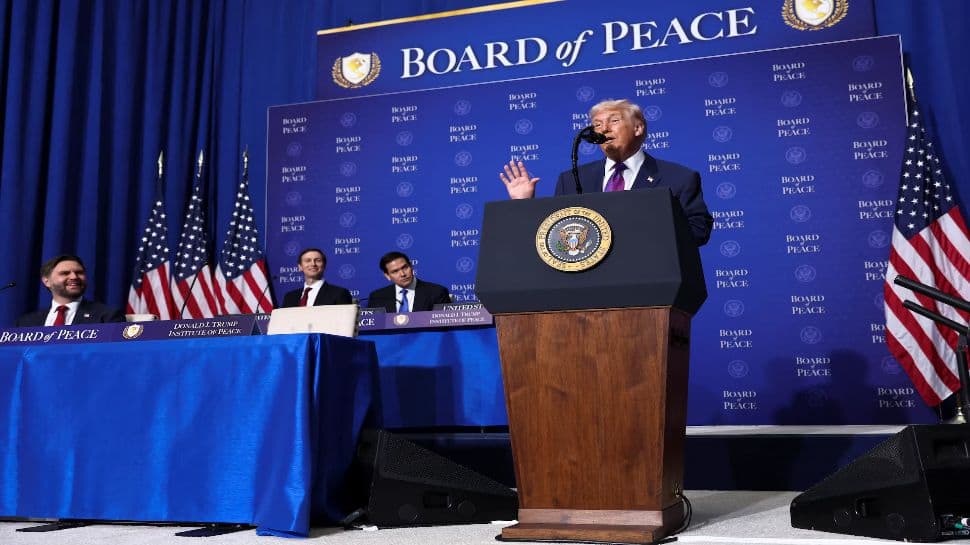
Pakistan's Prime Minister Shehbaz Sharif recently undertook a diplomatic visit to Washington D.C. to participate in the inaugural session of the 'Board of Peace' summit, an initiative led by former US President Donald Trump focused on Gaza and global conflict resolution. The summit, held around February 19-20, 2026, aimed to oversee Gaza's reconstruction, raise humanitarian aid, and establish an international stabilization force for the region's security.
However, the visit was immediately overshadowed by a significant diplomatic gaffe from Pakistan's Ministry of Foreign Affairs. An official statement announcing Prime Minister Sharif's visit was riddled with typos, most notably misspelling 'United States of America' as 'Unites States of Americas'. This error quickly went viral on social media, drawing widespread ridicule and commentary on Pakistan's recurring official blunders.
The India Today article characterized the overall experience for Pakistan's Prime Minister as a 'summit of humiliation,' pointing to this typo and perceived instances of Trump sidelining Sharif. The article highlighted moments such as Trump asking Sharif to 'stand up' during his speech, only to subsequently praise Indian Prime Minister Narendra Modi as a 'great man' and 'very good friend.' It also described an 'awkward embrace' between the two leaders at the summit's conclusion. These instances were interpreted as reflecting Islamabad's diminishing influence in Trump's diplomatic calculus, especially given Pakistan's inability to provide concrete commitments regarding a Gaza stabilization force.
In contrast, some Pakistani media outlets presented a more cordial picture of the interactions. ARY News and Geo News reported an 'informal meeting' where Trump and Sharif exchanged pleasantries, shook hands, and Trump 'warmly embraced' the Pakistani Prime Minister, even stating, 'I like this man [PM Shehbaz].' These reports also noted Sharif's informal interactions with several other world leaders attending the summit.
A notable aspect of Prime Minister Sharif's participation was his effusive praise for Donald Trump. Sharif lauded Trump as a 'man of peace' and 'saviour of South Asia,' going as far as to formally nominate him for the Nobel Peace Prize. These accolades were primarily based on Trump's repeated, yet disputed, claims of mediating a ceasefire between India and Pakistan, an assertion consistently rejected by India. This was not the first instance of such praise; Sharif had similarly flattered Trump at a gathering in Sharm El-Sheikh in the previous year. There was also a prior incident at the World Economic Forum in Davos where Trump had publicly referenced Sharif's praise regarding his supposed role in averting war between India and Pakistan, which some news outlets interpreted as a humiliation for Sharif.
The primary substantive agenda for Pakistan at the 'Board of Peace' involved discussions around contributing to an International Stabilization Force (ISF) in Gaza. Pakistan's Foreign Office maintained that while the country is willing to provide troops, it has 'red lines' and requires absolute clarity on the force's mandate. Islamabad emphasized that its troops would only participate in a strictly peacekeeping mission and would not be involved in disarming Hamas. This cautious stance stems from potential domestic political risks, as Palestine is a deeply emotive issue in Pakistan, making coordination with Israeli forces politically sensitive. Despite Trump announcing pledges for funding and troops from other Muslim-majority nations, Pakistan was notably not among the initial countries (Morocco, Albania, Indonesia, Kazakhstan, Kosovo) that committed personnel to the ISF.
The 'Board of Peace' itself, proposed in September 2025 and formally established in January 2026, aims to address the complex challenges in Gaza following a two-year conflict. A UN Security Council resolution adopted in mid-November of the previous year authorized the board to establish the ISF after a ceasefire that began in October under a Trump-backed plan. The summit, therefore, represented a crucial platform for Pakistan to articulate its foreign policy objectives and potential contributions to a sensitive international issue, despite the diplomatic missteps and varying interpretations of its interactions with the US leadership.
Overall, Prime Minister Shehbaz Sharif's visit to Washington for the 'Board of Peace' summit highlighted Pakistan's desire for global relevance and its nuanced position on the Gaza conflict, set against a backdrop of internal communication errors and a somewhat ambiguous reception from the US President. The narrative surrounding the visit reflects a blend of diplomatic engagement, domestic political considerations, and the subjective interpretation of high-level international interactions.
Frequently Asked Questions
What was the 'Board of Peace' summit?
The 'Board of Peace' was an initiative launched by former US President Donald Trump, with its inaugural summit held in Washington D.C. around February 19-20, 2026. Its primary objectives were to oversee the reconstruction of Gaza, raise humanitarian aid, and establish an international stabilization force to ensure security in the Palestinian territory.
What major typo did Pakistan's Foreign Ministry make?
Pakistan's Ministry of Foreign Affairs issued an official statement announcing Prime Minister Shehbaz Sharif's visit to the United States, but it contained a significant typo, misspelling 'United States of America' as 'Unites States of Americas'. This error garnered considerable attention and ridicule on social media.
How did Donald Trump interact with Pakistan's PM Shehbaz Sharif at the summit?
Reports on the interaction varied. While some outlets, like India Today, described moments of perceived sidelining, such as Trump asking Sharif to stand up and then praising Indian PM Modi, and an 'awkward embrace,' Pakistani media often characterized the interaction as 'informal,' 'cordial,' and 'warm,' noting a handshake and even a 'warm embrace' from Trump.
What was Pakistan's stance on contributing troops to a Gaza stabilization force?
Pakistan expressed willingness to contribute troops to an International Stabilization Force (ISF) for Gaza but stipulated that it would only do so if the mission was strictly for peacekeeping. Pakistan's Foreign Office emphasized that it had 'red lines' and would not participate in efforts aimed at disarming Hamas, seeking clarity on the ISF's mandate.
Why did PM Shehbaz Sharif praise Donald Trump so extensively?
Prime Minister Shehbaz Sharif extensively praised Donald Trump, calling him a 'man of peace' and 'saviour of South Asia,' and nominated him for the Nobel Peace Prize. This praise was linked to Trump's repeated claims of having mediated a ceasefire between India and Pakistan, a claim that India has consistently rejected.