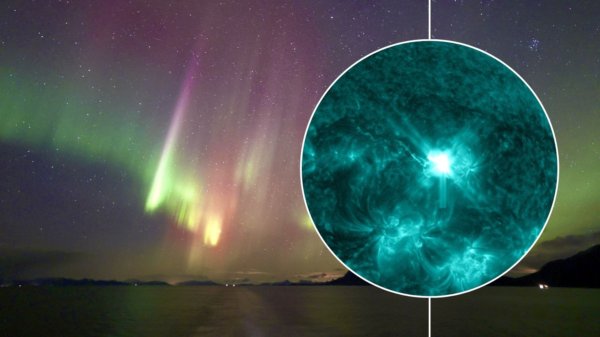
Intense Solar Storms Spark Aurora Alerts for July 4th Weekend
Recent intense solar activity, dubbed a 'machine-gun sun,' has triggered powerful solar flares and multiple coronal mass ejections (CMEs). These events are expected to cause moderate to strong geomagnetic storms, potentially bringing widespread auroras to over a dozen U.S. states during the July 4th holiday weekend.
Key Highlights
- Sun unleashes X1.1 solar flare followed by 10 M-class flares.
- Multiple CMEs are heading towards Earth, impacting July 3-6.
- NOAA forecasts G1-G3 geomagnetic storms for July 4th weekend.
- Northern Lights visible in over a dozen U.S. states, potentially 26.
- June 30 X-flare caused R3 radio blackouts over North America.
- Term 'machine-gun sun' reflects rapid succession of eruptions.
The Sun has entered a period of extraordinary activity, characterized by a rapid succession of powerful solar flares and coronal mass ejections (CMEs) – a phenomenon aptly described by solar physicist Dr. Tamitha Skov as a 'machine-gun sun' [5, 9, 13, 19]. This heightened solar output is generating significant excitement and has prompted aurora alerts for the upcoming July 4th holiday weekend, with forecasts suggesting the Northern Lights could be visible across more than a dozen, and potentially up to 26, U.S. states [10, 15].
The surge in solar activity began prominently on June 30, 2026, when sunspot region AR4479 unleashed a powerful X1.1-class solar flare [1, 2, 3, 6, 12, 13]. X-class flares are the most intense category of solar flares, and this particular event triggered strong (R3) radio blackouts across the daylight side of Earth, primarily affecting high-frequency radio communications in parts of North America and the Pacific region within just eight minutes of eruption [1, 2, 3, 6, 7]. These radio blackouts, impacting frequencies below 25 MHz, are crucial for aviation, maritime operations, and amateur radio communications [6].
Following this initial powerful X-flare, the Sun continued its aggressive display by firing off an additional ten M-class solar flares within a 24-hour period between July 1st and July 2nd [5, 13, 15, 19]. M-class flares are considered moderate but still capable of causing brief radio blackouts and minor radiation storms. Crucially, many of these flares were accompanied by coronal mass ejections – colossal clouds of magnetized solar plasma and radiation hurled into space [5, 15].
Space weather forecasters, notably the NOAA Space Weather Prediction Center (SWPC), have been closely monitoring these multiple CMEs. Current projections indicate that these plasma clouds are heading towards Earth and are expected to make impact in stages, beginning on July 3rd and potentially continuing through July 6th, 2026 [9, 14, 19]. The first disturbance was anticipated to reach Earth as early as the morning of July 3rd [13].
The interaction of these CMEs with Earth's magnetic field is projected to trigger moderate to strong geomagnetic storms. Specifically, the NOAA SWPC has issued a G2 (Moderate) geomagnetic storm watch for July 3rd, with the possibility of reaching G3 (Strong) conditions on July 4th [10, 14, 19]. A G2-level storm is significant enough to push the visibility of auroras much farther south than their usual polar regions [1]. If G3 conditions materialize, the Northern Lights could be seen from an unusually broad range of locations. Forbes reports that a G3 storm could allow aurora sightings in northern states like Montana, North Dakota, Minnesota, and Wisconsin, and potentially as far south as Kansas or Maryland [10]. Other states mentioned in forecasts include Washington, Idaho, Oregon, Wyoming, Nebraska, Iowa, Illinois, Indiana, Ohio, New York, Vermont, New Hampshire, and Alaska [16, 20].
While the prospect of widespread aurora displays is exciting, space weather conditions can also have practical implications. Beyond radio blackouts, stronger geomagnetic storms can affect power grids, disrupt satellite operations (including GPS), and pose risks to astronauts [6]. However, the current forecasts suggest impacts primarily related to radio communications and aurora visibility, rather than severe infrastructure damage. For aurora enthusiasts, NOAA's real-time forecasts and specialized apps are recommended for crucial updates on the interplanetary magnetic field's Bz component, which is a key factor for aurora visibility [10, 14].
Despite the auspicious timing with the July 4th celebrations in the U.S., factors such as the waning Strawberry Moon and the longer daylight hours of summer at higher latitudes could slightly hinder visibility for casual observers [10, 16]. Experts advise heading as far north as possible, away from city lights, and looking towards the northern horizon between 10 p.m. and 2 a.m. local time for the best chances of viewing [19]. Modern smartphone cameras, with their long-exposure settings, are often surprisingly effective at capturing the faint colors of the aurora that might be less apparent to the naked eye [19].
For an Indian audience, while auroras are not typically visible in India due to its low latitude, the ongoing solar activity represents a significant global scientific event. Such intense solar periods are closely watched worldwide for their potential effects on satellite communications, GPS, and power infrastructure, which have global relevance. The 'machine-gun sun' activity underscores the dynamic nature of our star and the continuous need for space weather monitoring and forecasting.
Frequently Asked Questions
What is a 'machine-gun sun'?
The term 'machine-gun sun' was coined by solar physicist Dr. Tamitha Skov to describe a period of unusually frequent and rapid solar eruptions, specifically a series of solar flares and coronal mass ejections (CMEs) occurring in quick succession.
What are solar flares and Coronal Mass Ejections (CMEs)?
Solar flares are intense bursts of radiation from the Sun's surface, traveling at the speed of light. Coronal Mass Ejections (CMEs) are large expulsions of plasma and magnetic field from the Sun's corona, which travel slower than flares but carry a much greater mass of charged particles. Both can impact Earth's space environment.
How do solar storms cause auroras?
When Earth-directed CMEs reach our planet, their magnetic fields can interact with Earth's magnetic field, causing a geomagnetic storm. These storms energize particles in Earth's atmosphere, which then collide with gases, emitting light and creating the dazzling aurora displays, also known as the Northern and Southern Lights.
What are the potential impacts of these solar storms?
The recent solar storms have already caused strong (R3) radio blackouts, primarily affecting high-frequency communications over North America and the Pacific. Further geomagnetic storms could lead to more radio disruptions, affect satellite operations (including GPS), and potentially impact power grids, although the current forecasts for July 3-4 are moderate to strong, rather than extreme.
Will the auroras be visible in India?
No, auroras are typically visible at high latitudes, near the Earth's magnetic poles. India is located at low latitudes, so the auroras associated with these solar storms are not expected to be visible there. The current forecasts indicate visibility primarily in higher-latitude regions, particularly northern U.S. states and Canada.