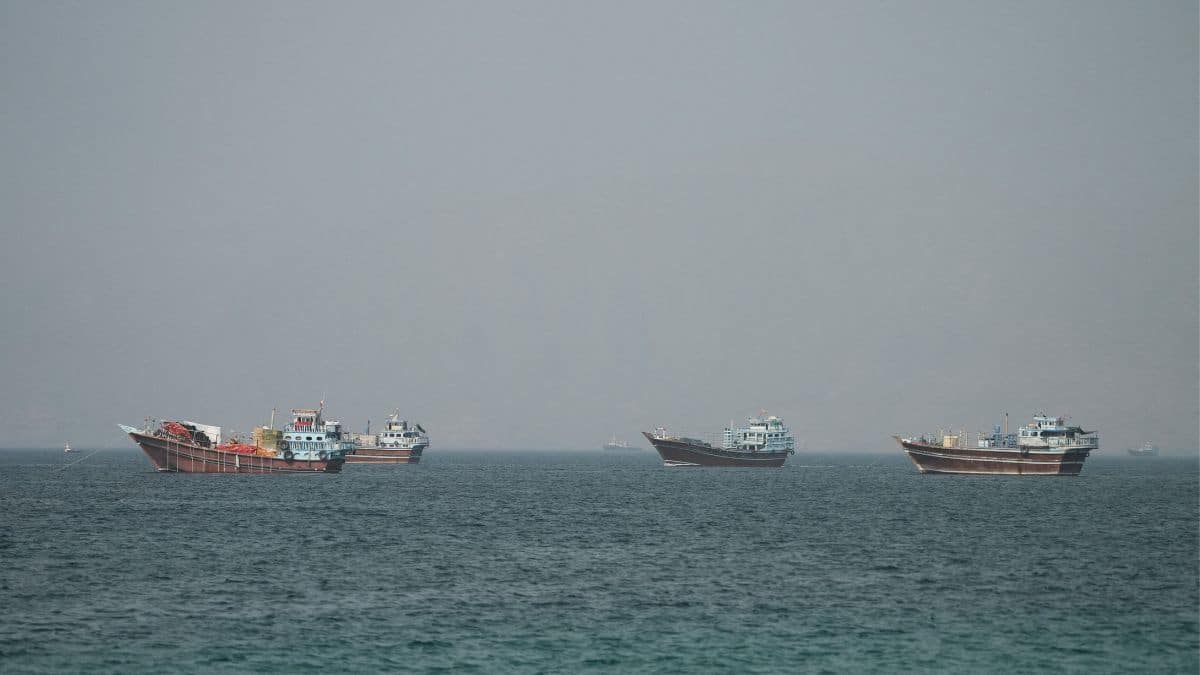
Trump Accuses Iran of Drone Attack in Hormuz, Citing Ceasefire Violation
Former US President Donald Trump has accused Iran of a 'foolish violation' of a ceasefire agreement after an alleged drone attack on ships in the Strait of Hormuz. Trump claimed Iran fired four drones, with one hitting a cargo ship and US forces intercepting three others. The incident has disrupted international shipping and led to a pause in UN-backed evacuation plans.
Key Highlights
- Former US President Trump alleges Iran fired four drones at ships in Hormuz.
- One drone reportedly hit a Singapore-flagged cargo ship, causing damage.
- Trump claimed US forces shot down the remaining three Iranian drones.
- The attack is labelled a 'foolish violation' of a recent US-Iran ceasefire.
- The incident paused UN-backed efforts to evacuate stranded ships in the region.
- Tensions escalate amidst fragile diplomatic efforts to reopen the Strait of Hormuz.
Former United States President Donald Trump has made a significant accusation against Iran, claiming it launched a drone attack on commercial vessels in the strategic Strait of Hormuz. In a post on Truth Social, Trump stated that Iran's Islamic Revolutionary Guard Corps (IRGC) fired at least four one-way attack drones at ships traversing the strait. According to Trump, one of these drones 'solidly hit the upper deck of a large and very expensive Cargo Carrying Ship,' causing damage, though the vessel was reportedly able to continue its journey. He further asserted that US forces successfully 'knocked down three other Drones,' describing the event as a 'foolish violation of our Ceasefire Agreement.'
This incident has been corroborated by multiple sources, although the specific details regarding the number of drones fired and intercepted by the US are primarily attributed to Trump's statement. US officials confirmed that Iran's Islamic Revolutionary Guard Corps was behind a drone strike on a Singapore-flagged cargo ship leaving the Strait of Hormuz. The UK Maritime Trade Operations (UKMTO) center also reported that a vessel was hit by a projectile several miles off the coast of Oman. The damaged ship was identified as a Singapore-flagged cargo vessel, and its operator, Taiwanese shipping company Evergreen Marine, confirmed that its container ship was hit by an 'unidentified object' but that the crew, vessel, and cargo were 'unharmed,' allowing it to resume transit.
The timing of this alleged attack is particularly sensitive, as it occurs amid a reportedly 'fragile ceasefire' or 'ceasefire agreement' between the US and Iran. This agreement, described by some as an 'interim ceasefire' or a 'memorandum of understanding' signed recently by President Trump and his Iranian counterpart, aims to de-escalate tensions and reopen the crucial Strait of Hormuz for international shipping. The Strait of Hormuz is a vital chokepoint for global oil and gas shipments, and previous disruptions have significantly impacted energy markets.
In response to the drone strike, the International Maritime Organization (IMO) has temporarily paused its vessel evacuation operation in the region. This UN-backed effort was designed to move hundreds of stranded ships through the strait, utilizing an alternative route hugging the shores of Oman. The halt underscores the immediate impact of such attacks on maritime safety and global commerce. The UAE also reported an incoming missile alert in Dubai, later attributed to a technical malfunction, which highlights the heightened regional volatility.
While the article focuses on Trump's statements, the broader context involves ongoing US-Iran tensions. There have been previous incidents in the Strait of Hormuz, including drone shoot-downs and attacks on tankers, some dating back to 2019 during Trump's presidency. However, the current reporting clearly indicates that Trump's remarks on June 26, 2026, pertain to a very recent event, suggesting a continued, albeit complex, involvement in US foreign policy discussions even as a former president. The incident has raised concerns about the viability of the recently brokered ceasefire and the long-term stability of shipping lanes in the Persian Gulf. International observers are keenly watching for further developments and reactions from both the US and Iranian governments, as well as the impact on regional and global security. The situation underscores the persistent challenges in maintaining peace and freedom of navigation in this critical waterway, with potential implications for oil prices and global supply chains.
Frequently Asked Questions
What did Donald Trump claim regarding Iran's actions in the Strait of Hormuz?
Former US President Donald Trump claimed on Truth Social that Iran fired at least four one-way attack drones at ships in the Strait of Hormuz. He stated that one drone hit a large cargo ship, and US forces subsequently shot down the other three.
Which ship was reportedly hit in the drone attack?
A Singapore-flagged cargo ship was reportedly hit in the drone attack. Its operator, Evergreen Marine, confirmed that its container ship was struck by an 'unidentified object' but was able to continue its journey with no casualties or further damage.
What is the significance of this attack in the context of US-Iran relations?
The attack is significant because it is described by Trump as a 'foolish violation' of a recently brokered ceasefire agreement between the US and Iran. This agreement aimed to de-escalate tensions and reopen the Strait of Hormuz for international shipping, making the drone strike a challenge to fragile diplomatic efforts.
How has the international community reacted to the incident?
The International Maritime Organization (IMO) has temporarily paused its UN-backed vessel evacuation operation in the Strait of Hormuz due to the attack, highlighting concerns about maritime safety. The incident has also raised fears about renewed disruption to global oil supplies.
Why is the Strait of Hormuz strategically important?
The Strait of Hormuz is a narrow waterway connecting the Persian Gulf to the open ocean, through which a significant portion of the world's oil and natural gas shipments pass. Its strategic importance makes it a frequent flashpoint for regional tensions and disruptions, with global economic implications.