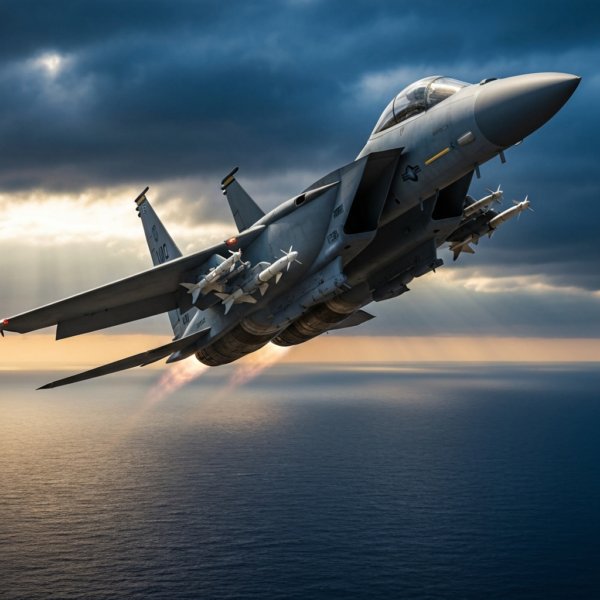
China Deploys 11 J-20 Stealth Jets Near India's Border, Widening Capability Gap
Satellite imagery reveals China has deployed at least 11 J-20 "Mighty Dragon" stealth fighter jets to two airbases near India's northern frontier. This move highlights China's expanding air power and presents a growing challenge for India, which is still years away from operationalizing its indigenous stealth fighter.
Key Highlights
- China has deployed 11 J-20 stealth fighters to Hotan and Damxung airbases.
- The Hotan airbase is strategically located near India's Ladakh region.
- Damxung airbase in Tibet positions J-20s closer to Arunachal Pradesh.
- India currently lacks an operational stealth fighter, with its indigenous AMCA years away.
- The deployment signifies routine operations rather than a temporary show of force.
Recent commercial satellite imagery has confirmed China's significant escalation of its air power presence near India's northern borders, with the deployment of at least 11 J-20 "Mighty Dragon" stealth fighter jets across two strategic airbases. The analysis, primarily based on images captured in late June and early July 2026, indicates a substantial increase in the operational deployment of these fifth-generation aircraft, raising concerns about the evolving air-power balance along the Line of Actual Control (LAC).
Specifically, seven J-20 aircraft were observed at the Hotan airbase in China's Xinjiang Uyghur Autonomous Region on July 9. This dual-use (civil and military) airbase is situated approximately 389 kilometers northeast of Leh and a mere 245 kilometers northeast of the Indian Air Force's (IAF) Daulat Beg Oldi airfield in eastern Ladakh. Defence observers noted this as one of the largest visible deployments of J-20s at a Chinese airbase facing India to date.
In addition to the Hotan deployment, four more J-20 fighters were identified at the Damxung airbase, located in the Tibetan Lhasa Prefecture. This base is situated roughly 344 kilometers northwest of Tawang in Arunachal Pradesh, extending China's advanced fighter presence towards India's strategically sensitive eastern sector.
Military experts interpret this deployment not as a one-time display of strength, but as indicative of routine operations by the People's Liberation Army Air Force (PLAAF) from high-altitude bases near India. This suggests that China has developed the capability to regularly operate its fifth-generation stealth aircraft from these challenging environments, integrating them into its regular military posture.
The J-20's primary advantage lies in its stealth design, which significantly reduces its radar cross-section, allowing it to operate with a reduced chance of early detection. This capability gives it a distinct edge over fourth-generation aircraft, including India's current frontline fighters like the Dassault Rafale.
This development occurs at a critical juncture for India's air force modernization efforts. India currently does not operate any indigenous stealth fighters. Its own fifth-generation stealth fighter project, the Advanced Medium Combat Aircraft (AMCA), is still in development and is estimated to be at least a decade away from entering operational service.
In contrast, China's J-20 fleet has seen rapid expansion. Estimates suggest that by mid-2026, China could possess between 300 to 500 J-20 fighters, with production potentially reaching around 120 aircraft annually by late 2025. Some projections indicate China could field as many as 1,000 J-20s by 2030.
This growing capability gap underscores the need for India to enhance its air defense systems. Experts emphasize the urgency for India to improve its capabilities in detecting low-observable aircraft, strengthening integrated air defense networks, and developing more robust long-range strike capabilities.
The regular deployment of J-20s from high-altitude bases like Hotan and Damxung signifies a strategic shift, enabling China to compress warning times for India and potentially gain operational advantages during crises. This persistent forward presence allows China to shape crisis behavior by shortening mobilization timelines and increasing uncertainty for India.
The implications extend beyond immediate border defense, as China's ability to reallocate its stealth assets across different theaters, including the Indo-Pacific, demonstrates strategic flexibility. For India, this necessitates a sustained focus on multi-sector surveillance and continued investment in advanced air power to counter the evolving threat.
While the Indian Air Force is modernizing its fleet with aircraft like the Rafale, these are 4.5-generation platforms and do not possess the stealth characteristics of the J-20. India's long-term strategy relies on the development of its indigenous AMCA, but until then, the country faces a significant technological and tactical challenge from China's rapidly advancing stealth fighter capabilities.
The news highlights the ongoing military modernization race between India and China, emphasizing China's proactive steps in deploying advanced technology close to India's borders and India's efforts to bridge the technological disparity in the coming years.
Frequently Asked Questions
What are the J-20 stealth jets?
The J-20 "Mighty Dragon" is China's fifth-generation stealth fighter aircraft, designed for air superiority with advanced stealth capabilities that reduce its radar signature, making it harder to detect and engage.
Why is the deployment of J-20s near India significant?
The deployment is significant because it places advanced stealth fighter jets closer to India's borders, altering the air power balance. It also indicates that China is regularly operating these sophisticated aircraft from high-altitude bases near India, a capability that challenges India's current air defense systems.
Does India have its own stealth fighters?
Currently, India does not operate any indigenous stealth fighters. Its Advanced Medium Combat Aircraft (AMCA) project is underway, but the aircraft is estimated to be at least a decade away from operational service.
What are the implications for India's defense strategy?
The presence of Chinese J-20s necessitates India to enhance its counter-stealth capabilities, including improved sensors, integrated air defense networks, and potentially accelerating its own stealth fighter development programs. It also highlights the need for continuous surveillance and modernization of its existing air fleet.