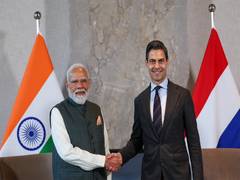
India, Netherlands Deepen Strategic Ties with Focus on Water Management
Prime Minister Narendra Modi's visit to the Netherlands, highlighted by a tour of the Afsluitdijk dam, has solidified a strategic partnership between India and the Netherlands. The nations signed 17 agreements focusing on critical areas like water management, climate resilience, defense, and critical minerals, with Dutch expertise eyed for India's Kalpasar Project.
Key Highlights
- PM Modi visited Netherlands' iconic Afsluitdijk dam on May 17, 2026.
- Visit underscored Dutch expertise in water management for India's Kalpasar Project.
- India and Netherlands elevated ties to a Strategic Partnership (2026-2030).
- Sealed 17 pacts covering defense, critical minerals, and green energy.
- Cooperation aims to bring modern technology for India's water challenges.
- Strategic partnership targets resilient supply chains and technological collaboration.
Prime Minister Narendra Modi's recent visit to the Netherlands on May 17, 2026, marked a significant step in bolstering bilateral relations, culminating in the elevation of ties to a Strategic Partnership. A key highlight of the visit was PM Modi's tour of the iconic Afsluitdijk dam, a monumental engineering feat in the Netherlands renowned for its advanced water management systems. Accompanied by Dutch Prime Minister Rob Jetten, the visit underscored India's keen interest in leveraging Dutch expertise in water management, flood protection, freshwater storage, and climate-resilient infrastructure.
The Afsluitdijk, a 32-kilometer-long barrier dam, has historically protected the Netherlands from floods while also managing freshwater storage, inland waterways, and renewable energy generation. The Ministry of External Affairs (MEA) and PM Modi himself emphasized the direct relevance of this Dutch model to India's ambitious Kalpasar Project in Gujarat. The Kalpasar Project, a proposed mega freshwater reservoir and dam system across the Gulf of Khambhat, has been under study for decades and aims to integrate tidal power generation, irrigation networks, and transportation infrastructure.
During the visit, PM Modi lauded the Netherlands' pioneering work in water resources, stating that the entire international community could learn a great deal from their experience. He reiterated India's commitment to adopting modern technology for irrigation, flood protection, and the expansion of its inland waterway network. To concretize this cooperation, a Letter of Intent was signed between India's Ministry of Jal Shakti and the Netherlands' Ministry of Infrastructure and Water Management, specifically for technical collaboration on the Kalpasar project. This agreement is expected to facilitate crucial knowledge-sharing in hydraulic engineering, coastal protection, and sustainable water infrastructure.
Beyond water management, the visit saw a comprehensive expansion of the Indo-Dutch relationship into a Strategic Partnership, formalized by the adoption of the 'Roadmap of India-Netherlands Strategic Partnership 2026-2030'. This roadmap outlines a five-year plan for focused, time-bound initiatives across various sectors. As part of this enhanced cooperation, India and the Netherlands sealed 17 agreements, signaling a deepened commitment to collaboration in critical areas.
Key sectors covered by these agreements include defense, critical minerals, clean energy (with a focus on green hydrogen), semiconductors, trade, technology, healthcare, and education. The leaders discussed strengthening supply chain resilience and technological collaboration, particularly inviting Dutch companies to invest in designing, innovating, and manufacturing in India. A notable development was the agreement between Tata Electronics and ASML, a Dutch semiconductor company, to support a semiconductor fabrication unit in Dholera, Gujarat, highlighting efforts to secure critical supply chains.
The elevation to a Strategic Partnership reflects the growing importance both nations attach to climate-resilient infrastructure, sustainable development, and a broader alignment on geopolitical issues. The leaders reviewed cooperation across sectors, affirming that the relationship is rooted in shared democratic values, strong economic cooperation, and deep people-to-people connections. The Netherlands is already one of India's largest trading partners in Europe, with bilateral trade reaching USD 27.8 billion in 2024-25, and this partnership aims to further boost trade and investment.
Discussions also touched upon global issues, including concerns over the situation in West Asia and its implications for global energy supplies and trade networks, as well as the ongoing conflict in Ukraine. Both leaders emphasized freedom of navigation and commerce and reaffirmed support for diplomatic solutions to international conflicts.
The collaboration extends to existing initiatives under the India-Netherlands Strategic Water Partnership, which includes developing a 'Centre of Excellence' on Water with India's National Mission for Clean Ganga (NMCG). This center aims to accelerate cooperation in various water management topics, encompassing policy, research, implementation, and innovation, and will provide a platform for Dutch Water Technology. Current cooperation also involves assisting Indian states like Kerala and West Bengal in flood risk management and coastal resilience.
Overall, PM Modi's visit to the Netherlands and the subsequent agreements underscore a multifaceted and forward-looking partnership, with water management and climate resilience emerging as central pillars alongside economic and strategic cooperation. The emphasis on adopting the 'Dutch model' for India's water challenges highlights a pragmatic approach to addressing critical environmental and developmental needs.
Frequently Asked Questions
What was the main purpose of PM Modi's visit to the Afsluitdijk dam in the Netherlands?
PM Modi visited the Afsluitdijk dam to explore and learn from the Netherlands' advanced water management, flood protection, and freshwater storage expertise. This knowledge is considered highly relevant for India's own ambitious water infrastructure projects, particularly the Kalpasar Project in Gujarat.
What is the Kalpasar Project and how does Dutch expertise relate to it?
The Kalpasar Project is a proposed mega freshwater reservoir and dam system across India's Gulf of Khambhat. Dutch hydraulic engineering and water management expertise, as exemplified by the Afsluitdijk, is sought to assist in developing this project for freshwater storage, flood control, irrigation, and transportation infrastructure.
What is the significance of the India-Netherlands Strategic Partnership?
The elevation of ties to a Strategic Partnership, outlined in a 2026-2030 roadmap, signifies a deepening of cooperation across various critical sectors. This includes defense, critical minerals, semiconductors, clean energy, trade, and technology, aiming for resilient supply chains and mutual economic growth.
How many agreements were signed during PM Modi's visit to the Netherlands?
During Prime Minister Modi's visit to the Netherlands, India and the Netherlands sealed 17 agreements aimed at boosting cooperation across diverse strategic sectors.
What other areas of cooperation were discussed besides water management?
Beyond water management, discussions and agreements covered a wide array of areas including defense, critical minerals, green hydrogen, semiconductor manufacturing (notably Tata Electronics and ASML), trade, technology, healthcare, and education.