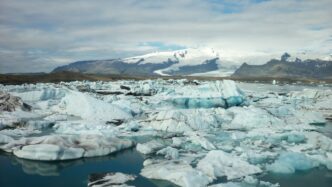
Antarctica's Warming: Irreversible Impacts and Global Sea-Level Threat
Antarctica is warming at an alarming rate, threatening irreversible melting of its ice sheets and sea ice, with catastrophic global consequences for sea-level rise and ecosystems. Scientific research highlights critical tipping points, some potentially already crossed, underscoring the urgent need for emissions reduction.
Key Highlights
- Antarctica is warming at twice the global average, with record heat events observed.
- Multiple Antarctic ice sheet tipping points exist; some in West Antarctica may be crossed.
- Accelerated ice melt directly contributes to global sea-level rise, endangering coastal regions.
- Declining sea ice impacts vital ecosystems and ocean circulation, affecting global climate.
- Best- and worst-case warming scenarios project vastly different futures for the continent.
- Urgent, deep emission cuts are critical to avert the most severe, irreversible impacts.
Antarctica, the Earth's largest store of frozen freshwater, is experiencing unprecedented warming, with profound and potentially irreversible consequences for the entire planet. Recent scientific findings indicate that the continent is warming at nearly twice the global average rate, prompting urgent warnings from researchers about a 'frightening prospect' and 'irreversible changes'. This alarming trend is driving accelerated ice melt, significant sea-level rise, and dramatic alterations to global climate systems and marine ecosystems.
Major claims from recent research underscore the severity of the situation. Scientists have observed a record heatwave in East Antarctica, with temperatures peaking at an astonishing 39°C above normal in 2022. The continent's ice sheet is losing mass at an accelerating pace, with losses tripling since 2012, contributing significantly to global sea-level rise. Should the entire Antarctic ice sheet melt, global mean sea levels could rise by an estimated 58 to 60 meters.
A critical aspect of the current climate crisis in Antarctica is the concept of 'tipping points' – thresholds beyond which changes become self-sustaining and irreversible over human timescales. Research from institutions like the Potsdam Institute of Climate Impact Research (PIK) and the Max Planck Institute of Geoanthropology (MPI-GEA) highlights that the Antarctic Ice Sheet does not have a single tipping point, but rather a complex set of interacting systems across its drainage basins. Disturbingly, some parts of West Antarctica, particularly the Amundsen Sea basin, which includes the massive Thwaites and Pine Island glaciers, may have already crossed these critical thresholds at current warming levels of approximately 1.3°C above pre-industrial levels. While crossing a tipping point does not imply immediate collapse, it initiates a centuries-long process of large-scale ice loss that is effectively irreversible. The West Antarctic Ice Sheet (WAIS) is particularly vulnerable, as much of it rests below sea level, making it susceptible to warm ocean currents melting it from below. A complete collapse of the WAIS could lead to a global sea-level rise of over 3 meters. Even regions of the East Antarctic Ice Sheet (EAIS), long considered more stable, could cross thresholds with moderate warming of 2-3°C, and massive areas like the Wilkes Basin face substantial ice loss with 2-5°C warming.
Ice shelves, the floating extensions of glaciers, play a crucial role in stabilizing the Antarctic ice sheet by slowing the flow of ice into the ocean. Their thinning or collapse, often triggered by warming ocean waters or surface melt, can lead to accelerated glacier retreat. The rapid decline in Antarctic sea ice since 2014 is another alarming signal, with record lows observed in recent years (2022, 2023, 2024), representing an 'abrupt regime shift'. This reduction in sea ice has significant knock-on effects, exposing ice shelves to damaging ocean swells and intensifying warming feedback loops.
The consequences extend dramatically to Antarctica's unique ecosystems. Sea ice is a critical habitat for numerous species, and its loss threatens the base of the Southern Ocean food web. Krill-dependent species, including whales and penguins, face devastating impacts, with emperor penguins, in particular, at heightened extinction risk due to the loss of stable sea ice for breeding. Changes are also projected in phytoplankton and krill growth, further disrupting the marine food chain.
Beyond direct ice melt, the warming of Antarctica is influencing global ocean circulation. Meltwater from the ice sheet and sea-ice loss has led to a significant slowdown (around 30% since the 1990s) in parts of the Southern Ocean overturning circulation. This circulation is vital for Earth's climate stability, as it helps remove heat and carbon from the atmosphere and distributes nutrients globally. A sustained slowdown or collapse could leave vital nutrients trapped at the seafloor, impacting marine biological systems worldwide.
Scientists have modeled various best- and worst-case scenarios based on different greenhouse gas emissions pathways. Under a low-emissions scenario, where global warming is limited to approximately 1.8°C by 2100, sea ice would remain largely stable, and land ice might even slightly grow due to increased snowfall. However, the world's current trajectory, closer to a medium-high emissions scenario, projects significant ocean warming, substantial sea ice loss, and accelerating ice loss, leading to largely irreversible changes to habitats. The worst-case scenario, with very high emissions leading to about 4.4°C warming by 2100, could see the likely collapse of major ice shelves like Larsen C and Wilkins, dramatic shrinkage of sea ice, and widespread devastation of krill-reliant species, potentially adding 116mm to global sea levels from the Antarctic Peninsula alone by 2300.
The global implications of Antarctica's warming are particularly relevant to India. Rising sea levels from Antarctic melt do not occur uniformly across the globe; they disproportionately affect low-lying coastal regions in the Indian Ocean basin. This poses severe threats to India's extensive coastline, including increased coastal erosion, damage to infrastructure, contamination of freshwater sources, and interference with agriculture due to saltwater intrusion. The potential for large-scale climate-induced migration and economic disruption for coastal communities is immense.
In conclusion, the scientific consensus is clear: Antarctica is undergoing rapid, profound, and in some cases, irreversible changes due to human-caused climate change. The 'frightening prospect' highlighted by the Euronews article is grounded in extensive research, with credible sources corroborating the severity of the situation. Urgent and deep reductions in carbon emissions are the only assured way to mitigate the most catastrophic long-term impacts, emphasizing that humanity's choices today will determine the fate of Antarctica and, by extension, the world's coastal regions, including those in India.
Frequently Asked Questions
What are the primary impacts of Antarctica's warming?
Antarctica's warming primarily leads to accelerated melting of its ice sheets and a dramatic decline in sea ice. This directly contributes to global sea-level rise, impacts marine ecosystems by disrupting the food web, and can slow down critical ocean circulation patterns that regulate global climate.
What are 'tipping points' in the context of Antarctic ice melt?
Tipping points are critical thresholds within the Antarctic ice sheet system where even small changes can trigger large, often irreversible, changes in the state of the system. Once crossed, these points initiate processes of ice loss that become self-sustaining and continue over centuries to millennia, regardless of future emission reductions.
How does Antarctica's warming affect India specifically?
Antarctica's ice melt contributes to global sea-level rise, which disproportionately impacts low-lying coastal regions in the Indian Ocean basin. This threatens India's extensive coastline with increased erosion, damage to infrastructure, saltwater intrusion into freshwater sources, and disruption to agriculture.
What are the best and worst-case scenarios for Antarctica?
The best-case scenario, with strong emissions cuts limiting warming to around 1.8°C, sees relatively stable sea ice and retained ice shelves. The worst-case, with very high emissions (around 4.4°C warming), predicts the collapse of major ice shelves, dramatic sea ice loss, ecosystem devastation, and significant sea-level contributions.
Can humanity still prevent the worst impacts of Antarctic warming?
Scientists emphasize that rapid and deep reductions in carbon emissions are crucial to prevent the most catastrophic and irreversible impacts of Antarctic warming. While some changes are already set in motion due to past emissions, humanity's choices in the coming decades will determine the severity of future consequences.