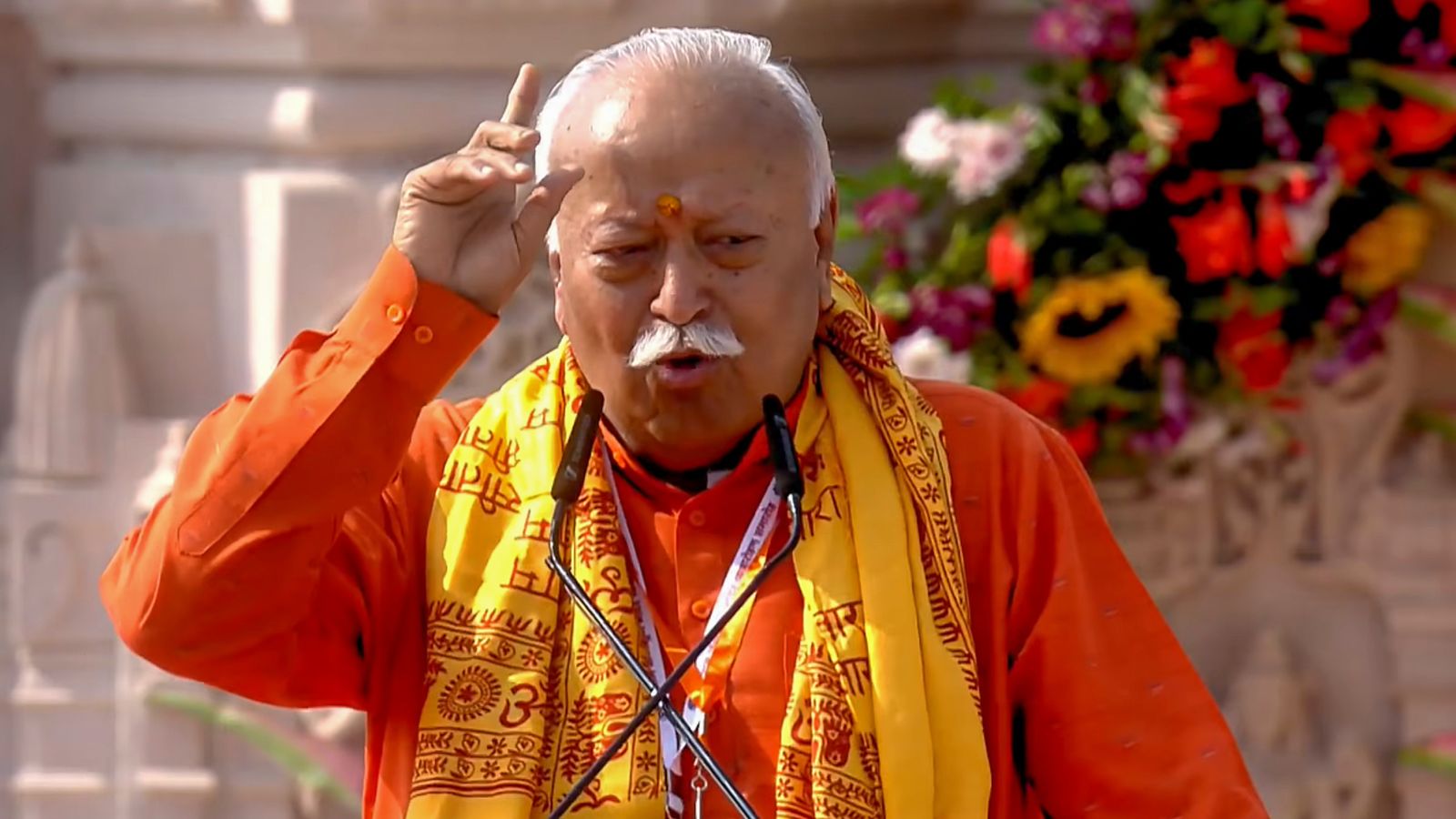
RSS Chief: Bharat Ratna to Savarkar will boost award's prestige
RSS chief Mohan Bhagwat stated that bestowing the Bharat Ratna on V.D. Savarkar would enhance the award's prestige, a remark made during an RSS centenary event in Mumbai. He also addressed questions about his age and potential retirement, clarifying that he would step down only if the Sangh directed him to do so. The statements come amidst ongoing political debate surrounding Savarkar's legacy.
Key Highlights
- Mohan Bhagwat supports Bharat Ratna for V.D. Savarkar.
- Bhagwat believes Savarkar's honour would elevate Bharat Ratna's prestige.
- RSS chief addressed his age and retirement from leadership.
- Stated no formal retirement in RSS; will serve as long as asked.
- Remarks made at an RSS centenary event in Mumbai.
- Comments fuel ongoing debate about Savarkar's historical legacy.
Rashtriya Swayamsevak Sangh (RSS) chief Mohan Bhagwat recently made significant statements regarding the Bharat Ratna award for Hindutva ideologue Vinayak Damodar Savarkar and his own tenure as the head of the Sangh. Speaking at a programme in Mumbai on Sunday, February 8, 2026, marking the RSS's centenary, Bhagwat asserted that conferring India's highest civilian honour, the Bharat Ratna, upon V.D. Savarkar would actually augment the prestige of the award itself.
Bhagwat, during an interactive session at the event, referred to Savarkar using the honorific 'Veer' (brave) and underscored that recognising him with such an honour would elevate its stature. This statement reignites a long-standing political debate surrounding Savarkar's legacy, particularly his mercy petitions to the British during his imprisonment in the Cellular Jail in the Andaman and Nicobar Islands. Critics, including the Congress party, have often labelled Savarkar a 'traitor' for these petitions, while his proponents view him as a fierce nationalist and freedom fighter who strategically sought release to continue his work.
Beyond the contentious issue of Savarkar, Mohan Bhagwat also addressed personal questions concerning his age and potential retirement from his role as the RSS chief. He revealed that he had turned 75 in the past year, a milestone that has previously sparked discussions in political circles, especially given the Bharatiya Janata Party's (BJP) unofficial age limit of 75 for holding active posts. However, Bhagwat clarified that despite reaching this age, the RSS organisation had asked him to continue his leadership.
He further elucidated the nature of leadership within the RSS, stating that there is no formal retirement age for swayamsevaks (volunteers) or the chief. Bhagwat emphasised that he would only step down from his position whenever the Sangh itself directed him to do so. He highlighted that the post of RSS chief is not determined by elections but rather by appointment through regional and divisional leadership within the organisation.
These comments from the RSS chief hold significant weight in India's political landscape, given the RSS's ideological influence over the ruling BJP. The demand for Bharat Ratna for Savarkar has been a recurring theme from right-wing organisations and has often been met with strong opposition from other political parties, particularly the Indian National Congress. The Congress has consistently cited Savarkar's clemency petitions to the British as a reason to oppose the honour.
The timing of Bhagwat's statements, made during the centenary celebrations of the RSS, adds another layer of significance. The organisation is reflecting on its past achievements and future direction, and the chief's remarks on ideological figures like Savarkar and internal leadership dynamics provide insights into the Sangh's current perspectives and priorities. The discussion around age and retirement is also particularly relevant in the context of Indian politics, where the age of leaders often becomes a point of public and political scrutiny. Bhagwat's assertion that 'retirement from work will never happen' for RSS volunteers, and that his tenure is solely dependent on the Sangh's directives, reinforces the organisation's disciplined and cadre-based operational philosophy.
The article from Hindustan Times accurately captures these key pronouncements, which have been widely corroborated by other reputable news agencies and media outlets in India, including The Hans India, Indian Express, Rediff.com, Times Now, The Economic Times, Deccan Herald, and The Federal. The narrative presented is consistent across these sources, indicating the factual accuracy of the report. The news falls squarely within the categories of 'Politics' and 'India News', as it pertains to statements from a prominent national ideological leader on matters of national honour and internal organisational leadership. The story is highly relevant to an Indian audience due to its direct implications for national political discourse, historical interpretation, and the future direction of a powerful ideological body like the RSS.
Frequently Asked Questions
What did RSS chief Mohan Bhagwat say about V.D. Savarkar and the Bharat Ratna?
RSS chief Mohan Bhagwat stated that conferring India's highest civilian honour, the Bharat Ratna, upon Hindutva ideologue V.D. Savarkar, would enhance the prestige of the award itself.
Where and when did Mohan Bhagwat make these statements?
Mohan Bhagwat made these statements in Mumbai on Sunday, February 8, 2026, during an interactive session at an event marking the centenary of the Rashtriya Swayamsevak Sangh (RSS).
What were Mohan Bhagwat's comments on age and retirement?
Mohan Bhagwat addressed questions about his age, stating that he turned 75 last year but the RSS had asked him to continue working. He clarified that there is no formal retirement from work in the RSS, and he would step down only when directed by the organisation.
Why is the Bharat Ratna for V.D. Savarkar a contentious issue?
The demand for the Bharat Ratna for V.D. Savarkar is contentious due to his historical legacy, particularly his mercy petitions to the British during his imprisonment. While his supporters consider him a nationalist, critics, like the Congress, often label him a 'traitor' for these petitions.
What is the significance of the RSS centenary event where these remarks were made?
The RSS centenary event is a significant occasion for the organisation to reflect on its history and future direction. Statements made by the RSS chief during such an event carry considerable weight, offering insights into the Sangh's ideological stances and leadership principles.