Ancient Gold Unearthed in Karnataka's Lakkundi Sparks Ownership Debate | Quick Digest
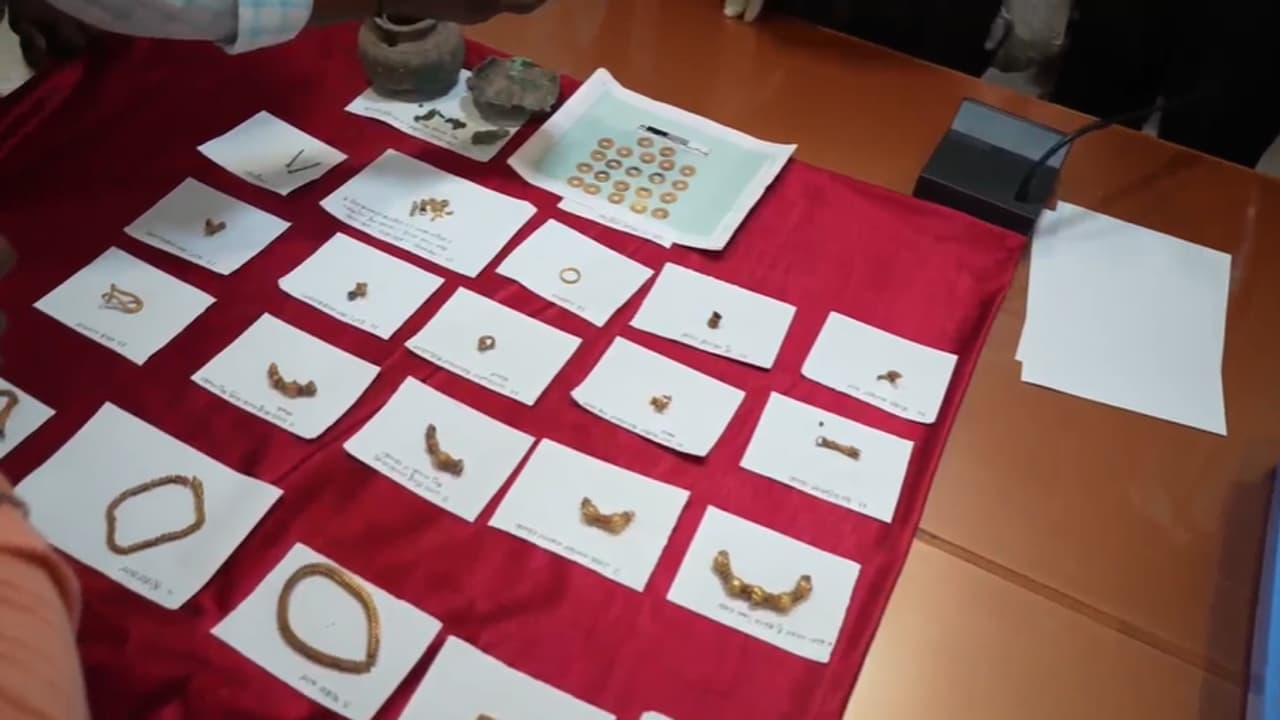
A pot of gold ornaments, estimated to be over 100 years old, was discovered in Karnataka's Lakkundi village, triggering a debate over ownership. An honest student found the treasure while digging for a house foundation. Authorities have taken custody, with the family now seeking a government-built home.
Gold ornaments, weighing around 470 grams, found in Lakkundi village, Karnataka.
Discovery made by 8th-grade student Prajwal Ritti during house foundation digging.
Archaeological officials confirmed the gold is over 100 years old, classifying it as 'treasure'.
Initial dispute over ownership, now family requests government housing instead of gold.
Karnataka government considering one-fifth compensation for the family for their honesty.
Lakkundi is a historic village with significant Chalukya-era heritage, adding to the find's context.
A significant archaeological discovery has recently captivated India, as a cache of gold ornaments was unearthed in Lakkundi village, Gadag district, Karnataka. The find, consisting of approximately 466-470 grams of gold jewelry in a copper pot, was made by an 8th-grade student, Prajwal Ritti, while excavating for a house foundation on January 10, 2026. The estimated monetary value of the gold is between ₹60-70 lakh.
Initially, there was a public and official discussion regarding the age and classification of the ornaments. While the WION headline suggests a 900-year-old origin, this remains an unconfirmed speculation. Archaeological officials have clarified that while Lakkundi boasts a rich history dating back to the 11th and 12th centuries, the specific ornaments are confirmed to be 'over 100 years old'. According to the Karnataka Department of Archaeology, Museum and Heritage, any artifact exceeding 100 years in age is legally classified as an antique or 'treasure'.
The discovery led to a 'fuss over who owns it,' as highlighted by WION. Initially, some Archaeological Survey of India (ASI) officials suggested the ornaments might be ancestral household jewelry, prompting the Ritti family to express a desire for its return. However, state archaeological authorities subsequently declared the find a government 'treasure.' Influenced by local sentiment that taking treasure could bring misfortune, the family has since relinquished their claim, instead appealing to the government for an alternative house or compensation. The Karnataka government is now considering rewarding the family with a compensation equivalent to one-fifth of the treasure's value for their honesty. The entire collection has been secured in the government treasury, and further studies are underway to determine its precise historical period.
Read the full story on Quick Digest