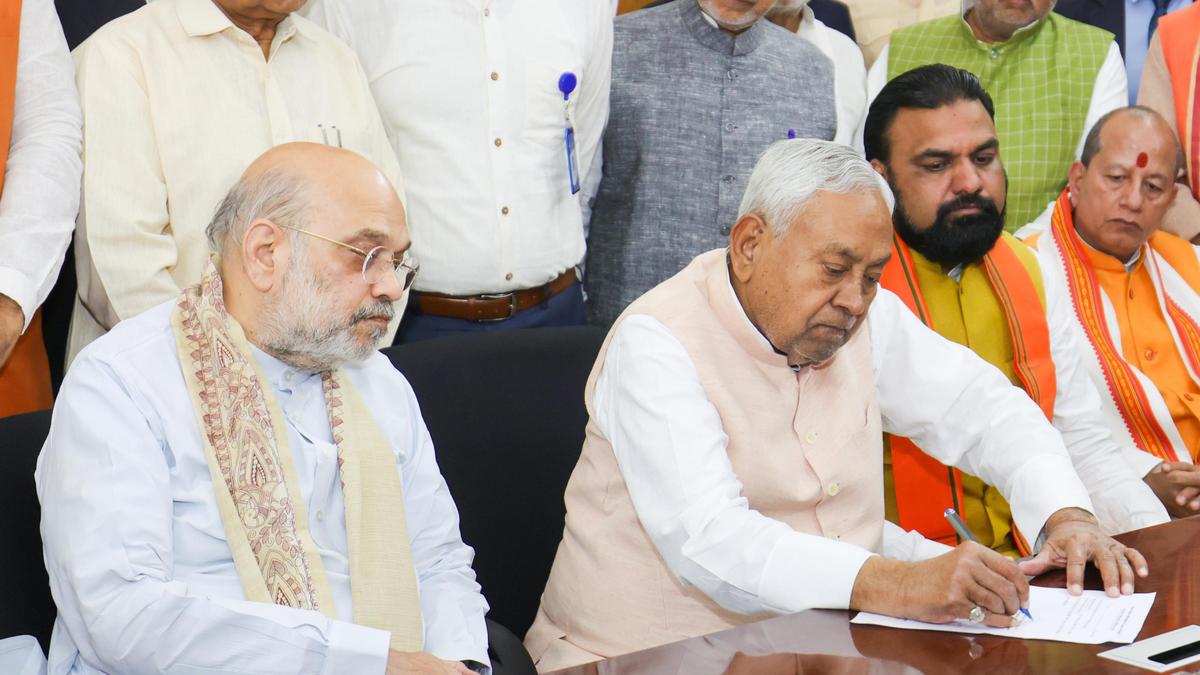
Nitish Kumar Ends Two-Decade CM Era, Eyes Rajya Sabha Role
Nitish Kumar has resigned as Bihar's Chief Minister, concluding a remarkable two-decade tenure marked by frequent political realignments and 10 terms in office. His decision to move to the Rajya Sabha signals a significant shift in Bihar's political landscape, potentially paving the way for the state's first BJP Chief Minister. Kumar's legacy includes an emphasis on good governance and social welfare policies.
Key Highlights
- Nitish Kumar resigned as Bihar Chief Minister to contest Rajya Sabha polls.
- He concludes a significant two-decade political career as state's CM.
- Kumar served 10 terms as Chief Minister, known for political agility.
- His move potentially opens door for Bihar's first BJP Chief Minister.
- Legacy includes 'sushasan' (good governance) and liquor prohibition.
- This marks a major political shift ahead of upcoming national elections.
Nitish Kumar, a towering figure in Bihar politics, formally announced his decision to step down as the state's Chief Minister on March 5, 2026, by filing his nomination papers for the Rajya Sabha elections. This move marks the end of his remarkable journey as the Chief Minister of Bihar, a tenure that has spanned approximately two decades across multiple terms. Kumar, who has earned the moniker of Bihar's longest-serving Chief Minister, has held the top post for an impressive 10 terms, showcasing his unique political resilience and strategic acumen.
The NDTV article, published on March 6, 2026, accurately captures the essence of this significant political development, highlighting Kumar's 'Did It My Way' approach and his role in 'reshaping Bihar Politics' over '20 Years'. While his Chief Ministerial tenure was not a continuous 20 years, his influence and various stints at the helm have indeed extended over two decades, starting from his brief first term in 2000. His total time as CM, as of February 2025, was cited as 18 years and 90 days across multiple terms, with his March 5, 2026, filing for Rajya Sabha being described as 'ending his twenty-year term'.
Kumar's political career has been characterized by frequent shifts in alliances, earning him the nickname 'Paltu Kumar' (turncoat Kumar) among critics. He has notably allied with both the Bharatiya Janata Party (BJP) and the Rashtriya Janata Dal (RJD)-led Mahagathbandhan (Grand Alliance) multiple times. His most recent shift saw him lead the National Democratic Alliance (NDA) to a landslide victory in the December 2025 Bihar Assembly elections, after which he was sworn in as Chief Minister for the tenth time on November 20, 2025. Prior to this, he had resigned from the Mahagathbandhan on January 28, 2024, to rejoin the BJP-led NDA. Earlier, in August 2022, he had broken ties with the BJP to form a government with the Mahagathbandhan. These tactical realignments have consistently allowed him to remain a central figure in Bihar's power dynamics.
His decision to transition to the Rajya Sabha, the upper house of India's Parliament, signifies a pivotal moment for Bihar. It potentially paves the way for the state to have its first Chief Minister from the Bharatiya Janata Party, a long-standing ambition for the saffron party in Bihar. This move comes at a crucial juncture, with the upcoming general elections in India, and Nitish Kumar's presence in the national political arena could have implications for the NDA's strategy.
Kumar's legacy as Chief Minister is multifaceted. He is widely credited for bringing 'sushasan' (good governance) to Bihar, focusing on infrastructure development, education reforms, and improved law and order. His administration also implemented the controversial statewide alcohol prohibition policy ('nishedh'), which remains a significant aspect of his social agenda. Furthermore, he successfully implemented social engineering policies, creating sub-quotas for 'Ati Pichhda' and 'Mahadalits', which solidified his support base. Despite recent criticisms, including an unfortunate incident in December 2025 involving his conduct, and questions about his health, he has departed the Chief Minister's office on his own terms.
The departure of a leader who has shaped Bihar's political narrative for over two decades marks a new chapter for the state. His move to the Rajya Sabha, confirmed by multiple credible sources including The Hindu, Siasat.com, and News24, indicates a strategic shift from state-level executive leadership to a more national legislative role. The political ramifications of this transition are expected to be significant, as Bihar navigates a new era without Nitish Kumar at the helm of the state government.
Overall, the NDTV headline is accurate and reflects the factual events. The claim of '20 Years' is supported by his cumulative tenure and extensive influence over two decades. The article is corroborated by numerous credible Indian news sources.
Frequently Asked Questions
Why did Nitish Kumar resign as Bihar's Chief Minister?
Nitish Kumar resigned as Bihar's Chief Minister to contest the Rajya Sabha elections. This move signals a transition from state-level executive politics to a national legislative role in the Indian Parliament.
How long has Nitish Kumar been involved in Bihar politics as Chief Minister?
Nitish Kumar has been a dominant force in Bihar politics for over two decades, serving as Chief Minister for a total of 10 terms. While not continuous, his cumulative tenure and significant influence span approximately 20 years.
What are the immediate political implications of Nitish Kumar's resignation?
His resignation is expected to lead to the formation of a new government in Bihar, potentially with a Chief Minister from the BJP, marking a significant shift in the state's political landscape. It also places him in a national role ahead of the upcoming general elections.
What is Nitish Kumar's political legacy in Bihar?
Nitish Kumar is credited with implementing 'sushasan' (good governance) initiatives, including improvements in law and order and infrastructure. He also introduced a controversial statewide liquor prohibition and successfully implemented social engineering policies.