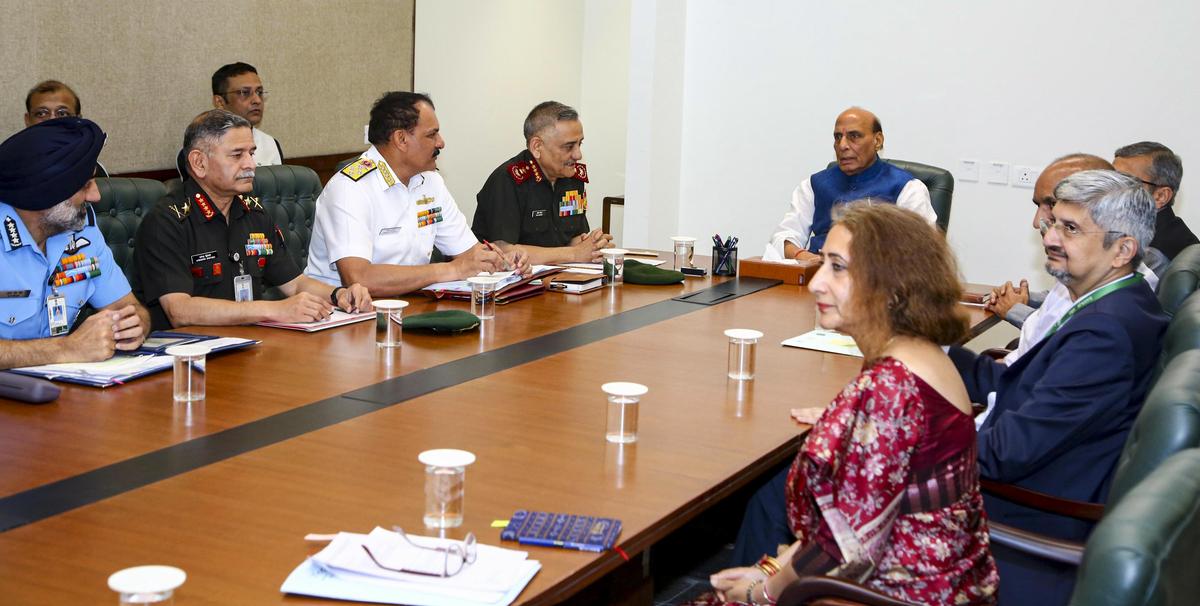
PM Modi Reviews West Asia Conflict Impact, Forms Ministerial Team
Prime Minister Narendra Modi chaired a high-level Cabinet Committee on Security (CCS) meeting to address the escalating West Asia conflict's impact on India. The government plans comprehensive measures across sectors and has formed a dedicated team of ministers and secretaries to mitigate economic and supply chain disruptions.
Key Highlights
- PM Modi chaired a CCS meeting to assess the West Asia conflict's impact on India.
- A dedicated team of ministers and secretaries has been formed to implement a 'whole-of-government' approach.
- Discussions focused on safeguarding citizens, food, energy, and fuel security.
- Measures include diversifying import sources and developing new export markets.
- The conflict poses significant risks to India's economy, including FPI outflows and rising inflation.
- PM emphasized coordination with states to prevent black marketing and hoarding of essential commodities.
Prime Minister Narendra Modi recently chaired a crucial meeting of the Cabinet Committee on Security (CCS) to thoroughly review the evolving global situation stemming from the ongoing conflict in West Asia and its potential ramifications for India. During the high-level meeting, which took place on Sunday, March 22, 2026, the Prime Minister assessed various mitigating measures already undertaken and those planned across critical sectors. A significant outcome of the meeting was the directive to establish a dedicated team comprising ministers and secretaries to implement a 'whole-of-government' approach in addressing the multifaceted impact of the conflict.
The meeting saw the attendance of key cabinet members, including Defence Minister Rajnath Singh, Home Minister Amit Shah, Finance Minister Nirmala Sitharaman, and External Affairs Minister S. Jaishankar, underscoring the gravity with which the Indian government views the crisis. The Cabinet Secretary presented a detailed overview of the global scenario and the steps initiated by various ministries and departments of the Government of India. The discussions spanned a wide array of sectors, including agriculture, fertilizers, food security, petroleum, power, Micro, Small & Medium Enterprises (MSMEs), exporters, shipping, trade, finance, and supply chains, with an aim to identify and address all affected areas.
The 'West Asia conflict' primarily refers to the escalating tensions and warfare involving the US, Israel, and Iran, which has led to significant regional instability and global disruptions. A critical concern highlighted in various reports is the effective closure or severe disruption of the Strait of Hormuz, a vital shipping lane through which a substantial portion of the world's oil supply transits. This geopolitical flashpoint has profound implications for global energy markets, trade routes, and economic stability, directly impacting India due to its heavy reliance on energy imports and extensive trade ties with the region.
For India, the conflict has presented significant economic challenges. Reports indicate a notable selling spree by foreign portfolio investors (FPIs) in equity markets, with substantial net outflows recorded in March 2026, contributing to concerns about capital flight and investment stress. The Indian rupee has also shown signs of depreciation, breaching the 93-per-dollar mark, which could further exacerbate imported inflation risks. The country's current account deficit (CAD) is projected to widen if crude prices remain elevated, adding pressure on macroeconomic balances.
Beyond financial markets, the conflict's ripple effects are evident across India's real economy. The manufacturing sector has experienced a slump, with the Purchasing Managers' Index (PMI) dropping to a four-and-a-half-year low, primarily due to heightened uncertainty, volatile market conditions, and disruptions like gas shortages caused by the Strait of Hormuz blockade. Similarly, the services sector has also shown signs of slowing. Sectors such as fertilizers, metals, logistics, aviation, and construction face margin compression due to higher input costs and supply chain disruptions, potentially leading to significant revenue losses for listed companies. The rising seaborne costs have also impacted India's coal imports, contributing to increased domestic output and global thermal coal prices.
During the CCS meeting, a detailed assessment was made regarding the availability of critical needs for the common person, including food, energy, and fuel security. Short-term, medium-term, and long-term strategies were discussed to ensure the continuous availability of these essential commodities. This included exploring alternative sources for fertilizers for the upcoming Kharif season and diversifying import sources for key industrial inputs like chemicals, pharmaceuticals, and petrochemicals. Efforts to identify and develop new export destinations were also emphasized to promote Indian goods globally and mitigate external shocks.
Prime Minister Modi underscored the importance of safeguarding citizens from the conflict's impact, instructing all government agencies to work collaboratively to minimize inconvenience to the public. He also called for proper coordination with state governments to prevent black-marketing and hoarding of essential commodities, a crucial step to ensure market stability and public welfare during challenging times. The Prime Minister had earlier warned in Parliament that the difficult global conditions caused by the West Asia conflict are likely to persist for a long time and urged the nation to remain prepared and united.
The government's proactive stance is evident through these high-level reviews and the subsequent formation of dedicated groups to manage the fallout. India, starting from a position of relative strength due to robust economic fundamentals and foreign exchange buffers, has taken swift measures to cushion the early impact. The Union government is also holding an all-party meeting to discuss the escalating crisis, aiming to forge a common political response and address concerns about Indian nationals in Gulf nations. This comprehensive and coordinated approach reflects India's commitment to navigating the complexities of the West Asia conflict while prioritizing national interests and citizen welfare.
Frequently Asked Questions
What was the primary purpose of Prime Minister Modi's Cabinet Committee on Security meeting?
The primary purpose was to review the escalating West Asia conflict's impact on India and to discuss and formulate mitigating measures across various sectors to safeguard India's economy and its citizens.
What are the main economic impacts of the West Asia conflict on India?
The conflict has led to significant foreign portfolio investor (FPI) outflows, rupee depreciation, rising oil and gas prices, potential widening of the current account deficit, and disruptions in supply chains affecting various sectors like manufacturing, fertilizers, and trade.
Which key ministers attended the CCS meeting?
Defence Minister Rajnath Singh, Home Minister Amit Shah, Finance Minister Nirmala Sitharaman, and External Affairs Minister S. Jaishankar were among the key ministers present at the meeting.
What measures is the Indian government taking to mitigate the conflict's impact?
The government is adopting a 'whole-of-government' approach, forming a dedicated team of ministers and secretaries, focusing on ensuring food, energy, and fuel security, diversifying import sources, developing new export destinations, and coordinating with states to prevent black marketing and hoarding.
How is the West Asia conflict affecting Indian citizens, particularly the diaspora?
The conflict raises concerns for the large Indian diaspora in the Gulf region, with potential risks to employment, remittances, and the need for safeguarding measures. The PM stressed the importance of ensuring the least inconvenience to citizens.