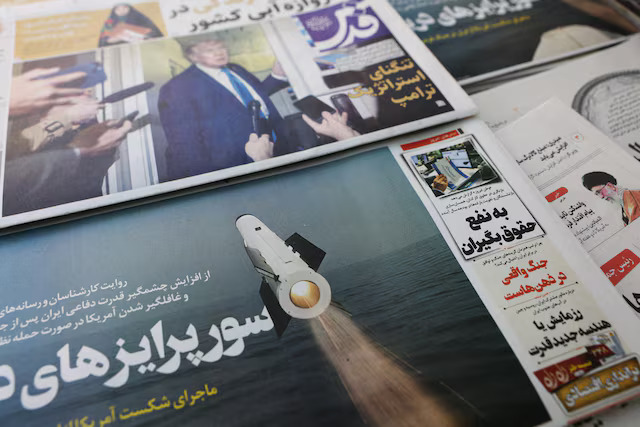
Iran Nears Deal for Chinese Supersonic Anti-Ship Missiles
Iran is reportedly close to finalizing a deal with China to purchase advanced CM-302 supersonic anti-ship missiles. These missiles, capable of flying low and fast with a range of approximately 290 km, would significantly enhance Iran's offensive capabilities and pose a considerable threat to naval operations in the region, particularly to U.S. naval forces. The negotiations, which have been ongoing for at least two years, have gained momentum amidst escalating regional tensions and the U.S. deployment of naval assets near Iran.
Key Highlights
- Iran in final stages of acquiring Chinese CM-302 supersonic missiles.
- Missiles pose a significant threat to naval forces in the region.
- Deal accelerates amid heightened US-Iran tensions and naval deployment.
- Negotiations ongoing for at least two years, gaining recent momentum.
- Potential violation of UN arms embargo raises international concerns.
Multiple sources indicate that Iran is on the verge of a significant arms deal with China, potentially acquiring advanced CM-302 supersonic anti-ship missiles. This development, reported by Reuters and corroborated by various international news outlets, signals a substantial boost to Iran's military capabilities and a potential shift in the regional strategic balance. The CM-302 missiles are characterized by their supersonic speed and a range of approximately 290 kilometers, making them adept at evading naval defenses through low-altitude, high-speed flight [3, 4, 11].
The negotiations for these missiles have reportedly been underway for at least two years, with a notable acceleration occurring after a conflict between Israel and Iran in June [9, 11, 13]. This intensified pace of talks coincides with a period of heightened geopolitical tension in the Middle East, marked by the United States' significant deployment of naval forces, including the aircraft carriers USS Abraham Lincoln and USS Gerald R. Ford, to the region [3, 10, 39]. The proximity of these U.S. naval assets to Iran underscores the strategic implications of the potential missile deal.
Weapons experts cited by Reuters suggest that the acquisition of the CM-302 missiles would be a 'complete gamechanger,' significantly enhancing Iran's ability to strike naval targets and posing a direct threat to U.S. naval operations [4, 7, 11, 32]. The missiles are marketed by China's state-owned China Aerospace Science and Industry Corporation (CASIC) as capable of destroying large naval vessels, including aircraft carriers [27].
The potential arms sale also raises concerns regarding international arms embargoes. If finalized, the deal would represent a significant transfer of advanced military technology to Iran, potentially violating a United Nations arms embargo first imposed in 2006 and reimposed in September 2025 [3, 27]. Historically, China was a major arms supplier to Iran in the 1980s, but transfers decreased significantly in the late 1990s due to international pressure [3, 10]. While U.S. officials have previously alleged that Chinese companies provided missile materials to Iran, direct accusations of supplying complete missile systems have been rare until now [3, 10].
Beyond the CM-302 missiles, reports suggest Iran is also in discussions with China for other advanced weaponry, including surface-to-air missile systems, anti-ballistic weapons, and anti-satellite technology [3, 10]. This broadening of military cooperation highlights a strengthening relationship between China and Iran amidst rising rivalry with the U.S. [3].
Analysts interpret China's actions in this context as a strategic move to prevent the emergence of a pro-Western government in Iran, which could threaten its regional interests [3]. The situation is further complicated by the ongoing U.S. efforts to curb Iran's missile and nuclear programs [10]. The news of this potential deal comes as Iran's military capacity has been reportedly weakened by past conflicts, making the acquisition of advanced weaponry crucial for its defense [3].
Chinese officials have not directly confirmed the deal, with Beijing's foreign ministry stating it was unaware of any missile sale talks, while the U.S. White House has also declined to comment directly on the negotiations [4, 7, 10]. However, an Iranian foreign ministry official indicated that Iran has military agreements with its allies and that 'now is an appropriate time to make use of these agreements' [4, 9, 11, 27, 32]. This statement suggests a willingness from Iran to leverage existing partnerships during a period of heightened regional tensions.
The credibility of the reporting is bolstered by the consistent nature of the information across multiple reputable news organizations, primarily stemming from a Reuters report that cited six sources familiar with the negotiations. Reuters itself is a highly credible and reliable news agency with a strong track record for factual reporting [5, 8, 20, 21, 26]. Other news outlets that have reported on this story, such as The Times of India, News18, Oneindia, and WION, are also prominent in their respective regions, although their individual credibility scores and biases vary, with Reuters being consistently rated as highly reliable and least biased. The Times of India, while a widely read publication in India, has faced criticism regarding sensationalism and bias, though it was also ranked as a trusted news brand in India by a Reuters survey [6, 12, 16, 22]. News18 and WION have mixed credibility ratings, with News18 being rated as right-center biased and questionable, and WION as least biased but with mixed factual reporting [14, 15, 17, 24, 25, 33, 36].
Frequently Asked Questions
What are the CM-302 missiles?
The CM-302 missiles are Chinese-made supersonic anti-ship cruise missiles. They are designed to fly at high speeds and low altitudes to evade naval defenses and have a reported range of approximately 290 kilometers.
Why is this potential deal between Iran and China significant?
This deal is significant because it could significantly enhance Iran's offensive military capabilities, particularly its ability to threaten naval forces in the region. It also represents a strengthening of military ties between China and Iran, potentially challenging the U.S. influence in the Middle East and violating UN arms embargoes.
What is the current geopolitical context surrounding this deal?
The reported deal is occurring amidst heightened tensions between Iran and the United States, with the U.S. deploying a significant naval force near Iran. This also occurs within a broader context of rivalry between the U.S. and a coalition of China and Russia.