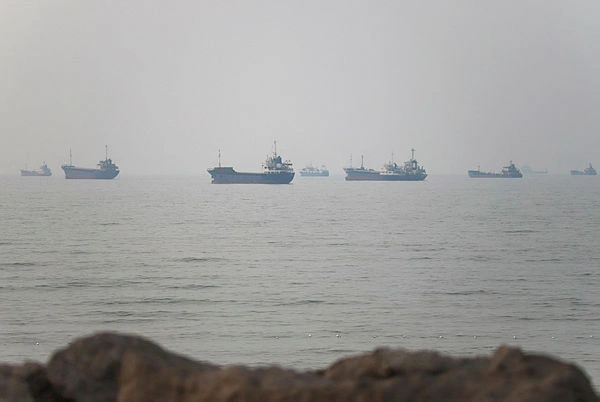
US, Iran Trade Strikes Amid Collapsed Ceasefire in West Asia
Intense hostilities have resumed between the United States and Iran in West Asia, with both nations engaging in direct military strikes following the collapse of a fragile ceasefire. The conflict has severely impacted shipping in the critical Strait of Hormuz, causing global energy concerns and civilian casualties, including an Indian sailor. Diplomatic efforts have failed to de-escalate the escalating war.
Key Highlights
- US and Iran exchange direct military strikes in West Asia.
- Fragile ceasefire officially ended on July 8, 2026.
- Strait of Hormuz shipping severely disrupted by attacks.
- Iranian attacks target commercial vessels, drawing US retaliation.
- Global energy prices surge due to Strait of Hormuz crisis.
- Indian sailor killed in recent Strait of Hormuz vessel attack.
A fierce escalation of hostilities between the United States and Iran has plunged West Asia into renewed conflict, with both nations engaged in direct military strikes. The situation has intensified following the complete breakdown of a previously negotiated ceasefire and a subsequent memorandum of understanding. The original news article, published by The Hindu on June 27, 2026, accurately captured the 'LIVE' and unfolding nature of this major regional crisis, a truth that remains pertinent as of mid-July 2026.
The roots of the current conflagration trace back to the broader '2026 Iran war,' which commenced on February 28, 2026, following years of escalating tensions over Iran's nuclear program, ballistic missile development, and regional influence. This period was marked by unsuccessful negotiations aimed at reviving a nuclear deal and was preceded by the 'Twelve-Day War' in June 2025, where Israel, supported by the United States, struck Iranian nuclear and military facilities. These earlier conflicts left Iran's economy weakened by sanctions and fueled widespread domestic protests.
Amidst the initial phase of the 2026 conflict, a two-week ceasefire, brokered by Pakistan, was agreed upon by the United States and Iran on April 8, 2026. This temporary truce offered a brief respite, with hopes for a more lasting peace. President Donald Trump later extended this ceasefire indefinitely on April 21, 2026. However, the agreement proved fragile, repeatedly violated by both sides through low-intensity fighting. A more comprehensive 'memorandum of understanding' (MoU) was signed on June 17, 2026, aiming to formally end the war and reopen the crucial Strait of Hormuz. Despite these diplomatic efforts, President Trump officially announced the end of the ceasefire on July 8, 2026, citing continuous violations by Iran.
The month of July 2026 witnessed a rapid and dangerous acceleration of the conflict. On July 6-7, Iran reportedly attacked three commercial vessels, testing the limits of the fragile MoU. This was followed by a decisive breakdown of the interim truce on July 8, after Iran struck multiple commercial ships in the Strait of Hormuz. The US responded on July 12 with a new round of strikes against Iranian targets near the Strait of Hormuz, provoked by an Iranian Revolutionary Guard Corps (IRGC) missile attack that severely damaged a commercial cargo ship. Iran retaliated swiftly, launching drones and missiles at US military targets and allies in Qatar, the United Arab Emirates, and Jordan.
The maritime arena, particularly the Strait of Hormuz, became a focal point of intense confrontation. On July 13, a container ship identified as the GFS Galaxy was targeted by Iran while transiting the Strait. The vessel was set ablaze, forcing the crew to abandon ship. Tragically, an Indian marine engineer, Herambh Karmarkar from Pune, was among the casualties, killed in this attack. His family confirmed his death, stating he had messaged his wife that the vessel had safely crossed the Strait just before the incident. The United Nations maritime agency, IMO, condemned these deadly overnight attacks on shipping, reporting fresh strikes and emphasizing the severe risks to seafarers and global navigation.
In response to Iran's actions, the United States intensified its military operations. On July 15, the U.S. conducted a new wave of strikes targeting Iran's coastal defense systems and cruise missile storage and launch sites. Concurrently, the US reimposed a naval blockade of Iranian ports. President Trump further escalated rhetoric, warning on the same day that the US would expand military strikes to Iranian power plants and bridges if Tehran did not return to negotiations. Iran's IRGC, in turn, claimed to have struck US military targets in Bahrain, Kuwait, and Jordan, and threatened to shut off additional regional energy export routes. As of July 16, 2026, US military strikes continued, aimed at degrading Iranian defenses and compelling the reopening of the Strait of Hormuz.
The Strait of Hormuz, a critical maritime choke point through which a significant portion of the world's seaborne oil and liquefied natural gas passes, has been largely blocked by Iran since February 28, 2026. Iran's objective appears to be to assert hegemonic control over the strait and potentially levy fees on passing ships, a move that has drawn strong international condemnation and US military responses. The disruption has led to a global fuel crisis, with surging Brent crude and natural gas prices, severely impacting the global economy. The humanitarian consequences are also significant, with the IMO reporting over 20,000 seafarers at risk and having paused evacuation efforts after renewed attacks. The conflict's expansion to include drone and missile attacks on neighboring Gulf states further underscores the widespread instability gripping West Asia, with Bahrain's military accusing Iran of targeting civilians. The continuous cycle of escalation, marked by direct military engagements and the failure of diplomatic solutions, positions the region at a critical juncture with profound global implications, especially for countries like India reliant on West Asian energy supplies and maritime trade routes.
Frequently Asked Questions
What is the current status of the ceasefire between the US and Iran?
The ceasefire between the US and Iran, initially agreed upon in April 2026 and extended, officially ended on July 8, 2026. A subsequent Memorandum of Understanding signed in June 2026 also appears to have collapsed, leading to a significant resumption of military strikes by both sides.
How has the conflict impacted the Strait of Hormuz?
The Strait of Hormuz has become a major flashpoint. Iran has largely blocked shipping traffic since February 28, 2026, and has repeatedly attacked commercial vessels, leading to a global fuel crisis and surging energy prices. The US has responded by reimposing a naval blockade and conducting strikes to force the reopening of the Strait.
What are the recent examples of US-Iran military exchanges?
Recent exchanges include US strikes on Iranian targets near the Strait of Hormuz on July 12, following an IRGC missile attack on a cargo ship. Iran retaliated by striking Qatar, UAE, and Jordan. Further US strikes targeted Iranian coastal defense systems on July 15, while Iran claimed to hit US military targets in Bahrain, Kuwait, and Jordan.
Are there any civilian casualties, and has India been affected?
Yes, there have been civilian casualties reported. Tragically, an Indian marine engineer, Herambh Karmarkar, was killed on July 13, 2026, when the container ship GFS Galaxy was attacked in the Strait of Hormuz. The UN has also condemned deadly attacks on shipping that killed at least two seafarers.
What are the broader implications of this conflict for West Asia and the global economy?
The conflict has led to widespread instability in West Asia, with regional allies of the US experiencing Iranian drone and missile attacks. Globally, the disruption of shipping through the Strait of Hormuz, a vital energy chokepoint, has caused significant spikes in oil and natural gas prices, threatening global economic stability and energy security.