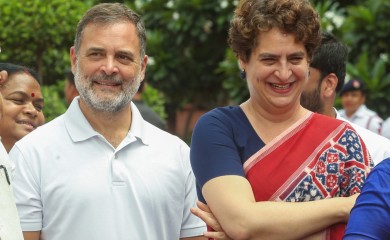
Rijiju-Gandhi Spar Over Women's Quota Bill Implementation
Union Minister Kiren Rijiju questioned Rahul Gandhi's 'change of heart' on women's empowerment, challenging him to support the Women's Reservation Bill unconditionally. Gandhi retorted, demanding immediate implementation of the already passed 2023 law, delinked from delimitation, sparking a significant political debate.
Key Highlights
- Rijiju linked Rahul Gandhi's 'women power' video to Women's Quota Bill support.
- Gandhi called for women's free expression, crucial for India's progress.
- Gandhi countered, highlighting the Bill's 2023 passage and implementation delay.
- The core dispute is the Bill's implementation being tied to delimitation.
- Women's Reservation Bill (2023) reserves 33% seats for women in legislatures.
- Implementation is pending post-2026 census and delimitation exercise.
Union Parliamentary Affairs Minister Kiren Rijiju recently took a swipe at Leader of Opposition Rahul Gandhi, suggesting a 'change of heart' following a video Gandhi posted about women's empowerment. On Saturday, August 8, 2026, Rijiju responded to Gandhi's social media video, which emphasized the critical role of women's freedom of expression for India's development. In his video, posted on Friday, August 7, 2026, Rahul Gandhi argued that the 'energy of India's women is trapped' and that the country cannot be successful if its women are not allowed to express themselves freely and imagine their futures. He stressed the necessity of a 'certain amount of freedom from this patriarchy, from the rigid control that India's men impose on their women' for India to truly develop. Gandhi had earlier stated that 'India's women are our strength, our biggest asset' during an 'Ask Me Anything' session, expressing concern about how women are treated in various systems.
Seizing on these remarks, Kiren Rijiju posted on X (formerly Twitter), calling Gandhi's message a 'positive message from the Congress Party' and noting a 'visible change of heart in Shri Rahul Gandhi Ji about the Women'. He then challenged the Congress party to 'support the Women's Reservation Bill unconditionally'. This challenge reignited a long-standing political debate surrounding the implementation of the Women's Reservation Bill, officially known as the Nari Shakti Vandan Adhiniyam, 2023.
Rahul Gandhi quickly countered Rijiju, asserting that the Women's Reservation Bill, 2023, had already been passed unanimously by both Houses of Parliament with the full support of the Congress party in September 2023. He questioned why, despite its passage, the law had not been implemented for three years and why the government was 'unnecessarily linking' its implementation to the delimitation exercise. Gandhi demanded that the 2023 law be implemented 'without any conditions'. Other Congress leaders also weighed in, accusing the Centre of creating the very delay Rijiju was citing.
The Women's Reservation Bill (The Constitution (One Hundred and Sixth Amendment) Act, 2023) aims to reserve 33% of seats for women in the Lok Sabha (the lower house of Parliament) and all state legislative assemblies. While it received presidential assent on September 28, 2023, and a gazette notification brought it into force on April 16, 2026, its practical implementation is constitutionally linked to the first census taken after that date and a subsequent delimitation exercise. The government's stance, articulated by Rijiju, is that the quota can only take effect post-delimitation, which would be based on census figures published after 2026. This timeline implies that the reservation might not be implemented until the 2029 or even 2034 general elections.
The opposition, including the Congress, has consistently supported the Women's Reservation Bill in principle but strongly opposes the condition of linking its implementation to delimitation. They argue for immediate implementation, delinked from the delimitation exercise, which they see as a tactic to delay the constitutional amendment. The defeat of the Constitution (131st Amendment) Bill, 2026, which sought to increase Lok Sabha seats and permit delimitation using the 2011 census, further complicates the immediate implementation. This ongoing political exchange underscores the differing views between the ruling party and the opposition regarding the timeline and conditions for a landmark legislation aimed at enhancing women's political representation in India.
Frequently Asked Questions
What is the core dispute between Kiren Rijiju and Rahul Gandhi regarding women's reservation?
The core dispute revolves around the implementation of the Women's Reservation Bill. While the Bill was passed in 2023, the government, through Kiren Rijiju, insists its implementation is linked to the post-2026 census and subsequent delimitation process. Rahul Gandhi and the opposition demand immediate, unconditional implementation, arguing against linking it to delimitation.
What is the Women's Reservation Bill, 2023 (Nari Shakti Vandan Adhiniyam)?
The Women's Reservation Bill, 2023, also known as the Nari Shakti Vandan Adhiniyam, is a constitutional amendment (106th Amendment) that aims to reserve 33% of seats for women in the Lok Sabha (Indian Parliament's lower house) and all state legislative assemblies.
When was the Women's Reservation Bill passed and why is it not implemented yet?
The Women's Reservation Bill was passed by both houses of Parliament in September 2023 and received presidential assent. However, its implementation is constitutionally tied to a delimitation exercise based on census figures published after 2026, meaning it cannot take effect immediately and faces potential delays until future elections.
What was Rahul Gandhi's 'women power' video about?
Rahul Gandhi's 'women power' video emphasized that India's development is incomplete without the full expression and participation of its women. He highlighted that the 'energy of India's women is trapped' and called for greater freedom from patriarchal controls to allow women to express themselves in all spheres of life.
What is 'delimitation' in the context of the Women's Reservation Bill?
Delimitation refers to the process of redrawing boundaries of parliamentary or assembly constituencies to ensure that each constituency has roughly the same population. The Women's Reservation Bill's implementation is currently linked to this exercise, which is to be undertaken based on census figures published after 2026, creating a significant delay in its actualization.