Macron's 'Make in India' Rafale Push Lifts Defence Stocks
French President Emmanuel Macron's statements on India co-producing Rafale jets significantly boosted Indian defence stocks, with Data Patterns and Bharat Dynamics (BDL) seeing notable gains. This development reinforces the growing India-France strategic defence partnership and India's 'Make in India' initiative.
Key Highlights
- French President Macron visited India, emphasizing defence cooperation.
- Macron confirmed plans for India to co-produce Rafale fighter jets.
- Defence Acquisition Council cleared proposal for 114 new Rafale jets.
- Indian defence stocks, including Data Patterns and BDL, rallied up to 6.37%.
- Deal highlights 'Make in India' initiative and stronger bilateral ties.
- Future defence deals, including submarines, are also under discussion.
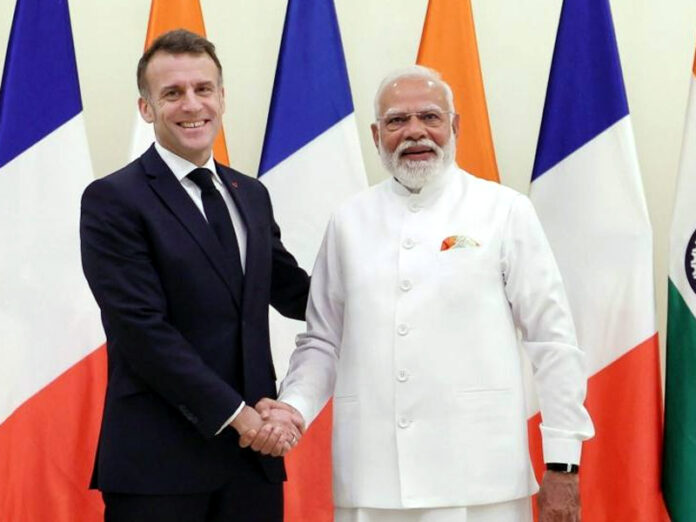
French President Emmanuel Macron's recent visit to India, from February 17 to February 20, 2026, significantly bolstered the defence ties between the two nations, sparking a notable rally in Indian defence sector stocks. A key highlight of his visit was the reaffirmation of plans for India to domestically manufacture Rafale fighter jets, a move that sent positive signals across the Indian stock market. Moneycontrol reported that defence stocks like Data Patterns and Bharat Dynamics Limited (BDL) rose by up to 5.5% following Macron's remarks [10, 16].
During his visit, President Macron underscored France's commitment to expanding its defence partnership with India, particularly through the co-production of Rafale fighter jets and helicopters. He stated that India had confirmed its willingness to order a new batch of 114 Rafales, with a significant portion intended for co-production within India under the 'Make in India' initiative [4, 5, 6, 7]. This initiative aims to boost indigenous manufacturing and reduce reliance on foreign imports for critical defence equipment. Indian media reports, corroborated by several news outlets, indicated that up to 90 of these 114 jets could be produced in India with a yet-to-be-identified joint venture partner [4, 7, 15]. The Defence Acquisition Council (DAC) of India's Ministry of Defence had already given initial clearance (Acceptance of Necessity – AoN) for the acquisition of these 114 Multi-Role Fighter Aircraft (MRFA) for the Indian Air Force, estimated to cost approximately Rs 3.25 lakh crore (around $35.65 billion) [4, 5, 13, 15, 20, 21]. This deal is considered a crucial step towards enhancing the IAF's air-dominance capabilities and strengthening India's deterrence with long-range offensive strikes [15].
The financial markets reacted positively to these developments. On February 20, 2026, Data Patterns (India) Ltd.'s share price notably moved up by 6.37% from its previous close, reaching ₹3,099.60 [18]. While Bharat Dynamics Limited (BDL) showed a 2.96% increase on February 18, 2026, and a 6.85% jump on January 28, 2026, indicating broader positive sentiment in the defence sector leading up to and during Macron's visit [28]. The Nifty India Defence index itself surged, with many constituent stocks trading higher on hopes of advanced discussions regarding additional Rafale fighter jets [21, 29]. This market reaction highlights investor confidence in the growth trajectory of India's defence manufacturing sector, driven by government policies like 'Make in India' and strategic international collaborations.
Macron's visit was not limited to Rafale jets alone. He expressed hope for similar cooperation in the submarine sector, noting that India operates six French Scorpene submarines and has plans to order more [4, 5, 9]. Furthermore, during his visit, Macron and Indian Prime Minister Narendra Modi jointly announced the establishment of the first H125 helicopter assembly line in India, a joint venture between Airbus and Tata Advanced Systems. They also outlined plans for the co-production of Hammer missiles in India by Safran and India's state-owned Bharat Electronics [4, 14, 20]. These announcements underscore a comprehensive deepening of defence and technological cooperation between India and France, extending beyond fighter jets to various critical military platforms.
The ongoing defence relationship between India and France has seen previous significant deals, including India's purchase of 36 Rafale jets for its air force in 2016 and an order for 26 marine versions of the jet for the navy [4, 5, 15]. The current proposed order for 114 additional jets, with a focus on local production, signifies a strategic shift towards greater self-reliance and technology transfer, aligning with India's long-term defence modernization goals. This partnership is viewed as a special global strategic partnership that transcends conventional defence ties, focusing on mutual strength, job creation, and enhanced strategic coordination between the two nations [5, 6, 9]. The positive market response reflects the anticipation of robust order backlogs and ambitious government spending in the defence sector, signaling a promising growth trajectory for India's defence industry [11, 12].
Frequently Asked Questions
What was the main announcement made by French President Emmanuel Macron during his recent India visit?
During his visit, President Macron announced plans for India to co-produce 114 additional Rafale fighter jets, with a significant portion being manufactured domestically under India's 'Make in India' initiative. [4, 5, 6]
How did the Indian stock market react to Macron's statements on Rafale manufacturing?
Indian defence stocks, including Data Patterns and Bharat Dynamics Limited (BDL), experienced a significant rally. Data Patterns saw its share price rise by 6.37% on February 20, 2026, while BDL also recorded gains. [10, 16, 18]
What is the 'Make in India' component of the new Rafale deal?
The 'Make in India' component implies that a substantial number, potentially up to 90 out of the 114 new Rafale jets, will be manufactured within India through a joint venture, promoting indigenous defence production and technology transfer. [4, 7, 15]
Besides Rafale jets, what other defence cooperation was discussed or announced?
Beyond Rafale jets, discussions included expanding cooperation in the submarine sector. Additionally, Macron and Prime Minister Modi inaugurated India's first H125 helicopter assembly line (Airbus-Tata joint venture) and planned co-production of Hammer missiles. [4, 5, 14, 20]
Why is this deal significant for India's defence capabilities?
This deal is crucial for India as it will enhance the Indian Air Force's capabilities, boost domestic defence manufacturing, and strengthen India's strategic partnership with France, reducing reliance on other foreign defence suppliers. [5, 15, 20]