Moonquakes: Unveiling Lunar Tremors and Future Mission Risks | Quick Digest
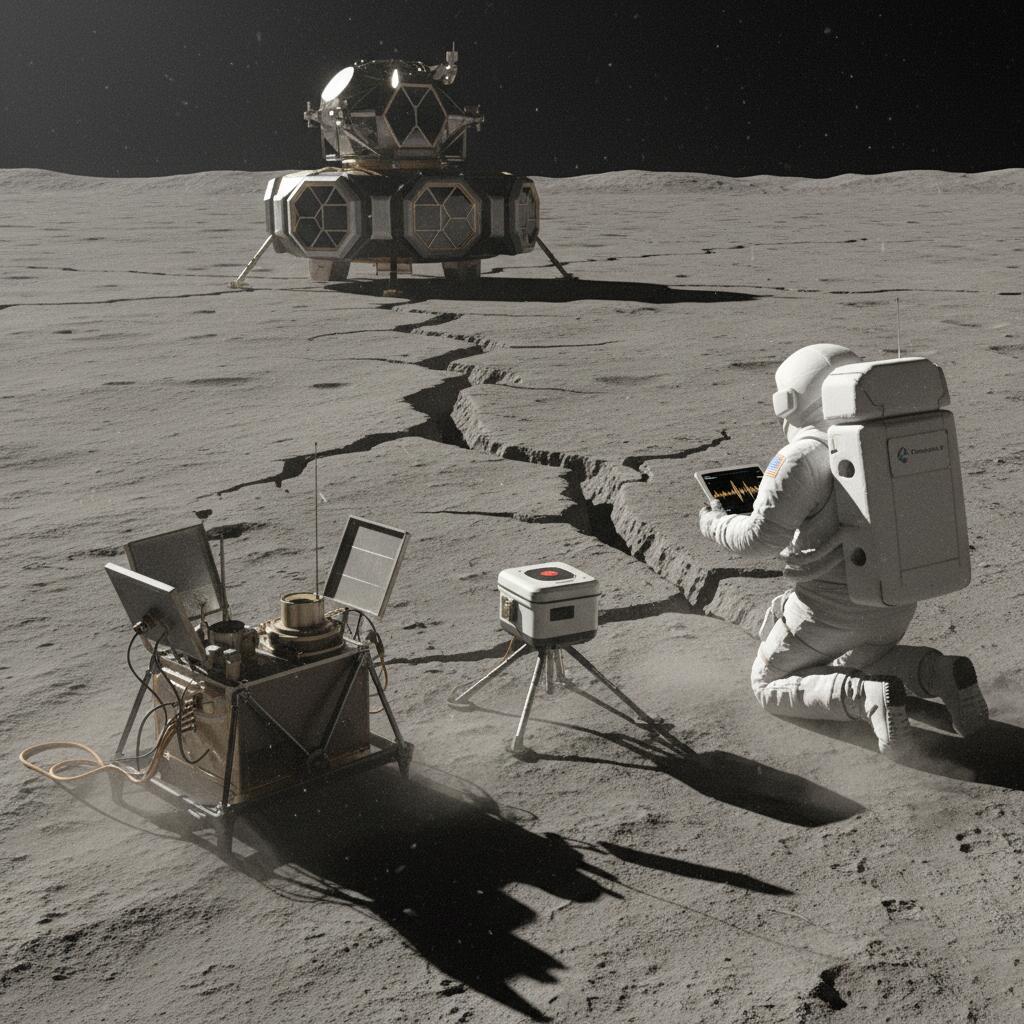
Moonquakes are seismic events on the Moon caused by tidal forces, thermal stresses, impacts, and lunar shrinking. Data from Apollo missions and recent re-analysis reveal their prevalence. While mostly mild, shallow moonquakes pose potential threats to future long-term lunar missions and infrastructure, especially near proposed landing sites.
Moonquakes are lunar seismic events, unlike Earth's earthquakes, lacking tectonic plate movement.
Four main types exist: deep, shallow, thermal, and impact-induced moonquakes.
Apollo missions first detected moonquakes, with recent re-analysis tripling known events.
Shallow moonquakes can reach magnitude 5.5 and last over ten minutes, posing risks.
These tremors threaten future lunar bases, especially long-term missions near active faults.
India's Chandrayaan-3 also detected a moonquake, highlighting global relevance.
Moonquakes are seismic tremors occurring on the Moon, fundamentally different from Earth's earthquakes as the Moon lacks active tectonic plates. Instead, they originate from several distinct mechanisms, including the gravitational pull of Earth causing deep moonquakes, the Moon's gradual cooling and shrinking leading to shallow moonquakes, impacts from meteoroids, and thermal expansion and contraction of surface rocks due to extreme temperature fluctuations between lunar day and night.
The pioneering Apollo missions between 1969 and 1977 deployed seismometers that provided the first direct evidence of lunar seismic activity. This data revealed the Moon's internal structure, including its crust, mantle, and core. Recent re-analysis of these decades-old Apollo records, utilizing modern techniques, has uncovered an additional 22,000 previously unrecognized moonquakes, nearly tripling the total number of known seismic events and indicating the Moon is more tectonically active than previously thought.
While deep and thermal moonquakes are generally mild, shallow moonquakes, occurring closer to the surface (20-30 km deep), can be more intense, reaching magnitudes up to 5.5 on the Richter scale and notably lasting for over ten minutes. This extended duration is attributed to the Moon's solid, rock-like composition, which dissipates seismic energy less effectively than Earth's chemically weathered crust.
These shallow moonquakes, often linked to thrust faults formed by the Moon's shrinking, present a significant concern for future lunar exploration. Studies indicate that such seismic activity could pose hazards to future landers, habitats, and long-term infrastructure, especially near crucial areas like the lunar South Pole, a key target for missions such as NASA's Artemis program and India's Chandrayaan missions. While short-term missions face a low risk, the cumulative probability of a damaging moonquake increases significantly for long-duration human outposts. India's Chandrayaan-3 lander also recently detected a moonquake, underscoring the global relevance of this ongoing research.
Read the full story on Quick Digest