Global Polio Vaccine Policies Under Review Amid Eradication Challenges
Global health experts are actively debating and refining polio vaccine policies, particularly those concerning international travel, as the world works towards complete eradication. These discussions are critical in addressing persistent outbreaks of vaccine-derived polioviruses and safeguarding polio-free regions, including India.
Key Highlights
- Global health bodies are debating polio vaccine policies for eradication endgame.
- International travel mandates polio vaccination for travelers from affected countries.
- Wild poliovirus type 1 is now endemic only in Afghanistan and Pakistan.
- Circulating vaccine-derived polioviruses (cVDPVs) pose significant ongoing challenges.
- India, though polio-free, maintains strict vaccination requirements for travelers.
- New vaccine strategies, including nOPV2 and IPV, are crucial to combating outbreaks.
The global fight against poliomyelitis, or polio, has entered a critical phase, prompting intense debates and revisions of vaccine policies among leading health organizations. Recent discussions by the Strategic Advisory Group of Experts (SAGE) on Immunization's Polio Working Group, held in February 2026, focused on the 'polio endgame' strategy, encompassing evolving vaccine approaches, the eventual cessation of the bivalent oral polio vaccine (bOPV), and advancements in the novel oral polio vaccine (nOPV) and inactivated polio vaccine (IPV) development and integration into routine immunization schedules.
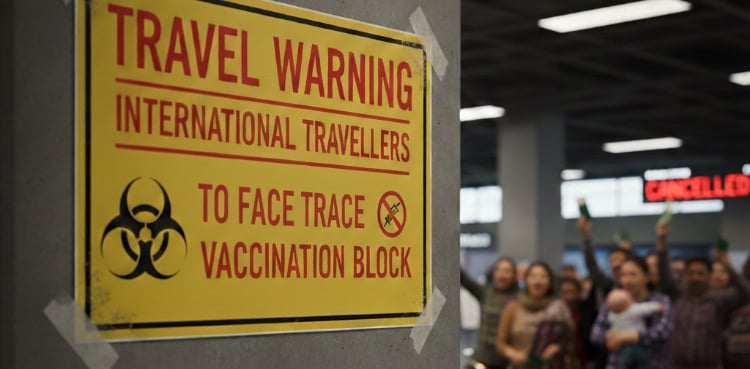
A central aspect of these policy discussions revolves around international travel, with numerous countries implementing 'Vax-Before-Travel' requirements to prevent the reintroduction and spread of the virus. Organizations like the CDC and WHO advise international travelers to ensure they are fully vaccinated against polio before departure, especially when visiting areas with an increased risk of exposure to poliovirus. Governments of countries with active poliovirus transmission may mandate proof of polio vaccination, often documented on an International Certificate of Vaccination or Prophylaxis (ICVP), for travelers departing their territory.
India, which achieved polio-free status, maintains stringent polio vaccination requirements for both inbound and outbound travelers to and from polio-infected countries. The Ministry of Health and Family Welfare, Government of India, stipulates that travelers to India should possess a polio vaccination certificate, issued by authorized health officers, after receiving an additional dose of OPV or IPV at least four weeks prior to travel. Foreign nationals residing in identified polio-infected countries are advised, though not always mandated, to receive vaccination before traveling to India. Those lacking such certificates may be required to receive oral polio vaccine (OPV) upon arrival at points of entry.
The global polio eradication effort, spearheaded by the Global Polio Eradication Initiative (GPEI) and its partners including WHO, UNICEF, and the CDC, has made remarkable progress since 1988, reducing wild poliovirus cases by over 99%. Currently, wild poliovirus type 1 (WPV1) is endemic only in Afghanistan and Pakistan. Wild poliovirus types 2 and 3 have been successfully eradicated.
However, a significant ongoing challenge is the emergence and spread of circulating vaccine-derived polioviruses (cVDPVs), particularly cVDPV2, which can arise in under-vaccinated populations when the weakened virus in oral vaccines circulates for extended periods and regains neurovirulence. During January 2023–June 2024, 74 cVDPV outbreaks were detected in 39 countries, predominantly in Africa, highlighting the persistent threat. The novel oral polio vaccine type 2 (nOPV2), designed to be more genetically stable, is proving crucial in managing these cVDPV2 outbreaks, with over 2 billion doses administered across 35 countries by late 2025.
The WHO continues to declare the international spread of poliovirus a Public Health Emergency of International Concern (PHEIC), reviewing temporary recommendations every three months. These recommendations emphasize strengthening surveillance and vaccination efforts, particularly for international travelers, to prevent the reintroduction of poliovirus into polio-free regions. The debates surrounding polio vaccine policies are therefore not questioning the efficacy of vaccination, but rather focusing on optimizing global strategies, ensuring high-quality immunization campaigns, and adapting to the evolving challenges posed by both wild and vaccine-derived polioviruses to secure a lasting polio-free world.
Frequently Asked Questions
Why are polio vaccine policies currently being debated?
Polio vaccine policies are being debated to refine global eradication strategies, particularly concerning outbreaks of vaccine-derived polioviruses, and to optimize the use of different vaccine types (oral and inactivated) as the world approaches complete eradication.
What are the current polio vaccination requirements for international travel?
Travelers, especially those visiting or departing from polio-affected countries, are often required to show proof of polio vaccination (recorded on an International Certificate of Vaccination or Prophylaxis) as part of international health regulations to prevent the spread of the virus.
How do vaccine-derived polioviruses (cVDPVs) affect eradication efforts?
cVDPVs emerge in under-vaccinated populations when the weakened virus in oral polio vaccines circulates for extended periods and mutates, regaining the ability to cause paralysis. These outbreaks pose a significant challenge to global eradication efforts.
What is India's stance on polio vaccination for international travelers?
India, despite being polio-free, mandates polio vaccination for travelers arriving from or departing to polio-infected countries. Travelers must possess a valid vaccination certificate, and those without may receive an oral polio vaccine upon arrival.
Which countries are still considered endemic for wild poliovirus?
As of recent reports, wild poliovirus type 1 (WPV1), the last remaining wild strain, is endemic only in Afghanistan and Pakistan.