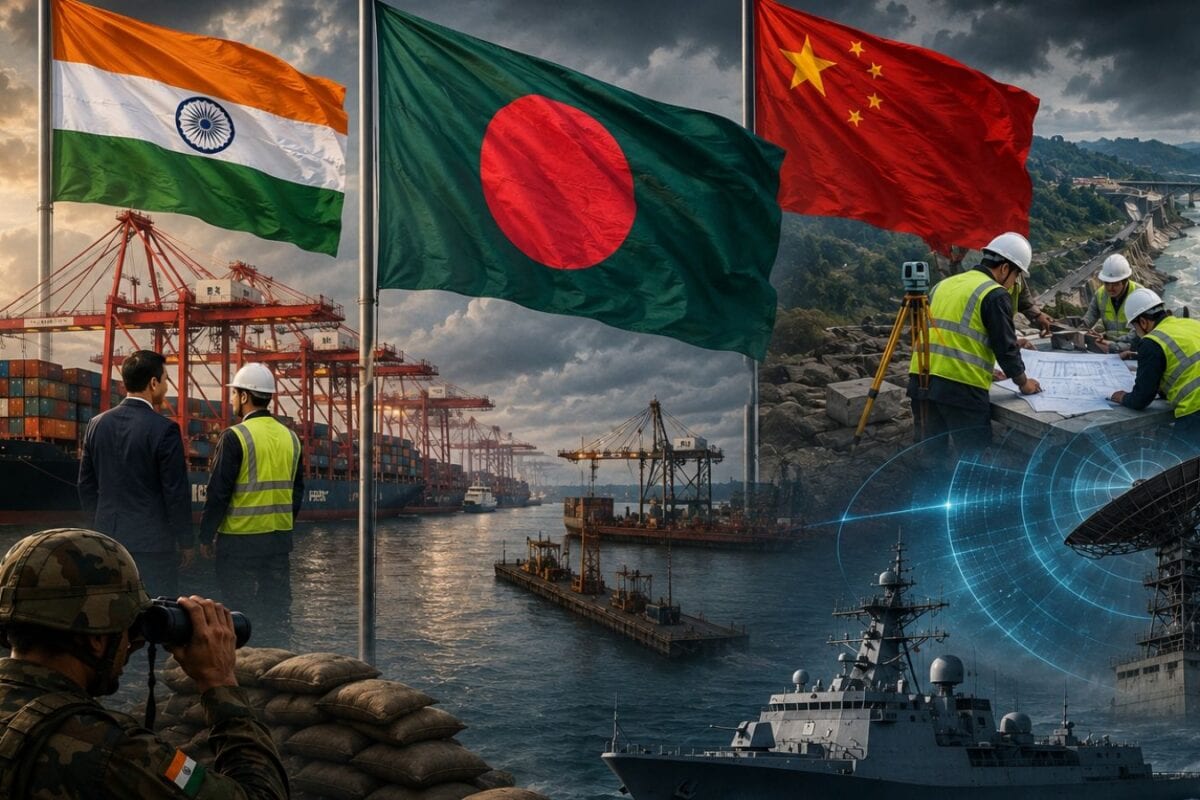
Bangladesh PM, Chinese Water Minister Advance Teesta Project Talks
Bangladesh's Prime Minister Tarique Rahman and China's Water Resources Minister Li Guoying recently discussed advancing the Teesta River Comprehensive Management and Restoration Project during Rahman's visit to Beijing in June 2026. This collaboration, aimed at comprehensive river management in Bangladesh, has significant geopolitical implications, particularly for India, which shares the Teesta river and has long-standing concerns regarding its water-sharing.
Key Highlights
- Bangladesh PM Tarique Rahman visited Beijing from June 24-26, 2026.
- Rahman met Chinese Water Resources Minister Li Guoying to discuss Teesta project.
- The 'Teesta River Comprehensive Management and Restoration Project' is a major initiative.
- China has pledged support and technical assistance for the multi-billion dollar project.
- India has expressed strong concerns over China's involvement due to strategic location.
- The project aims to enhance water security and agricultural output in northern Bangladesh.
Bangladesh's Prime Minister, Tarique Rahman, embarked on a significant visit to Beijing from June 24 to 26, 2026, where a central agenda item was the long-discussed Teesta River Comprehensive Management and Restoration Project. During his visit, Prime Minister Rahman held discussions with top Chinese officials, including Chinese Water Resources Minister Li Guoying, who assured Bangladesh of China's full cooperation for water resource management initiatives.
The Teesta River Comprehensive Management and Restoration Project, also referred to as the Teesta Barrage Master Plan, is a multi-billion dollar endeavor. Bangladesh has sought approximately USD 1 billion or more in funding and technical assistance from China for its implementation. The project aims to significantly transform the Teesta river basin within Bangladesh. Key components include extensive dredging of riverine sediment (estimated at 140 million cubic meters), reclamation of vast stretches of land (around 171 square kilometers), repair and construction of embankments, and the development of supporting infrastructure such as a 224-kilometer road network and 82 jetty facilities. The overarching goals are to stabilize the river's movement, mitigate flood risks, control erosion, increase water availability by storing monsoon rains for the dry season through a network of canals and ponds, and enhance agricultural output and livelihoods in northern Bangladesh.
China's interest in this project is not new. A non-binding Memorandum of Understanding (MoU) between the Bangladesh Water Development Board and China's state-owned Power Construction Corporation of China (Power China) was initially signed on September 28, 2016. Since then, Power China has submitted a masterplan and a feasibility study, with an extension to the MoU being signed in January 2026 under Bangladesh's interim government. During his recent visit, Prime Minister Rahman emphasized the Teesta Barrage Master Plan as a national priority, vowing to implement it 'at any cost' to ensure water security and support agriculture.
This burgeoning cooperation between Bangladesh and China on the Teesta project holds significant geopolitical implications, particularly for India. The Teesta river, a transboundary river, flows through India's states of Sikkim and West Bengal before entering Bangladesh. India and Bangladesh have a long-standing, but unresolved, water-sharing dispute over the Teesta. An agreement was nearly reached in 2011 but was stalled due to opposition from West Bengal's Chief Minister. India views China's deep involvement in the project with concern, primarily due to the project's proximity to the sensitive Siliguri Corridor, often called the 'Chicken's Neck,' a narrow strip of land vital for connecting India's northeastern states to the rest of the country.
New Delhi has consistently expressed its apprehensions, tracking all developments in the region closely. In 2024, India had offered its own technical and conservation assistance for the Teesta basin in Bangladesh, signaling its desire to collaborate and keep China from gaining a strategic foothold in such a sensitive area. While China asserts that its cooperation with Bangladesh is not aimed at any third party and should be free from external influence, India remains wary of the strategic implications. The Teesta project represents a critical juncture in regional geopolitics, underscoring Bangladesh's efforts to secure its water future while navigating complex relationships with both India and China. The project also highlights the urgent need for political will and basin-level water cooperation among riparian states.
Frequently Asked Questions
Who is the current Prime Minister of Bangladesh mentioned in the context of the China visit?
The Prime Minister of Bangladesh who visited Beijing in late June 2026 and discussed the Teesta project with Chinese officials is Tarique Rahman.
What is the Teesta River Comprehensive Management and Restoration Project?
It is a multi-billion dollar initiative in Bangladesh aimed at managing the Teesta river. It involves extensive dredging, land reclamation, embankment construction, and developing infrastructure to control floods, prevent erosion, store water, and improve agricultural output in northern Bangladesh.
Why is China's involvement in the Teesta project a concern for India?
India is concerned because the Teesta river is a transboundary river vital to both nations, and China's deep involvement in a major project in Bangladesh, especially near India's strategically sensitive Siliguri Corridor ('Chicken's Neck'), is seen as a move that could have geopolitical and security implications, potentially giving China leverage in the region.
What is the history of the Teesta water-sharing dispute between India and Bangladesh?
The Teesta water-sharing issue has been a long-standing unresolved bilateral issue between India and Bangladesh. An agreement was almost finalized in 2011 but was stalled due to objections from the Chief Minister of West Bengal, India, over concerns about its impact on the state's farmers.
Has India offered any alternative to Chinese involvement in the Teesta project?
Yes, in June 2024, India signaled its interest in taking up the conservation and management of the Teesta river within Bangladesh, with Prime Minister Narendra Modi stating that an Indian technical team would visit Dhaka for talks on the matter.