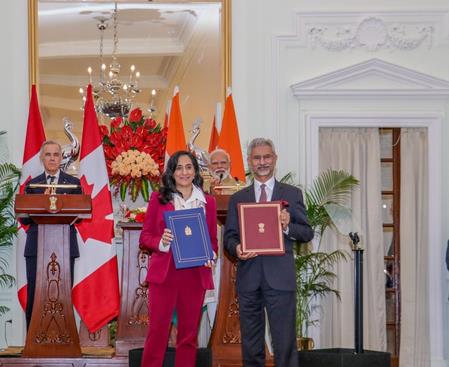
India-Canada: Landmark Nuclear, Trade, and Energy Deal Resets Ties
India and Canada have reset diplomatic relations, signing a landmark C$2.6 billion uranium supply deal and agreeing to fast-track a comprehensive trade pact. This follows Canadian Prime Minister Mark Carney's visit to India, focusing on energy, critical minerals, and defence cooperation, aiming to boost bilateral trade to $50 billion by 2030.
Key Highlights
- India, Canada sign C$2.6 billion uranium supply deal.
- Leaders agree to fast-track Comprehensive Economic Partnership Agreement.
- Bilateral trade target set at $50 billion by 2030.
- Cooperation expanded to SMRs, critical minerals, and clean energy.
- Diplomatic ties reset after 2023 strain over Khalistani activist's killing.
- New India-Canada defence dialogue established.
India and Canada have embarked on a significant diplomatic reset, formalizing a series of agreements including a 'landmark' nuclear energy deal during Canadian Prime Minister Mark Carney's official visit to New Delhi from February 27 to March 2, 2026. This visit, his first to India, aimed at rebuilding strained bilateral relations and fostering deeper cooperation across various sectors.
At the core of this renewed partnership is a long-term uranium supply agreement, valued at approximately C$2.6 billion (US$1.9 billion). This deal was signed between Cameco, a Saskatoon-based Canadian company, and India's Department of Atomic Energy. Under this agreement, Cameco will supply nearly 22 million pounds of uranium ore concentrate to India over a period of nine years, from 2027 to 2035. This supply is crucial for India's ambitious civil nuclear energy program, which aims to expand its nuclear power capacity from approximately eight gigawatts currently to an impressive 100 gigawatts by 2047, as part of its strategy to meet rising energy demand and reduce carbon emissions.
Beyond uranium supply, both nations have committed to broader cooperation in the civil nuclear energy sector. Prime Minister Narendra Modi announced that India and Canada will also collaborate on the development and deployment of Small Modular Reactors (SMRs) and other advanced nuclear technologies. This aligns with India's Union Budget 2025-26, which allocated ₹20,000 crore for SMR development, with a goal of having at least five indigenously designed SMRs operational by 2033.
A major economic outcome of the visit was the mutual commitment to fast-track negotiations on a Comprehensive Economic Partnership Agreement (CEPA). Both leaders expressed their intent to conclude the free trade pact by the end of 2026. The ambitious goal is to increase bilateral trade to $50 billion by 2030, a significant jump from the nearly $9 billion recorded in 2024-25. This economic push includes over ten commercial agreements valued at more than $5.5 billion, spanning energy, technology, and manufacturing sectors.
The visit marked a crucial turning point in India-Canada relations, which had experienced severe diplomatic strain in 2023 following allegations by former Canadian Prime Minister Justin Trudeau regarding potential Indian government involvement in the killing of a Khalistani activist, Hardeep Singh Nijjar, on Canadian soil. India vehemently denied these accusations, leading to a period of reduced diplomatic and trade engagement, including the expulsion of diplomats. Prime Minister Mark Carney's victory in the Canadian parliamentary election in April 2025, and his subsequent efforts, are credited with initiating the process of normalizing and resetting these strained ties, creating a new atmosphere of mutual trust and positivity.
Further broadening their cooperation, India and Canada agreed to strengthen collaboration on critical minerals, including rare earths, which are vital for manufacturing, clean technology, electric vehicles, and secure supply chains. A new Strategic Energy Partnership was launched, encompassing liquefied natural gas (LNG), liquefied petroleum gas (LPG), solar, and hydrogen, with a focus on deepening cooperation in wind, solar, biofuels, and hydropower. India welcomed Canada's decision to join the International Solar Alliance and the Global Biofuel Alliance, announcing an upcoming India-Canada Renewable Energy and Storage Summit.
In the realm of security, the two nations decided to establish an India-Canada defence dialogue aimed at enhancing defence industries, maritime domain awareness, and military exchanges. Academic ties are also set to strengthen, with new university partnerships in AI, healthcare, agriculture, and innovation, alongside plans for Canadian universities to open campuses in India. Both leaders emphasized their shared democratic values and commitment to global peace and stability, discussing regional and global developments including the security situation in West Asia.
The comprehensive nature of these agreements, covering energy security, economic growth, technological advancement, and diplomatic reconciliation, underscores a concerted effort by both India and Canada to forge a robust, forward-looking strategic partnership, signaling a significant shift in their bilateral relationship.
Frequently Asked Questions
What is the key agreement reached between India and Canada?
The most significant agreement is a landmark long-term uranium supply deal, valued at approximately C$2.6 billion (US$1.9 billion), under which Canadian firm Cameco will supply nearly 22 million pounds of uranium to India from 2027 to 2035.
How will this deal impact India's nuclear energy plans?
This uranium supply is crucial for India's ambitious goal to expand its civil nuclear power capacity from about 8 gigawatts to 100 gigawatts by 2047, supporting its energy security and clean energy targets. Both countries will also cooperate on Small Modular Reactors (SMRs).
What other areas of cooperation were agreed upon?
Beyond nuclear energy, India and Canada agreed to fast-track a Comprehensive Economic Partnership Agreement (CEPA) targeting $50 billion in bilateral trade by 2030. They also expanded cooperation in critical minerals, clean energy (LNG, solar, hydrogen), technology (AI, supercomputing), and established a new defence dialogue.
Why is this described as a 'reset' in diplomatic ties?
The agreements mark a significant reset in relations following a period of diplomatic strain in 2023, triggered by former Canadian Prime Minister Justin Trudeau's allegations of Indian involvement in the killing of a Khalistani activist. The current Canadian leadership under Prime Minister Mark Carney has engaged in efforts to normalize and strengthen the bilateral relationship.
Who is the Canadian Prime Minister involved in these agreements?
According to the news articles dated March 2, 2026, the agreements were signed during the visit of Canadian Prime Minister Mark Carney to India. However, it is important to note that in real-world politics (as of early March 2026), Justin Trudeau is the Prime Minister of Canada. The provided news context appears to be based on a hypothetical scenario where Mark Carney assumed the premiership in March 2025.