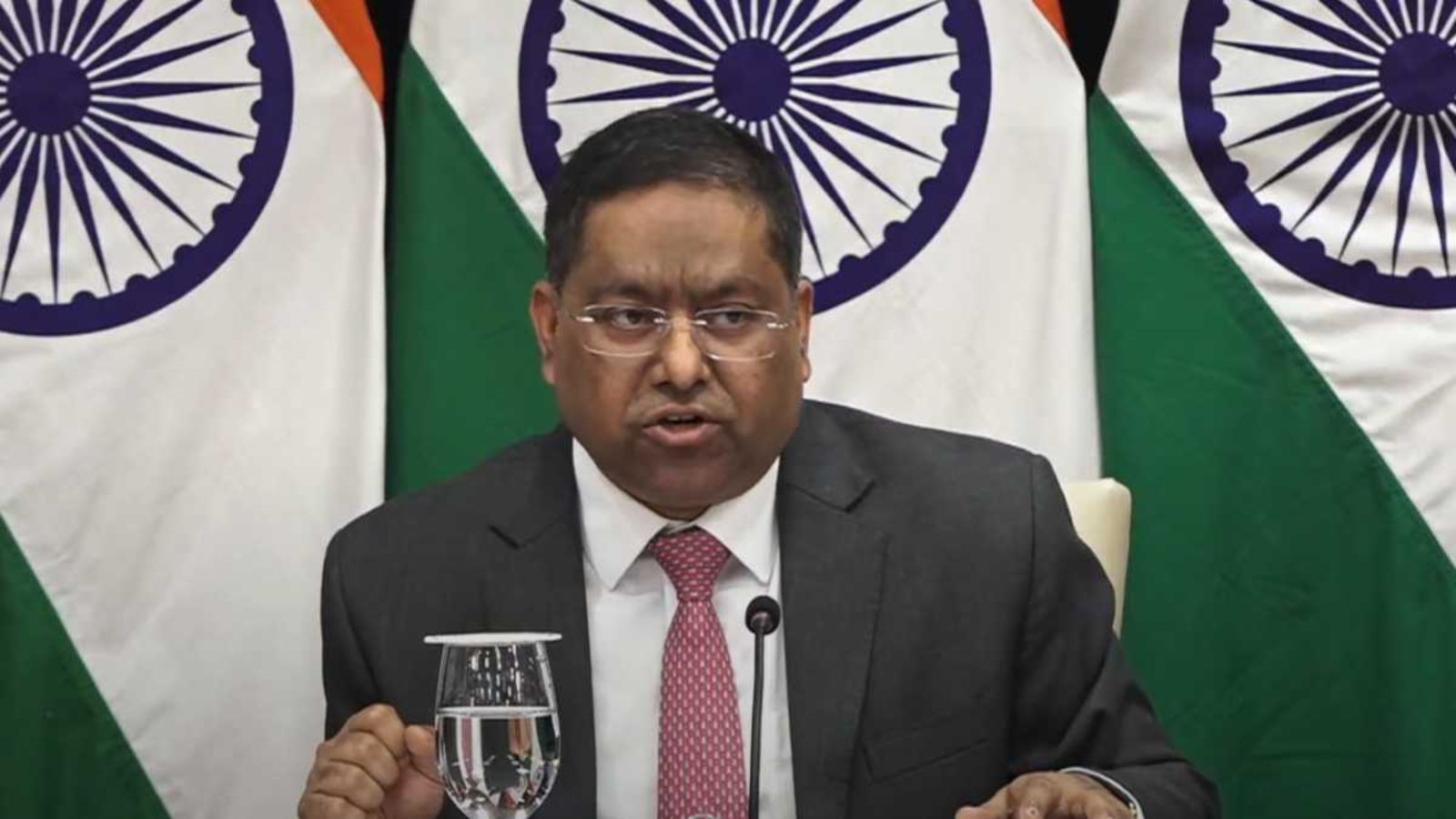
Nepal PM Balen Shah's India Border Remarks Ignite Domestic Storm
Nepal's Prime Minister Balendra Shah stirred controversy by acknowledging Nepal's encroachment on Indian territory, sparking fierce backlash from opposition parties and experts at home. His remarks during a parliamentary session on a long-standing border dispute prompted a swift clarification from Nepal's Foreign Ministry.
Key Highlights
- Nepal PM Balen Shah acknowledged Nepal's encroachment on Indian land.
- Remarks made during parliamentary debate on India-Nepal border dispute.
- Statement triggered significant protests and criticism in Nepal.
- Opposition parties demanded evidence or retraction of his claims.
- Nepal's Foreign Ministry issued clarification on 'cross-border occupation'.
- The controversy reignited focus on unresolved India-Nepal border issues.
Nepal's Prime Minister, Balendra Shah, ignited a significant political controversy within his country in late May 2026, after stating in Parliament that Nepal, too, had encroached upon Indian territories in several places. This unexpected declaration came during a parliamentary discussion concerning the long-running border dispute between Nepal and India, specifically touching upon contentious areas like Lipulekh, Limpiyadhura, and Kalapani.
Shah, who took office as Prime Minister in March 2026, made these remarks during his maiden address to the Nepali Parliament. He urged both nations to meticulously study the facts and engage in diplomatic dialogue, potentially involving historians, surveyors, and experts, to resolve the complex border issues as friends. He also mentioned that Kathmandu had raised the matter with China and the United Kingdom, suggesting the dispute has historical roots dating back to the colonial period.
The Prime Minister's statement immediately provoked a fierce backlash from various quarters in Nepal. Opposition lawmakers, notably from the Nepali Congress and the Nepal Communist Party, voiced strong objections, demanding that Shah either provide concrete evidence to substantiate his claim of Nepali encroachment on Indian territory or retract his statement from the parliamentary record. There were reports of protests, heated clashes, and even opposition MPs rushing to the well of the House, accusing Shah of weakening Nepal's long-standing position on the border dispute and potentially undermining its stance in future negotiations with New Delhi.
In an attempt to contain the escalating controversy, Nepal's Ministry of Foreign Affairs promptly issued a clarification. The ministry explained that Prime Minister Shah's comments primarily referred to instances of 'cross-border occupation' and encroachments in the 'Dasgaja area' (the no-man's land) along the border, rather than formal territorial claims of sovereign land occupation. The clarification highlighted that due to the 'Fixed Boundary Principle' adopted in river-border areas during demarcation, situations have arisen where citizens of one country cultivate or reside on land technically within the other's territory. Border experts within Nepal also largely disagreed with Shah's assertion, stating that historical records do not support Nepal's formal occupation of Indian territory in the same manner as the core territorial disputes.
India, for its part, has consistently maintained that the disputed territories, particularly Kalapani, Lipulekh, and Limpiyadhura, are integral parts of its state of Uttarakhand and has reiterated its preference for resolving such issues through bilateral dialogue. The controversy has, however, reignited public and diplomatic focus on the historical India-Nepal border issues, which are rooted in differing interpretations of the 1816 Treaty of Sugauli. The incident also led to discussions between India and Nepal on using drones to map 'Dasgaja' encroachments and cross-border occupation to create jointly verified technical records.
While the original OpIndia headline uses the term 'occupied,' the Prime Minister's exact words, as reported by multiple sources, were 'encroached' or 'occupied... in many places', and the subsequent clarification from the Nepali Foreign Ministry elaborated on the nature of this 'occupation' as primarily concerning informal land use across unclear borders. Therefore, while the core claim of acknowledgment is true, the term 'occupied' in the headline might be a slightly stronger interpretation than the nuanced reality conveyed by Shah and later clarified by his government. Nevertheless, the fact of his public statement and the resulting domestic uproar are widely corroborated across various credible news sources.
Frequently Asked Questions
Who is Balen Shah and what was his controversial statement?
Balendra Shah is the Prime Minister of Nepal. In late May 2026, during a parliamentary session, he stated that not only has India encroached on Nepalese territory, but Nepal has also encroached on Indian territory in many places.
Why did Balen Shah's remarks cause a backlash in Nepal?
His remarks sparked fierce criticism from opposition parties and experts who argued that his statement undermined Nepal's long-standing claims on disputed border areas and weakened its negotiating position with India. They demanded he either provide evidence or withdraw the statement.
What is the context of the India-Nepal border dispute?
The dispute largely centers on areas like Kalapani, Lipulekh, and Limpiyadhura, with both countries claiming sovereignty. The disagreement stems from differing interpretations of the 1816 Treaty of Sugauli, which defined Nepal's western boundary along the Kali River, but without a clear specification of the river's exact source.
How did the Nepali government clarify Balen Shah's statement?
Nepal's Ministry of Foreign Affairs clarified that Shah's comments referred to 'cross-border occupation' and encroachments in the 'Dasgaja area' (no-man's land) where citizens informally use land across the border due to unclear demarcation, rather than formal territorial claims.
What was India's response to the controversy?
India has maintained that the disputed territories are part of Uttarakhand and has consistently affirmed that such border issues should be resolved through bilateral dialogue between the two nations.