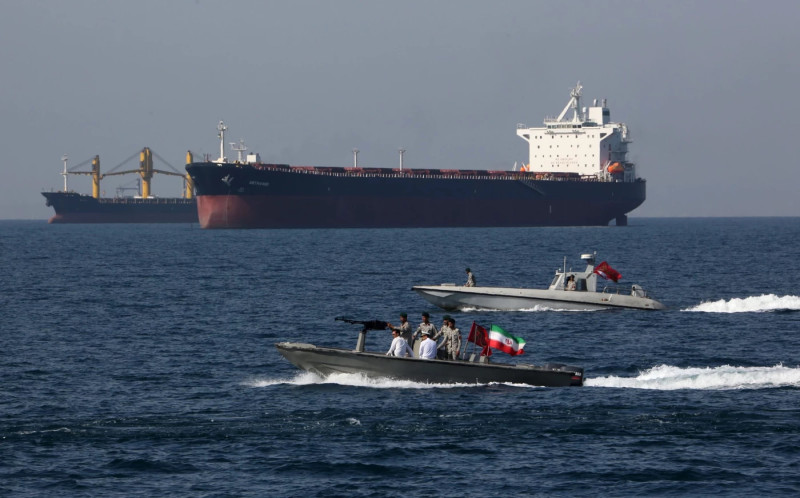
US Sanctions Severely Limit Iran's Oil Exports to China
US Treasury Secretary Scott Bessent stated that Iran has only about 30 million barrels of oil remaining in floating storage for China, due to stringent US sanctions and a naval blockade. This has drastically cut Iran's oil exports, significantly impacting its economy, despite its vast proven oil reserves. China remains Iran's primary oil customer.
Key Highlights
- US Treasury Secretary Scott Bessent confirmed Iran's limited exportable oil.
- Iran has approximately 30 million barrels in floating storage for China.
- US sanctions and naval blockade severely restrict Iranian oil exports.
- China remains Iran's largest crude oil purchaser, receiving most exports.
- Iranian oil exports to China have sharply declined due to US pressure.
- Iran possesses hundreds of billions of barrels in total proven oil reserves.
US Treasury Secretary Scott Bessent recently stated that Iran has approximately 30 million barrels of crude oil remaining in floating storage that China has not yet purchased, and that US sanctions and a naval blockade will soon prevent Tehran from supplying more. This assertion, made during an interview with Fox News, highlights the severe impact of Washington's 'Operation Economic Outcast' campaign aimed at economically isolating Iran.
It is crucial to clarify that Bessent's statement refers specifically to Iran's *exportable* crude in floating storage and not to the nation's total proven oil reserves. Iran possesses some of the world's largest proven oil reserves, estimated at approximately 208.6 billion barrels as of 2025, ranking third globally. Other estimates place these reserves between 150 billion and 209 billion barrels, representing a significant portion of the world's total. These vast underground reserves are distinct from the limited volume currently available for immediate export under the current geopolitical circumstances.
The US pressure campaign, which intensified with a naval blockade in the Strait of Hormuz in mid-July 2026, has drastically curtailed Iran's ability to export crude oil. Reports indicate that Iranian crude loadings fell from around 2 million barrels per day (bpd) before the conflict to approximately 220,000–255,000 bpd in August 2026. Kpler data suggests that Iranian crude loadings declined to about 260,000 bpd in September 2026, a sharp drop from roughly 1.7 million bpd a year earlier.
China has historically been Iran's most significant oil customer, absorbing a substantial majority of its crude exports. In 2024, China accounted for approximately 91% of Iran's oil exports, and in 2025, it took between 80% to 90% of Iran's seaborne crude exports, equating to about 1.38 million to 1.4 million bpd. This trade has served as a crucial economic lifeline for Tehran, particularly given the extensive international sanctions. However, under the renewed US pressure, Chinese imports of Iranian crude have also witnessed a considerable decline. Bessent indicated a roughly 66% drop in volume, with Chinese imports falling to an estimated 534,000 bpd in August 2026, down from a peak of 1.58 million bpd earlier in 2026.
The effectiveness of the US naval blockade has been highlighted by analysts, who note that unlike previous sanctions campaigns where Iranian crude continued to reach buyers, the current blockade has prevented fresh crude cargoes from transiting the Strait of Hormuz to China. This means Iran can only sell crude to China from existing floating storage in Asia, which it cannot replenish as new crude accumulates on tankers inside the strait. Satellite imagery has also shown a marked decline in visible vessel and terminal activity at critical Iranian ports, underscoring the growing squeeze on Iran's imports and exports.
The economic implications for Iran are severe. The collapse in exports is draining a primary source of foreign-currency income, potentially forcing Tehran to resort to printing money and risking even higher inflation, which the International Monetary Fund estimated at nearly 70% in Iran for 2026. The US campaign, dubbed 'Operation Economic Outcast,' targets not only oil transactions but also shipping companies, aviation networks, gold markets, and technology sectors, aiming to sever economic lifelines and isolate Tehran from the US dollar system.
While China remains Iran's main buyer, its major state-owned refiners have largely shunned Iranian oil due to sanction fears, leaving the trade to independent 'teapot' refiners. Payments are often processed in Yuan via China's Cross-border Interbank Payment System (CIPS) to bypass international financial networks. Despite these mechanisms, the tightening sanctions and blockade are making such evasion increasingly difficult and expensive. The situation underscores a delicate balance for China, which relies on discounted Iranian oil but also needs to avoid direct exposure to US punitive measures.
India, historically a buyer of Iranian oil, would likely be among the first non-Chinese buyers to re-engage if sanctions were eased, but currently, its purchases are also limited by the existing restrictions.
Ultimately, the news emphasizes the considerable economic pressure the US is exerting on Iran's oil sector through a combination of sanctions and a naval blockade, significantly impacting its ability to export even existing crude to its largest customer, China. This situation has global implications for oil markets and international relations, particularly concerning the dynamics between the US, Iran, and China.
Frequently Asked Questions
What did US Treasury Secretary Scott Bessent claim about Iran's oil?
US Treasury Secretary Scott Bessent stated that Iran has approximately 30 million barrels of crude oil remaining in floating storage that China has not yet purchased. He emphasized that US sanctions and a naval blockade would soon prevent Iran from supplying more.
Does Iran actually only have 30 million barrels of oil left in total?
No, Iran does not have only 30 million barrels of oil left in total. This figure refers specifically to exportable crude oil held in floating storage that has not been bought by China. Iran possesses vast proven oil reserves, estimated at over 200 billion barrels, ranking it among the top three countries globally for oil reserves.
How are US sanctions and the naval blockade affecting Iran's oil exports?
The US sanctions and naval blockade, particularly in the Strait of Hormuz, are severely restricting Iran's ability to export crude oil. Exports have plummeted from around 2 million barrels per day before the conflict to as low as 220,000-260,000 barrels per day, making it difficult for Iran to sell even its stored oil.
Why is China central to Iran's oil trade, and how is it impacted?
China is Iran's largest oil customer, typically buying 80-90% of its crude exports. This trade has been a crucial financial lifeline for Iran under sanctions. However, due to intensified US pressure, China's imports of Iranian crude have also significantly declined, with estimates suggesting a drop of around 66%.
What are the broader economic consequences for Iran?
The drastic reduction in oil exports is severely impacting Iran's economy by depleting its foreign-currency income. This pressure could force the government to print more money, exacerbating an already high inflation rate, which was estimated at nearly 70% in 2026.