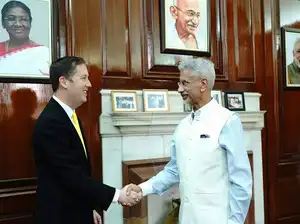
India's Oil Strategy: US Envoy Cites Russian Import Decline, Venezuela Talks
US Ambassador Sergio Gor claims India has committed to reducing Russian oil purchases as part of an interim trade deal, with active negotiations underway for Venezuelan oil. While India is diversifying its energy sources, its foreign ministry maintains that national interest drives oil procurement. Russian oil imports to India have significantly decreased recently.
Key Highlights
- US Ambassador Sergio Gor claims India committed to reduce Russian oil purchases.
- India's foreign ministry states energy policy is guided by national interest and diversification.
- US-India interim trade deal ties tariff cuts to India's Russian oil purchases.
- India's Russian oil imports hit a 38-month low in December 2025.
- Active negotiations are ongoing for India to procure oil from Venezuela.
- Indian refiners are actively shifting away from Russian crude.
US Ambassador to India, Sergio Gor, recently stated that India has made a commitment to reduce its purchases of Russian oil, a move he linked to an ongoing interim trade deal between the United States and India. This assertion was made on February 20, 2026, during a media briefing in New Delhi, where Gor emphasized that the US does not want any country buying Russian oil as part of efforts to end the Russia-Ukraine conflict.
According to Ambassador Gor, an understanding was reached between Prime Minister Narendra Modi and US President Donald Trump during a February 2 phone call. This understanding is part of a broader interim trade agreement that is nearing finalization, with Gor indicating it could be signed very soon. As a consequence of this agreement, the US has reportedly slashed tariffs on Indian imports from 50% to 18%, which notably included the removal of a 25% punitive levy that had been imposed in August 2025, specifically targeting India's continued purchases of Russian crude oil. Indian Commerce Minister Piyush Goyal further corroborated that the interim trade deal is expected to become effective in April 2026.
While Ambassador Gor highlighted a "commitment" from India regarding Russian oil, the Indian Foreign Ministry offered a more nuanced stance. In response to Gor's remarks, the ministry referred to an earlier statement by Foreign Secretary Vikram Misri, which reiterated that India's energy policy is primarily driven by its national interest. The ministry clarified that actual oil sourcing decisions are made by Indian oil companies based on an assessment of various factors, including cost-effectiveness, prevailing market conditions, availability of supplies, and associated risks. India has consistently emphasized its strategy of maintaining multiple sources and diversifying its energy supply to ensure stability and security for its population.
Evidence suggests that India is indeed diversifying its oil imports and significantly reducing its reliance on Russian crude. In December 2025, India's Russian oil imports fell to a 38-month low, constituting less than a quarter (24.9%) of its total crude imports, a notable drop from 34% just a month prior. This downward trend continued into January 2026, when Russian crude shipments represented the smallest portion of India's oil imports since late 2022, with Russia's share in overall imports declining to 21.2% from peak levels of 35-40% observed in the previous year. Furthermore, India's total merchandise imports from Russia experienced a substantial decrease of over 40% in January 2026, predominantly attributed to reduced crude purchases. Major Indian refiners are reportedly shifting their strategies, with Reliance Industries, the country's largest private refiner, reporting zero Russian crude deliveries in January 2026.
In line with this diversification strategy, Ambassador Gor also confirmed that the US and India are engaged in "active negotiations" to facilitate India's procurement of oil from Venezuela. He noted that the US Department of Energy is in discussions with India's Ministry of Energy on this matter, with hopes for imminent news. Venezuela, which boasts the world's largest proven oil reserves, was a significant crude supplier to India before increased US sanctions impacted its exports. Recent shifts in US policy, including a military operation that ousted Venezuelan leader Nicolas Maduro, have opened new avenues for Venezuelan oil to re-enter the international market. Indian state-run refiners like Bharat Petroleum and Hindustan Petroleum, along with private entities such as Reliance Industries, have reportedly begun or are exploring purchasing Venezuelan crude.
Overall, while the US ambassador's statements indicate a strong US desire and an perceived commitment from India to reduce Russian oil imports as part of a trade-off for tariff reductions, India's public posture remains focused on strategic energy diversification guided by its economic and security interests. The observed decline in Russian oil imports and active pursuit of alternative sources, including Venezuela, align with India's long-term energy security objectives and its pragmatic approach to navigating global geopolitical dynamics.
Frequently Asked Questions
Who is US Ambassador Sergio Gor and what did he claim about India's oil purchases?
Sergio Gor is the current US Ambassador to India, appointed by President Donald Trump. On February 20, 2026, he claimed that India has committed to not buying Russian oil as part of an interim trade deal with the US, linking it to efforts to end the Russia-Ukraine war.
What is India's official stance on buying Russian oil?
While US Ambassador Gor claimed a commitment, India's Ministry of External Affairs has stated that India's energy policy is guided by national interest and the diversification of supply sources, rather than an explicit commitment to cease all Russian oil imports.
How have India's Russian oil imports changed recently?
India's Russian crude oil imports have significantly decreased. In December 2025, they reached a 38-month low, and in January 2026, Russia's share in India's total oil imports fell to 21.2%, the lowest since late 2022.
Are India and the US negotiating for Venezuelan oil?
Yes, US Ambassador Sergio Gor confirmed that the US and India are in 'active negotiations' to facilitate India's procurement of oil from Venezuela, with discussions involving both countries' energy departments.
What is the status of the India-US interim trade deal?
According to Ambassador Gor, an interim trade deal is 'done' with only a few minor details left to resolve, and its signing is expected very soon. This deal reportedly includes the US cutting tariffs on Indian goods from 50% to 18%.