Why Trump Targeted Venezuela And India’s Stakes | Quick Digest
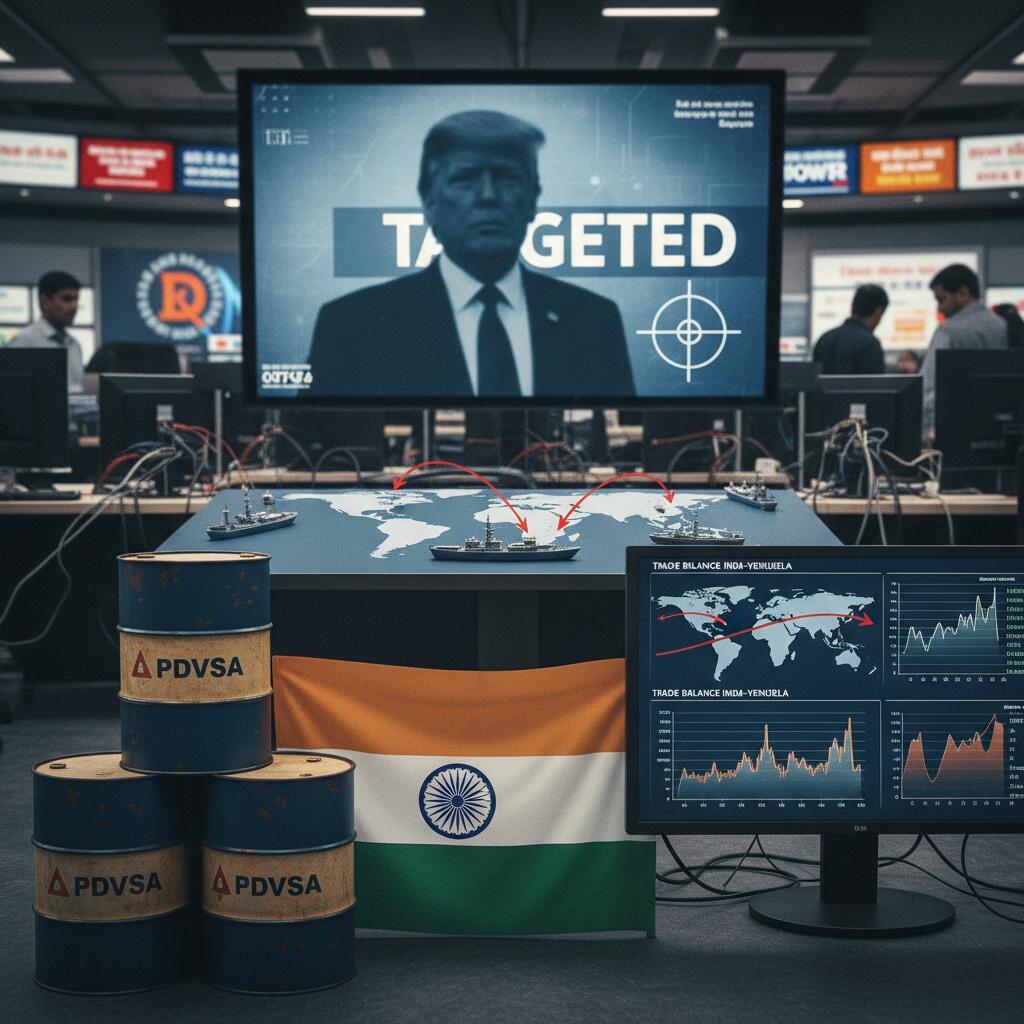
This topic explores why the Trump administration moved aggressively against Venezuela’s Maduro government, focusing on motives like oil, narco‑terrorism claims and great‑power rivalry. It then examines how these actions affect India through oil supplies, energy security, trade relations and India’s diplomatic balancing between the US, Russia, China and Latin America.
Trump’s Venezuela policy evolved from financial sanctions to direct military action, culminating in the 2026 airstrikes and Maduro’s capture.
Control over Venezuelan oil has been central to U.S. strategy, turning the country’s crude into a sanctions-governed geopolitical asset.
India’s stakes lie in discounted heavy crude, diversification away from the Gulf, and the broader impact of U.S. sanctions on its energy security.
The crisis underscores the need for India to deepen supplier diversification, expand non-dollar payment options, and strengthen energy and financial diplomacy to preserve strategic autonomy.
## Why Trump Targeted Venezuela And India’s Stakes
Donald Trump’s confrontational policy toward **Venezuela** – from sweeping sanctions in his first term to the 2026 airstrikes and capture of Nicolás Maduro – was driven by a mix of ideology, oil geopolitics, and domestic politics.[1][2] India, as a major energy importer and a sometimes key buyer of Venezuelan crude, has **real economic and strategic stakes** in how this standoff evolves.[3]
This article unpacks why Trump “attacked” Venezuela (politically, economically, and now militarily) and what it means for India’s energy security, foreign policy balancing, and business landscape.
---
## How Trump’s Confrontation With Venezuela Escalated
### From sanctions to “maximum pressure”
U.S. sanctions on Venezuela started well before Trump, with targeted measures against individuals as early as 2005, and expanded under Barack Obama.[1][2] But it was during Trump’s first term (2017–2021) that Washington imposed the **most sweeping economic sanctions**:
- In 2017, the Trump administration blocked U.S. financial institutions from dealing in key Venezuelan debt and payments, hitting state oil company PDVSA’s finances.[2][3]
- In 2018–2019, sanctions escalated into an **effective embargo** on Venezuelan **oil, gold, finance and defense sectors**, freezing about **$22–30 billion** in assets abroad and crippling oil exports.[2][6]
- By 2019, U.S. imports of Venezuelan crude – once roughly **500,000 barrels per day** – had fallen to zero, forcing Caracas to pivot to discounted sales via “shadow fleets” to countries including China and India.[3]
This strategy was explicitly framed as **“maximum pressure”** on the Maduro government, justified in Washington by concerns over democracy, human rights abuses, and corruption, as well as alleged narco‑trafficking ties.[2][6]
### Why Venezuela was in Trump’s crosshairs
Several motives overlapped in Trump’s approach:
1. **Regime change and ideological signaling**
The U.S. accused Maduro of dismantling democratic institutions and committing serious human rights abuses.[2][6] Sanctions and diplomatic isolation were meant to weaken Maduro and signal U.S. opposition to left‑wing, anti‑U.S. regimes in its traditional sphere of influence.
2. **Oil leverage and energy geopolitics**
Venezuela holds some of the **world’s largest proven oil reserves**, but its production collapsed due to mismanagement and sanctions.[2][3] For Trump, controlling or constraining this supply served multiple goals:
- Punish a hostile regime while supporting U.S. producers via higher or more volatile prices.
- Deter China, Russia, and others from consolidating influence over Venezuelan oil.[3]
3. **Domestic politics and the Latino vote**
Hardline policies on Cuba and Venezuela played well with parts of the Cuban‑American and Venezuelan‑American communities, especially in Florida. A tough stance on Maduro helped Trump project a strong anti‑socialist image at home.
4. **Narrative of crime and narco‑trafficking**
U.S. officials tied Venezuelan elites to drug trafficking, though UN data show Venezuela is not a cocaine or fentanyl producer and most cocaine entering the U.S. comes via the Pacific, not through Venezuela.[1] Sanctions and, later, military moves leaned heavily on this narrative to justify intervention.
---
## From Economic War To Airstrikes: Operation Southern Spear
### The 2026 escalation
By early 2026, tensions spiked. After sanctions, asset freezes, and years of political standoff, the U.S. moved from economic to **overt military action**:
- In **January 2026**, the U.S. launched **airstrikes across Venezuela’s coastline** under *Operation Southern Spear*.[2]
- U.S. special forces **seized Nicolás Maduro**, and Trump announced he had been flown out of the country.[1][2]
- Trump declared that the U.S. would **“run” Venezuela** until a “safe transition” of leadership, explicitly tying this to getting “our oil flowing.”[1][2]
These actions were widely criticized as a **clear violation of the UN Charter**, which prohibits such unilateral uses of force against sovereign states.[1]
### The new political reality in Caracas
Despite Maduro’s capture, his regime did not fully collapse:
- Vice‑President **Delcy Rodríguez** was appointed **interim president** by Venezuelan institutions.[1][2]
- Key power figures – including Defense Minister **Vladimir Padrino López** and influential strongman **Diosdado Cabello** – remained in place.[1]
- Rodríguez demanded Maduro’s return and emphasized “peace” and “stability” as priorities while resisting full U.S. control.[1]
Trump’s message was unapologetically coercive: he said Rodríguez would “pay a very big price, probably bigger than Maduro” if she did not “do what’s right,” and U.S. congressional leaders spoke openly about **“coercing”** Caracas to align with U.S. interests.[1]
> **Key insight:** Trump’s move from sanctions to airstrikes was less a sudden break and more the peak of a long “maximum pressure” arc aimed at reshaping Venezuela’s oil and political alignment.[1][2]
---
## The Oil Question: Who “Runs” Venezuelan Crude?
### Sanctions, collapse and the refugee crisis
Sanctions and asset seizures have devastated Venezuela’s economy:
- Between 2014 and 2020, Venezuela lost **99% of its foreign currency income**, much of it tied to oil.[2]
- Sanctions and asset freezes have cost the country an estimated **$24–30 billion** in overseas holdings, helping drive one of the world’s largest refugee crises, with more than **7.9 million Venezuelans** having fled by mid‑2025.[2]
- International banks, fearing penalties from the U.S. Office of Foreign Assets Control, even blocked payments for medicines, worsening humanitarian conditions.[2]
### U.S. control ambitions
Trump has openly said that **U.S. companies will go in, rebuild Venezuela, and get oil flowing**, promising that Washington will **sell Venezuelan oil** and place the proceeds in a **U.S.-controlled account**.[1] Venezuelans, he suggested, would only be able to use this money to buy **U.S. goods**.[1]
In practice, the U.S. has:
- Banned U.S. companies from trading with PDVSA or any foreign firm doing business with it, weaponizing the dollar system against Venezuela.[1][2]
- Pressured non‑U.S. entities to reduce purchases of Venezuelan oil and intimidated European banks into dropping Venezuelan clients.[2][3]
- Granted and then revoked special **licenses** (for example to Chevron) to operate in Venezuela, using them as leverage.[1]
This creates a highly politicized oil market, where who buys Venezuelan crude – and how – has become a matter of **geopolitical risk**, not just price.[3][4]
> **Key insight:** Venezuelan oil is no longer just a commodity; it is a **sanctions‑controlled asset** whose flow can be turned on or off as a tool of U.S. foreign policy.[1][2][3]
---
## India’s Energy Stakes In The Venezuela Fight
### How important is Venezuelan oil to India?
India is the world’s **third‑largest oil importer**, with about 80–85% of its crude needs met by imports. It has long tried to diversify beyond West Asia to reduce over‑dependence on the Gulf.
Before sanctions tightened, Venezuela was a **significant crude supplier** to India, selling heavy crude at discounts that suited Indian public and private refiners equipped to process such grades.[3] As U.S. sanctions intensified:
- Venezuela increasingly relied on **steep discounts and opaque shipping arrangements**, using “shadow fleets” and complex routing to reach buyers.[3]
- India and China periodically emerged as important destinations for this discounted oil, though secondary sanctions and enforcement pressured Indian refiners to scale back.[3]
For India, Venezuelan crude offered three benefits:
- **Price advantage** from discounts.
- **Supply diversification** away from traditional Middle Eastern suppliers.
- **Strategic autonomy** in choosing partners outside Western political preferences.
### What changes after Trump’s 2026 move?
The 2026 airstrikes and the stated aim to “run” Venezuela raise a new set of questions for India:
1. **Will Venezuelan barrels re‑enter the market under U.S. control?**
If Washington consolidates control, Venezuelan supply may rise, but **access and pricing** will be shaped by U.S. political considerations – potentially favoring its allies or domestic refiners first.[1][3]
2. **Will Indian refiners be caught in sanction crossfire?**
Stricter enforcement, new tariffs, or secondary sanctions on buyers deemed too close to Caracas could complicate Indian purchases, pushing refiners toward safer sources even if they are more expensive.[3][4]
3. **Does this deepen U.S. leverage over India’s energy security?**
If the U.S. effectively decides who gets Venezuelan oil and on what terms, India could find a key diversification channel **politically gated**, adding to existing pressures around Russian crude and Iran.
> **Key insight:** For India, Trump’s Venezuela strategy is not a distant drama; it directly affects **oil price volatility, diversification options, and negotiating leverage** with both Washington and other suppliers.[3][4]
---
## India’s Strategic Balancing Act
### Navigating between Washington, Moscow, Beijing – and Caracas
India has tried to maintain **strategic autonomy**: buying Russian oil despite Western discomfort, engaging the U.S. in the Quad and defense, and working with Latin American producers, including Venezuela, when convenient.
Trump’s aggressive Venezuela policy complicates this balancing:
- **Closer alignment with U.S. sanctions** could secure political goodwill in Washington but reduce India’s freedom to source cheap barrels from sanctioned suppliers.
- **Open defiance** – for instance, by stepping up purchases of Venezuelan oil via intermediaries – risks exposure to **secondary sanctions**, fines, or banking disruptions.
India’s likely approach will be **pragmatic hedging**:
- Maintain formal compliance with major U.S. measures.
- Use **indirect channels**, local currencies, or third‑country traders when risks are manageable.
- Quietly diversify to other Latin American and African suppliers to replace any lost Venezuelan volumes.
### Implications for Indian foreign policy
The Venezuela episode reinforces a few foreign‑policy lessons for New Delhi:
- **Oil is weaponized**: The U.S. (and others) increasingly use access to energy and the dollar system as tools of statecraft.[2][3]
- **Over‑reliance on any single bloc is risky**: Heavy dependence on Gulf supplies, Russian discounts, or access to sanctioned crude all carry political strings.
- **Voice on international law**: Unilateral actions widely viewed as violating the UN Charter put pressure on India to articulate a consistent stance on sovereignty and intervention, especially as a major Global South voice.[1]
> **Key insight:** India’s Venezuela dilemma is a case study in how a “multi‑alignment” foreign policy runs into the hard limits of **U.S.-centric financial and sanctions power**.[2][3]
---
## Economic And Business Impact On India
### Short‑term: price swings and refinery choices
In the near term, Trump’s move could translate into:
- **Higher or more volatile oil prices** if markets fear extended conflict, disruptions, or wider sanctions in Latin America.[3][4]
- **Refinery adjustments** as Indian refiners weigh the legal and reputational risk of processing Venezuelan grades tied to contested control or sanctions. Some plants built to handle heavy Venezuelan crude may need to import other heavy grades at higher cost.
- **Insurance and shipping risk premiums** for tankers operating in or near Venezuelan waters.
### Medium‑term: contracts, investments and rupee diplomacy
Over a medium‑term horizon, Indian business and policymakers will need to think about:
- **Long‑term supply contracts**: Locking in volumes from relatively stable suppliers (e.g., in the Gulf, the U.S., Africa) to offset uncertainties in Venezuela and other sanctioned states.
- **Equity stakes in foreign fields**: Investing via ONGC Videsh or private players in overseas upstream assets to gain more control over supply – a strategy India has pursued in Russia, Africa and Latin America.
- **Alternative payment systems**: Expanding use of **non‑dollar settlement**, including rupee or local‑currency trade mechanisms, to reduce exposure to U.S. financial sanctions over time.
> **Key insight:** Indian refiners and policymakers should treat Trump’s Venezuela gambit as a signal to **hedge harder** – in contracts, currencies, and supplier mix – against U.S. sanctions risk.[3][4]
---
## What India Can Practically Do Next
For Indian policymakers, businesses, and even investors, there are several **actionable steps** that flow from this crisis.
### 1. Deepen diversification – beyond headlines
- Expand and accelerate sourcing from **non‑traditional suppliers** in Africa and Latin America to reduce marginal dependence on any one political theater.
- Prioritize **flexible contracts** that allow cargo redirection when sanctions or conflicts flare.
### 2. Strengthen energy diplomacy
- Use bilateral dialogues with the U.S. to seek **clear carve‑outs** or predictable rules for Indian purchases when sanctions affect major suppliers.
- Coordinate more actively with producer groups and consumer coalitions to highlight the **humanitarian and developmental costs** of sweeping sanctions.[6]
### 3. Build financial resilience
- Increase the use of **local‑currency trade mechanisms** and test alternative payment platforms in energy transactions to reduce over‑reliance on the dollar.[3]
- Encourage Indian banks to develop stronger **sanctions‑compliance capabilities** so they can safely navigate gray areas rather than over‑complying and cutting off viable trade.
### 4. Upgrade risk management for companies
- Indian refiners and traders should integrate **geopolitical scenario analysis** into procurement strategies, modeling what happens if Venezuelan, Russian, or Iranian barrels suddenly become inaccessible.
- Corporates can use **hedging tools** and diversified shipping and insurance partners to cushion against sudden disruptions.
### 5. Invest in domestic buffers
- Continue expanding **strategic petroleum reserves** and storage to buy cheap in calm periods and soften shocks during crises.
- Accelerate investments in **renewables, electric mobility and efficiency**, which, over time, reduce the macro‑level risk that comes from imported fossil fuels.
---
## Bigger Picture: What Venezuela Means For India’s Future
Trump’s targeting of Venezuela – from crippling sanctions to the 2026 airstrikes and the declared intent to “run” the country – is a reminder that **geopolitics can reorder commodity flows overnight**.[1][2] For India, a rising power still heavily dependent on imported energy, the episode underlines three big realities:
- Energy security is now inseparable from **sanctions politics and great‑power rivalry**.[2][3][6]
- Strategic autonomy demands not just diplomatic balancing but **hard diversification and financial innovation**.
- Crises in faraway regions like Latin America can quickly show up in Indian inflation prints, corporate margins, and foreign‑policy dilemmas.
How India responds – by hedging smarter, speaking more clearly on international law, and investing in long‑term resilience – will determine whether episodes like the Trump–Venezuela confrontation become recurring threats or manageable bumps on its path to great‑power status.
Read the full story on Quick Digest