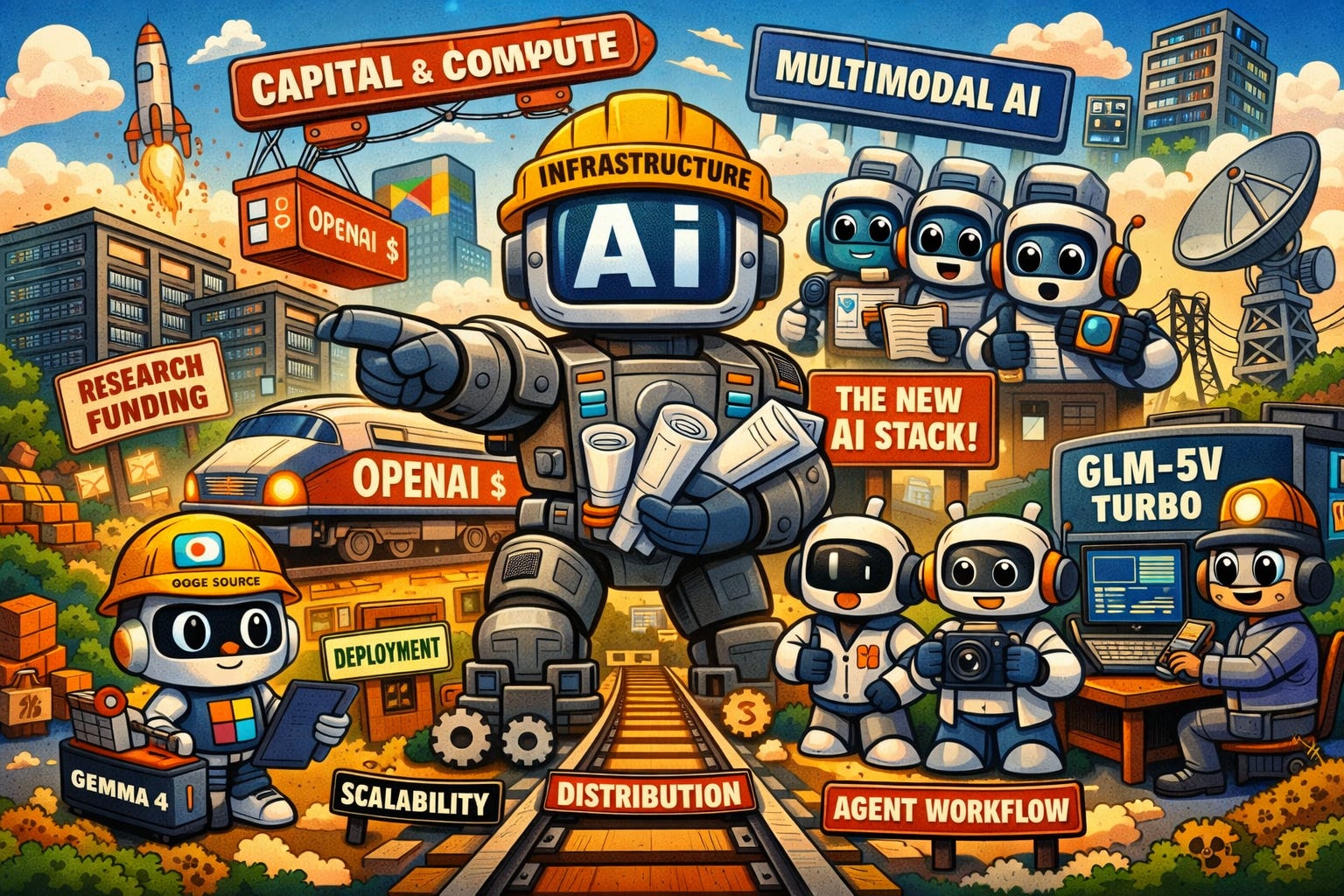
Google's Dual AI Strategy: Gemma 4 and Gemini Defined
Google has officially launched Gemma 4, its latest family of open-source AI models, complementing its flagship proprietary Gemini models. This dual strategy aims to democratize advanced AI by offering powerful, on-device capabilities alongside comprehensive cloud-based solutions, catering to diverse developer and user needs.
Key Highlights
- Google launched Gemma 4, an open-source AI model family, on April 2, 2026.
- Gemma 4 is built from the same research as the proprietary Gemini 3 models.
- It offers advanced reasoning, multimodal capabilities, and supports agentic workflows.
- Available in four sizes, Gemma 4 is optimized for devices from smartphones to workstations.
- Gemma 4 is released under a commercially permissive Apache 2.0 license.
- This dual approach provides both open and proprietary AI tools for developers.
Google's Artificial Intelligence (AI) strategy is distinctly shaped by two powerful model families: its recently launched open-source Gemma 4 models and its flagship proprietary Gemini models. This dual approach aims to cater to a broad spectrum of AI development needs, from on-device applications to large-scale cloud-based solutions, thereby democratizing access to cutting-edge AI technology across the globe.
Gemma 4, introduced by Google on April 2, 2026, represents the latest iteration of Google's lightweight, state-of-the-art open models. These models are built from the same world-class research and technology that powers the Gemini 3 family, signifying a strong foundational lineage. A significant highlight of Gemma 4's release is its availability under a commercially permissive Apache 2.0 license, a move that grants developers complete flexibility and digital sovereignty over their data, infrastructure, and models, enabling free building and secure deployment across various environments, including on-premises and cloud.
The Gemma 4 family is released in four versatile sizes: Effective 2B (E2B), Effective 4B (E4B), a 26B Mixture of Experts (MoE), and a 31B Dense model. These varied sizes are designed to support a wide range of hardware, from billions of Android devices, Raspberry Pi boards, and Nvidia Jetson edge devices to powerful developer workstations and accelerators. The smaller E2B and E4B models, developed in collaboration with Google's Pixel team, Qualcomm Technologies, and MediaTek, prioritize multimodal capabilities, low-latency processing, and seamless ecosystem integration, enabling them to run completely offline with near-zero latency on everyday devices.
Beyond basic chat functionalities, the entire Gemma 4 family is engineered for advanced reasoning and agentic workflows. They exhibit significant improvements in multi-step planning, deep logic, mathematics, and instruction-following benchmarks. Key capabilities of Gemma 4 include high-quality offline code generation, turning a workstation into a local-first AI coding assistant, and native processing of video and images, excelling at visual tasks like OCR and chart understanding. The E2B and E4B models also feature native audio input for speech recognition and understanding. Furthermore, Gemma 4 supports longer context windows, with edge models offering 128K tokens and larger models up to 256K, allowing for seamless processing of long-form content like entire repositories or extensive documents in a single prompt. Google states that Gemma 4 was natively trained on over 140 languages, making it a globally inclusive open model.
Complementing Gemma is Gemini, Google's flagship family of proprietary multimodal AI models. Gemini is deeply integrated into virtually all of Google's core products and services, including Google Search, Gmail, Google Docs, and Google Cloud, providing sophisticated capabilities for complex problem-solving and content generation. Unlike Gemma, which emphasizes openness and on-device deployment, Gemini focuses on delivering powerful, often cloud-backed, comprehensive AI experiences across Google's ecosystem.
The coexistence of Gemma and Gemini reflects Google's strategic vision to offer both the industry's most powerful combination of open and proprietary tools. This two-pronged approach allows Google to foster a vibrant developer ecosystem through open models like Gemma, which have seen over 400 million downloads since their first generation, leading to more than 100,000 variants in the 'Gemmaverse'. Simultaneously, Gemini continues to push the boundaries of AI capabilities within Google's own platforms, providing advanced, integrated solutions.
This strategy is particularly relevant for an audience in India, a rapidly growing technology hub with a vast developer community and an increasing demand for accessible AI tools. The ability to run powerful AI models like Gemma 4 locally on affordable devices and under a permissive license can significantly boost innovation and the creation of localized AI applications, without heavy reliance on cloud infrastructure. This also positions Google strongly in the competitive open-model landscape against other players like Meta's Llama.
In essence, Google's dual strategy with Gemma 4 and Gemini demonstrates a commitment to both broad accessibility and advanced proprietary innovation, ensuring that its AI offerings remain at the forefront of the global technological landscape.
Frequently Asked Questions
What is Gemma 4 and when was it released?
Gemma 4 is the latest family of open-source artificial intelligence models developed by Google, officially launched on April 2, 2026.
How is Gemma 4 different from Google's Gemini models?
Gemma 4 is an open-source model released under an Apache 2.0 license, allowing developers to use, modify, and deploy it freely, often on local devices. Gemini, in contrast, is Google's flagship proprietary AI model, deeply integrated across Google's cloud-based products and services. While Gemma 4 is built from the same research as Gemini 3, they represent Google's dual strategy of offering both open and proprietary AI tools.
What are the key capabilities of Gemma 4?
Gemma 4 boasts advanced reasoning, multi-step planning, deep logic, and significant improvements in math and instruction-following. It is multimodal, capable of processing images and video, supports native audio input in smaller versions, and can generate high-quality offline code. It also supports agentic workflows and long context windows for complex tasks.
What hardware can Gemma 4 run on?
Gemma 4 is designed to run on a diverse range of hardware, from low-power devices like smartphones (Android), Raspberry Pi boards, and Nvidia Jetson edge devices, to more powerful developer workstations and accelerators. It comes in different sizes to optimize performance for these various platforms.
Why is Google pursuing both open-source (Gemma) and proprietary (Gemini) AI paths?
Google's dual strategy aims to democratize AI by making powerful models accessible to a wider developer community through open-source offerings like Gemma, fostering innovation and enabling on-device AI. Concurrently, its proprietary Gemini models allow Google to push the frontiers of AI within its own ecosystem, delivering integrated and advanced AI experiences across its vast product portfolio. This provides developers with a comprehensive suite of tools.