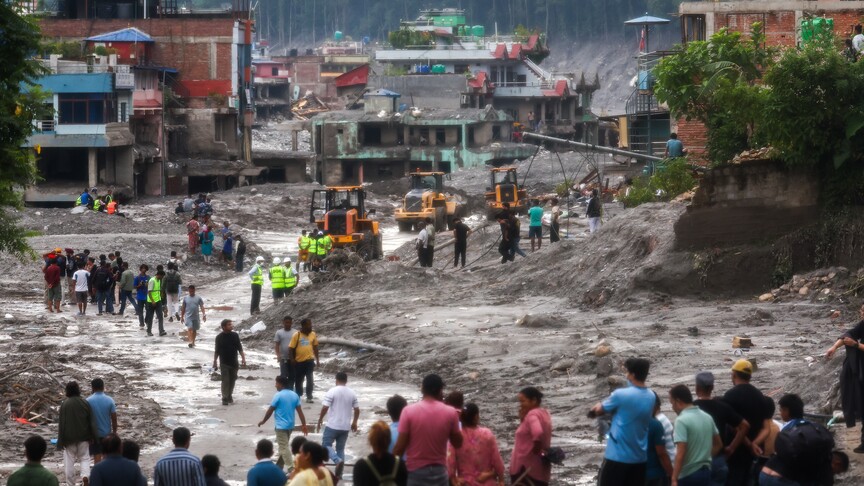
Nepal teacher's quick warning saves 1,643 students from devastating flash flood
Rajendra Dawadi, a school principal in Nepal, is being hailed as a hero for his swift actions that saved 1,643 children from a devastating flash flood. Receiving multiple warnings just minutes before the disaster struck, Dawadi immediately ordered an evacuation, ensuring all students and staff reached higher ground before the floodwaters destroyed their school. The incident highlights the critical role of timely information and decisive leadership during natural calamities.
Key Highlights
- Principal Rajendra Dawadi evacuated over 1,600 students just moments before a flash flood.
- Multiple warnings from locals prompted Dawadi's rapid decision to evacuate.
- The flash flood was triggered by a glacial collapse in the Himalayas.
- The school building was completely destroyed by the torrent of water and debris.
- Dawadi's courage and foresight are credited with saving all students.
- The disaster resulted in significant loss of life and destruction across Nepal.
In a remarkable display of courage and quick thinking, Rajendra Dawadi, the principal of Tribhuvan Trishuli Secondary School in Nepal, is being lauded as a hero for saving the lives of 1,643 children minutes before a catastrophic flash flood obliterated his school. The disaster, which struck on August 26, 2026, was triggered by a massive glacial collapse in the Himalayas near the Nepal-China border. The resulting torrent of water, ice, mud, and debris surged downstream, causing widespread devastation across several districts in Nepal and Tibet.
Dawadi received the first warning at approximately 9:20 AM from a friend in Betrawati, a village upstream, who frantically reported that the village had been swept away by the river and urged Dawadi to flee. This was quickly followed by a parent arriving at the school with a similar urgent warning about rising water levels. Faced with imminent danger and little time to confirm the extent of the threat, Dawadi made the life-saving decision to halt all classes and initiated an immediate evacuation.
He rang the school bell, signaling teachers to get students out of their classrooms. At the time of the evacuation, approximately 900 students were already on the school grounds, while another 700 were en route, some on school buses. Dawadi managed to contact most of the school bus drivers, instructing them to turn back and avoid the valley floor. Tragically, one bus could not be reached in time and was crossing a bridge as the floodwaters surged. However, by the grace of timely action, the bus managed to reverse to safety just before the bridge collapsed.
Dawadi personally oversaw the evacuation, guiding students and staff towards higher ground on a nearby hill. As they ascended, they witnessed their school, a three-story concrete building, being utterly consumed by the raging floodwaters, mud, rocks, and debris. The children, many still in their uniforms and some even barefoot, found refuge under a large bodhi tree, which became a temporary sanctuary.
While all 1,643 students were safely evacuated, the disaster was not without its casualties within the school community. Two staff members, social studies teacher Santos Pariyar and the school's janitor Sultan Lama, lost their lives. Pariyar had returned to his rented room near the river to prepare breakfast, and Lama had gone back to close the school doors.
The devastating flash floods claimed a significant number of lives across Nepal and China, with official reports indicating over 900 deaths in Nepal and 16 in Tibet, and thousands missing. The disaster caused extensive damage to infrastructure, including bridges, roads, homes, and hydropower facilities, cutting off entire communities and severely hampering rescue efforts.
Dawadi, a 47-year-old English teacher, has humbly rejected the title of 'hero', emphasizing that his actions were simply his responsibility as an educator. However, locals and international media have widely recognized his foresight and bravery, highlighting his crucial role in preventing a much larger tragedy. The incident underscores the devastating impact of climate change-induced glacial collapses and the vital importance of early warning systems and decisive leadership in disaster preparedness.
Other news outlets, including BBC, The New York Times, Reuters, and The Guardian, have also reported on this remarkable story, corroborating the key details of Rajendra Dawadi's heroic actions and the devastating impact of the floods. The Times of India, from which the original article is sourced, is a reputable Indian news outlet with a high trust score in India.
The news category is primarily Disaster and International News, with a specific focus on Nepal. The event is specific to Nepal and China, but its implications, such as climate change and cross-border disaster impacts, have global relevance. The publication date of the original article appears to be August 30, 2026, based on the timestamps of the related articles. The urgency of this news is high due to the immediate loss of life and destruction, and the ongoing rescue and relief efforts. The importance score is high due to the scale of the disaster and its impact on a large population.
Frequently Asked Questions
Who is Rajendra Dawadi?
Rajendra Dawadi is the principal of Tribhuvan Trishuli Secondary School in Nepal, who is being hailed as a hero for his quick thinking and decisive action in evacuating over 1,600 students just minutes before a devastating flash flood destroyed his school.
What caused the devastating flash flood in Nepal?
The flash flood was triggered by a massive collapse of ice and rock from a glacier in the Himalayas near the Nepal-China border, which sent a torrent of water, mud, ice, and debris downstream.
How many students did Rajendra Dawadi save?
Rajendra Dawadi saved 1,643 students by ordering an immediate evacuation shortly before the floodwaters swept away the school building.
What was the impact of the flash flood?
The flash flood caused widespread devastation, resulting in hundreds of deaths, thousands missing, and extensive damage to infrastructure such as homes, bridges, roads, and hydropower facilities across Nepal and parts of China.
When did this event take place?
The devastating flash flood occurred on the morning of Wednesday, August 26, 2026.