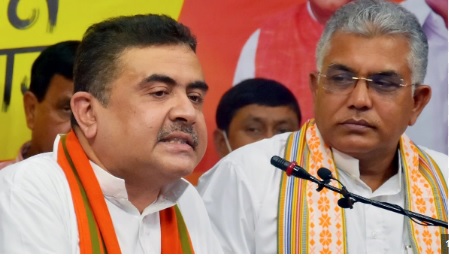
CM Suvendu Adhikari Revives Eastern Frontier Rifles, Targets Mamata on Gorkha Policy
West Bengal Chief Minister Suvendu Adhikari announced the revival of the Eastern Frontier Rifles (EFR) with 1,000 Gorkha youth recruitments, criticizing former CM Mamata Banerjee for allegedly stifling the force. He also unveiled a North Bengal development roadmap, while remaining silent on the Gorkhaland 'permanent political solution' during his Kurseong visit.
Key Highlights
- CM Adhikari announces revival of colonial-era Eastern Frontier Rifles.
- Over 1,000 Gorkha youths to be recruited into the EFR.
- Adhikari alleges Mamata Banerjee froze EFR recruitment, reduced battalions.
- CM pledges comprehensive development roadmap for North Bengal.
- Remains silent on 'permanent political solution' for Gorkhaland issue.
- Criticizes previous CM Mamata Banerjee for treating hills as 'tourist spot'.
West Bengal Chief Minister Suvendu Adhikari has announced the revival of the historic Eastern Frontier Rifles (EFR) and the recruitment of over 1,000 Gorkha youths into the force. The announcement was made during a public rally in Kurseong, Darjeeling district, on June 16, 2026. Adhikari, who assumed office as Chief Minister on May 9, 2026, after the BJP secured a majority in West Bengal, used the occasion to pay tribute to the valor and sacrifices of Gorkha soldiers and highlight his government's commitment to the region.
The 'Eastern Frontier Rifles' is a paramilitary force under the Bengal police, established in 1920, placing its origins within the colonial era. It has a significant history of predominantly recruiting Gorkhas and has participated in major conflicts including World War II, India-China conflicts, the 1965 India-Pakistan war, the Bangladesh Liberation War, and anti-Maoist insurgency operations. The force is headquartered at Salua in West Midnapore's Kharagpur.
During his address, Chief Minister Adhikari sharply criticized the previous state government led by Mamata Banerjee, alleging that it had 'frozen recruitment into the Eastern Frontier Rifles' and reduced the force to only two battalions. This accusation forms the basis of the headline's claim that 'Mamata tried to kill' the force, a sentiment explicitly voiced by Darjeeling MP Raju Bista. Adhikari further stated that unlike the former Chief Minister, who he claimed visited the hills 'as a tourist', he was there to work for the people and advance development. This directly corroborates and expands upon the context provided by related articles 1 and 4, which also mention Adhikari's criticism of Mamata Banerjee's approach to the hills.
Adhikari also unveiled a comprehensive roadmap for the development of North Bengal, assuring residents that all Central government welfare and development schemes would reach them smoothly. He promised transparency in government appointments and recruitment, vowing an end to corruption, and announced the establishment of a medical college in Kalimpong and the renovation of a major hospital in Kurseong. Plans also include efforts to reopen 25 closed tea gardens under the Pradhan Mantri Chaya Shramik Yojana and strengthen infrastructure, tourism, and sports facilities.
Notably, during his speech in Kurseong, Adhikari remained silent on the long-standing demand for a 'permanent political solution' (PPS) to the vexed Gorkhaland issue, a promise often highlighted by the BJP in its election manifestos. However, earlier on June 4, 2026, Suvendu Adhikari, in his capacity as Chief Minister, had met with Government of India interlocutor Pankaj Kumar Singh regarding the Gorkhaland issue, pledging full state government cooperation towards finding a constitutional solution. Darjeeling MP Raju Bista, who was present at the Kurseong rally, had previously expressed optimism that the dialogue process would gain momentum towards a permanent political solution. Mamata Banerjee's previous government, according to Raju Bista, had taken an 'outright antagonistic stand' and 'repeatedly refused to pursue the path of dialogue' concerning the Centre-appointed interlocutor for Gorkha issues. Banerjee herself had urged Prime Minister Modi to revoke the appointment of the interlocutor, citing constitutional concerns and regional stability.
Suvendu Adhikari's victory in the West Bengal elections, where he defeated Mamata Banerjee for a second consecutive time, marked a significant political shift, ending the Trinamool Congress's 15-year rule. His current visit and announcements in the Darjeeling hills are seen as crucial steps by the new BJP state government to address the aspirations and concerns of the Gorkha community, particularly after allegations of neglect and corruption under the previous administration.
Frequently Asked Questions
What is the Eastern Frontier Rifles (EFR)?
The Eastern Frontier Rifles (EFR) is a historic paramilitary force under the West Bengal police. It was formed in 1920 during the British colonial era and has a long tradition of recruiting predominantly from the Gorkha community. It has played roles in various conflicts and internal security operations.
What did Suvendu Adhikari announce regarding the EFR?
West Bengal Chief Minister Suvendu Adhikari announced the revival of the Eastern Frontier Rifles and pledged to recruit over 1,000 Gorkha youths into the force. He attributed the decline of the EFR to the previous Mamata Banerjee-led government, alleging it froze recruitment and reduced its battalions.
What is the 'permanent political solution' for Gorkhaland and Suvendu Adhikari's stance on it?
The 'permanent political solution' refers to the long-standing demand for a separate state of Gorkhaland or other significant administrative autonomy for the Gorkha community in the Darjeeling hills. While CM Adhikari discussed cooperation on the Gorkhaland issue with a Central interlocutor, he notably remained silent on the specific 'permanent political solution' during his recent public address in Kurseong.
How does Suvendu Adhikari's approach differ from Mamata Banerjee's, according to him?
Suvendu Adhikari criticized former CM Mamata Banerjee, stating that she visited the Darjeeling hills 'like a tourist' without focusing on genuine development. In contrast, Adhikari emphasized his government's commitment to a comprehensive development roadmap for North Bengal, promising transparent governance, job creation, and the effective implementation of Central schemes.
When was this news published and what is its significance?
This news was published on June 17, 2026. Its significance lies in being a major policy announcement by the newly elected Chief Minister of West Bengal, Suvendu Adhikari, directly addressing the Gorkha community and North Bengal. It also highlights the ongoing political rivalry between Adhikari and Mamata Banerjee and touches upon the historically sensitive Gorkhaland issue.