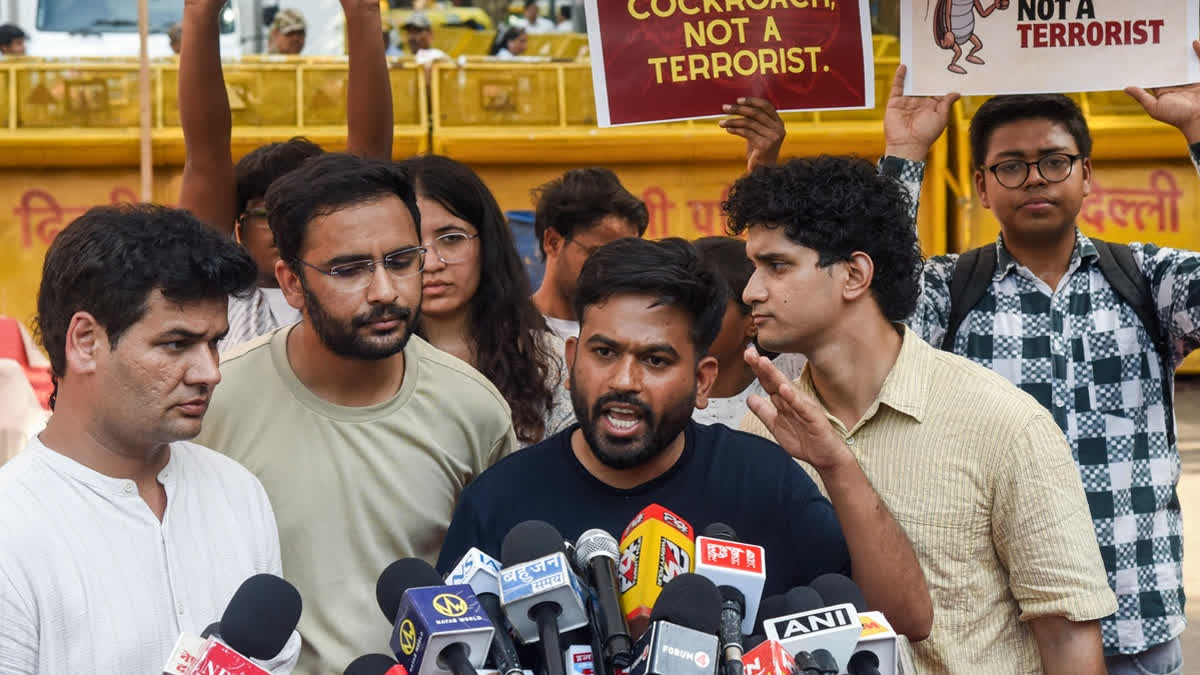
Sonam Wangchuk Joins CJP Hunger Strike Against Exam Irregularities
Climate activist Sonam Wangchuk began an indefinite hunger strike at Jantar Mantar, joining the Cockroach Janata Party's (CJP) protest. The agitation demands the resignation of Union Education Minister Dharmendra Pradhan over alleged irregularities in national examinations, particularly NEET-UG, and seeks broader reforms for transparency in the education system.
Key Highlights
- Sonam Wangchuk commenced indefinite hunger strike on June 28, 2026.
- Joined CJP's protest against alleged exam irregularities.
- Demands resignation of Education Minister Dharmendra Pradhan.
- CJP protest started on June 20, focused on NEET-UG concerns.
- Protest also advocates for accountability in education and Ladakh's environment.
- Hundreds of students, youth, and farmer leaders participated.
Climate activist Sonam Wangchuk commenced an indefinite hunger strike at Jantar Mantar in New Delhi on Sunday, June 28, 2026, lending significant weight to an ongoing protest initiated by the Cockroach Janata Party (CJP). The primary demand of the growing agitation is the resignation of Union Education Minister Dharmendra Pradhan, following widespread allegations of irregularities and paper leaks in major competitive examinations, most notably the NEET-UG medical entrance test.
The Cockroach Janata Party, abbreviated as CJP, emerged as a satirical political movement on May 16, 2026, founded by political communications strategist Abhijeet Dipke. The movement's name itself is a satirical response to remarks made by Chief Justice of India Surya Kant on May 15, 2026, who reportedly referred to some activists and unemployed youth as "cockroaches" and "parasites of society." This controversial statement sparked national outrage, prompting Dipke to harness the insult into a tool for protest, creating a mock political platform that quickly gained substantial traction online and evolved into a Gen-Z driven phenomenon. The CJP, while not officially registered as a political party, campaigns against broader societal, economic, and political issues affecting Indian youth.
The CJP's sit-in protest at Jantar Mantar began on June 20, 2026, advocating for accountability and transparency in the education system. Their core demands include the immediate resignation of Union Education Minister Dharmendra Pradhan and comprehensive reforms to prevent recurrent examination paper leaks and result delays. The movement gained further visibility when Sonam Wangchuk, a renowned education reformer and climate activist, announced his intention to join the protest and begin a hunger strike from June 28 if the government failed to address the demands related to the NEET paper leak allegations and accountability in education.
On the morning of June 28, 2026, before commencing his fast, Wangchuk, accompanied by CJP founder Abhijeet Dipke, visited Rajghat to pay tribute to Mahatma Gandhi, underscoring the non-violent nature of their protest. Hundreds of protesters, largely students, young professionals, and even some farmer leaders, gathered at Jantar Mantar to support the cause as Wangchuk began his indefinite hunger strike. The demonstration commenced with a two-minute silence, reflecting the gravity of the issues being raised.
Abhijeet Dipke, the CJP founder who returned from the United States to lead the protest, emphasized that the issues extend beyond a single examination, reflecting wider concerns over the integrity and reliability of the country's education system. He had previously appealed to farmers, students, and various organizations to join the protest to press for accountability over the alleged irregularities. Earlier on June 28, Dipke alleged on social media platform X that several farmer leaders from Uttar Pradesh, Haryana, and Punjab were being placed under house arrest to prevent them from reaching Jantar Mantar, highlighting concerns about potential suppression of the protest.
Wangchuk's involvement adds a significant voice to the student-led movement. He had previously articulated two key demands: ensuring accountability in the education system and addressing the long-standing demands for greater autonomy, environmental protection, and cultural preservation for Ladakh. His decision to undertake an indefinite fast signifies a strong resolve to see concrete action on these fronts. The protest has garnered widespread attention, with various civil society members and student groups joining the demonstrations, calling for reforms to ensure a fair and transparent examination process in the country. The presence of thousands of police personnel, along with CCTV surveillance and barricades at Jantar Mantar, indicated the high security arrangements surrounding the demonstration, which at its peak saw an estimated 2,000-2,500 protesters. The CJP had also planned an indefinite sit-in from June 20 if their demands were not met, showcasing a sustained commitment to their objectives.
The unfolding events at Jantar Mantar underscore a significant moment of youth and activist engagement in India, focusing on critical issues of educational integrity and governmental accountability. The satirical origins of the CJP, combined with the serious commitment of figures like Sonam Wangchuk, highlight a multifaceted approach to protest in contemporary India.
Frequently Asked Questions
Who is Sonam Wangchuk and why is he protesting?
Sonam Wangchuk is a renowned Indian education reformer and climate activist. He joined the protest and began an indefinite hunger strike at Jantar Mantar to demand accountability in the education system, specifically concerning alleged irregularities and paper leaks in national competitive examinations like NEET-UG, and to press for the resignation of Union Education Minister Dharmendra Pradhan. He also advocates for the protection of Ladakh's environment and culture.
What is the Cockroach Janata Party (CJP)?
The Cockroach Janata Party (CJP) is a youth-based satirical political movement founded by Abhijeet Dipke on May 16, 2026. It emerged as a response to a remark by the Chief Justice of India, who allegedly called some activists and unemployed youth 'cockroaches.' The CJP aims to highlight issues affecting Indian youth, primarily focusing on transparency and accountability in the education and examination system.
What are the main demands of the protest at Jantar Mantar?
The main demands of the protest include the immediate resignation of Union Education Minister Dharmendra Pradhan due to alleged irregularities and paper leaks in competitive examinations like NEET-UG. Protesters also seek comprehensive reforms to ensure transparency, fairness, and accountability in the country's examination and education system, along with compensation for students affected by these issues.
When did the protest start and how many people are involved?
The Cockroach Janata Party (CJP) initiated its protest at Jantar Mantar on June 20, 2026. Sonam Wangchuk joined the protest and began his indefinite hunger strike on June 28, 2026. Hundreds of protesters, including students, young people, and various farmer leaders, have gathered at Jantar Mantar to participate in the agitation. At its peak, the protest site saw an estimated 2,000-2,500 participants.
Why is the NEET-UG examination a key issue in this protest?
The NEET-UG examination is a key issue because of widespread allegations of a paper leak and other irregularities that have undermined public trust in the examination process. This controversy has led to demands for greater accountability from the government and the resignation of the Union Education Minister.