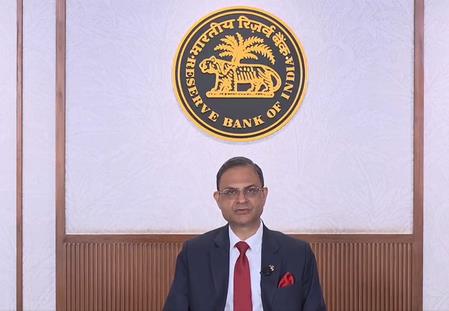
RBI Maintains Repo Rate at 5.25%; Upgrades GDP, Inflation Outlook
The Reserve Bank of India (RBI) has kept the repo rate unchanged at 5.25% in its February 2026 monetary policy review. The central bank also revised its GDP growth forecast for FY2025-26 upwards to 7.4% and provided inflation projections for the coming quarters.
Key Highlights
- RBI's Monetary Policy Committee (MPC) unanimously kept the repo rate at 5.25%.
- GDP growth forecast for FY2025-26 upgraded to 7.4% from 7.3%.
- Q1 FY27 GDP growth projected at 6.9%, Q2 FY27 at 7.0%.
- CPI inflation for FY2025-26 projected at 2.1%, Q4 at 3.2%.
- Q1 FY27 inflation at 4.0%, Q2 FY27 at 4.2%.
- Maintaining a 'neutral' stance, the RBI noted resilient economic activity.
The Reserve Bank of India (RBI) announced on Friday, February 6, 2026, its latest bi-monthly monetary policy decision, with the Monetary Policy Committee (MPC) opting to keep the key repo rate unchanged at 5.25%. This decision aligns with market expectations, signaling the central bank's confidence in India's economic resilience amidst a challenging global environment. The 'status quo' on the repo rate means that the rate at which commercial banks borrow money from the RBI remains stable, influencing lending rates for various loans, including home loan EMIs, and returns on fixed deposits.
The MPC, headed by RBI Governor Sanjay Malhotra, concluded its deliberations, unanimously voting to maintain the policy repo rate. Consequently, the Standing Deposit Facility (SDF) rate remains at 5.00%, and the Marginal Standing Facility (MSF) rate and the Bank Rate are held at 5.50%. This marks the first monetary policy decision following the Union Budget 2026-27 and the recently concluded India-US trade agreement, both of which are significant factors influencing the economic outlook.
On the growth front, the RBI presented an optimistic outlook, revising its real GDP growth forecast for FY2025-26 upwards to 7.4%, a modest increase from the earlier estimate of 7.3%. The central bank highlighted that the Indian economy continues on a steadily improving trajectory, driven by robust domestic factors, including private consumption and fixed investment. For the first half of FY2026-27, GDP growth projections were also revised upwards, with Q1 anticipated at 6.9% (up from 6.7%) and Q2 at 7.0% (up from 6.8%). The RBI deferred its full-year GDP projection for FY27 to the April policy review, pending the release of a new GDP series.
Regarding the inflation outlook, the RBI projected CPI inflation for FY2025-26 at 2.1%, with the fourth quarter (Q4) at 3.2%. For the initial quarters of the next fiscal year, CPI inflation is projected at 4.0% for Q1 FY2026-27 and 4.2% for Q2 FY2026-27. The RBI noted that headline CPI inflation remained low in November and December 2025, although it firmed up slightly due to a lower rate of deflation in the food group. Core inflation, excluding the volatility of precious metals, is expected to remain muted, indicating that underlying price pressures are unlikely to accelerate sharply. Similar to GDP, the full-year CPI inflation projection for FY2026-27 will be shared in the April policy, considering the impending release of the new CPI series (base 2024=100) on February 12, 2026.
Governor Malhotra emphasized that the domestic inflation and growth outlook remain positive, with the Indian economy exhibiting resilience despite intensified external headwinds. The MPC maintained a 'neutral' stance, indicating flexibility in future policy actions based on evolving macroeconomic conditions. This stance suggests that the RBI is prepared to adjust its policy either way if conditions warrant, balancing growth support with inflation management. The successful completion of recent trade deals and government measures are expected to further bolster exports and overall economic momentum.
The central bank highlighted that economic activity is expected to hold up well in the upcoming financial year, supported by healthy reservoir levels, robust rabi sowing, and improved crop vegetation conditions, which will boost agricultural activity. Furthermore, improving corporate sector performance and sustained momentum in the informal sector are expected to enhance manufacturing. The construction sector is anticipated to remain firm, driven by continued infrastructure spending, and the services sector is expected to remain resilient due to strengthening domestic demand. Urban demand, improving labor market conditions, and easing inflationary pressures are also expected to sustain household spending.
In essence, the RBI's February 2026 monetary policy review reflects a cautiously optimistic approach, balancing robust economic growth with manageable inflation, while keeping an eye on global uncertainties. The decision to maintain the repo rate signals stability and provides a clear direction for financial markets and consumers alike.
Frequently Asked Questions
What is the current repo rate in India?
As of February 6, 2026, the Reserve Bank of India (RBI) has maintained the repo rate at 5.25%.
How does the unchanged repo rate affect common people?
An unchanged repo rate generally means that the interest rates on loans (like home loans, car loans) and returns on savings instruments (like fixed deposits) are likely to remain stable, as banks' borrowing costs from the RBI have not changed.
What is India's projected GDP growth for FY2025-26?
The RBI has revised India's real GDP growth projection for FY2025-26 upwards to 7.4%.
What is the RBI's inflation outlook for FY2025-26 and early FY2026-27?
For FY2025-26, CPI inflation is projected at 2.1%, with Q4 at 3.2%. For Q1 FY2026-27, it's projected at 4.0%, and for Q2, at 4.2%.
What does 'status quo' or 'neutral stance' mean in RBI monetary policy?
A 'status quo' refers to keeping the policy rates unchanged. A 'neutral stance' indicates that the RBI remains flexible to either hike or cut rates in the future, depending on evolving macroeconomic conditions, balancing growth and inflation objectives.