Astronomers Find Unexpected Nebula Around Dead Star, Challenging Theories | Quick Digest
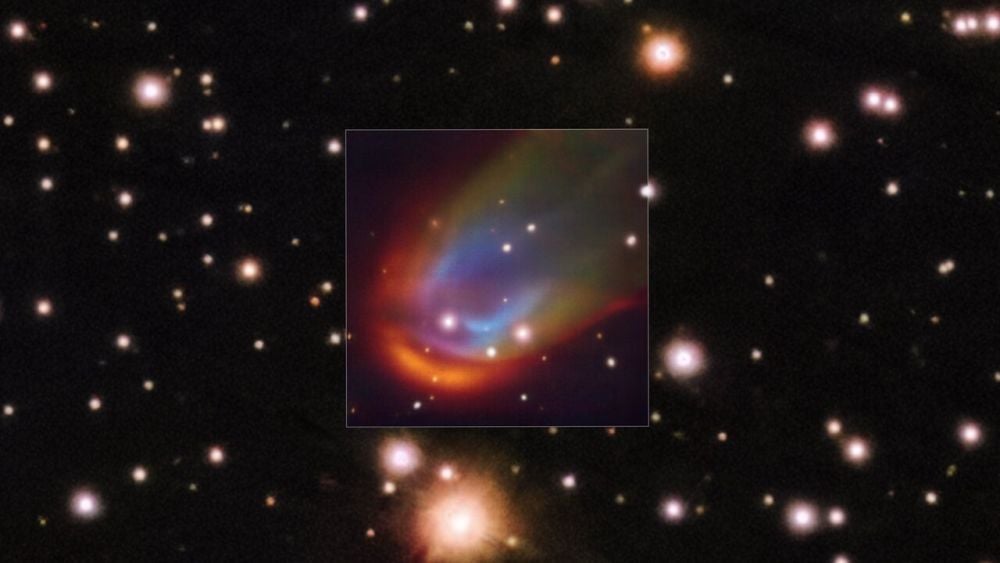
Astronomers have discovered a striking shockwave, or nebula, around a white dwarf star named RXJ0528+2838, a finding that defies existing theories. This 'dead star' system, without the usual accretion disk, is generating powerful outflows, hinting at a mysterious, unknown energy source. The discovery challenges our understanding of how such binary star systems interact.
A massive, bow-shaped nebula discovered around a white dwarf star.
The white dwarf RXJ0528+2838 lacks a typical accretion disk.
Powerful outflows are driven by an unknown 'mystery engine'.
Current theories on dead star interactions are being challenged.
Strong magnetic fields are suspected but don't fully explain the phenomenon.
Discovery made using the Very Large Telescope (VLT) in Chile.
Astronomers have made a significant discovery, observing a large, glowing shockwave — a nebula — around a white dwarf star designated RXJ0528+2838, approximately 730 light-years from Earth. This 'dead star' is part of a binary system, accreting material from a companion star. The surprise stems from the fact that this system lacks a visible accretion disk, a common feature in such binaries that is typically responsible for generating powerful outflows and nebulae. Scientists described this as a rare 'wow' moment, as the existence of such a dramatic structure around a supposedly quiet, discless system contradicts existing astronomical theories regarding how matter moves and interacts in these extreme environments.
The bow-shaped nebula, observed in detail using the European Southern Observatory's Very Large Telescope (VLT) in Chile, suggests a long-lasting outflow, potentially persisting for at least a thousand years. While researchers speculate that a strong magnetic field of the white dwarf plays a role in channeling material and driving this outflow, current calculations indicate that the magnetic field alone is insufficient to power the shockwave for such an extended period. This discrepancy leads to the concept of a 'mystery engine' — an as-yet unexplained energy source — that must be at play. The discovery challenges the standard picture of stellar evolution and how dead stars interact with their surroundings, prompting astronomers to rethink established models. Further studies of similar binary systems, potentially with advanced instruments like the forthcoming Extremely Large Telescope (ELT), will be crucial in unraveling this cosmic enigma.
Read the full story on Quick Digest