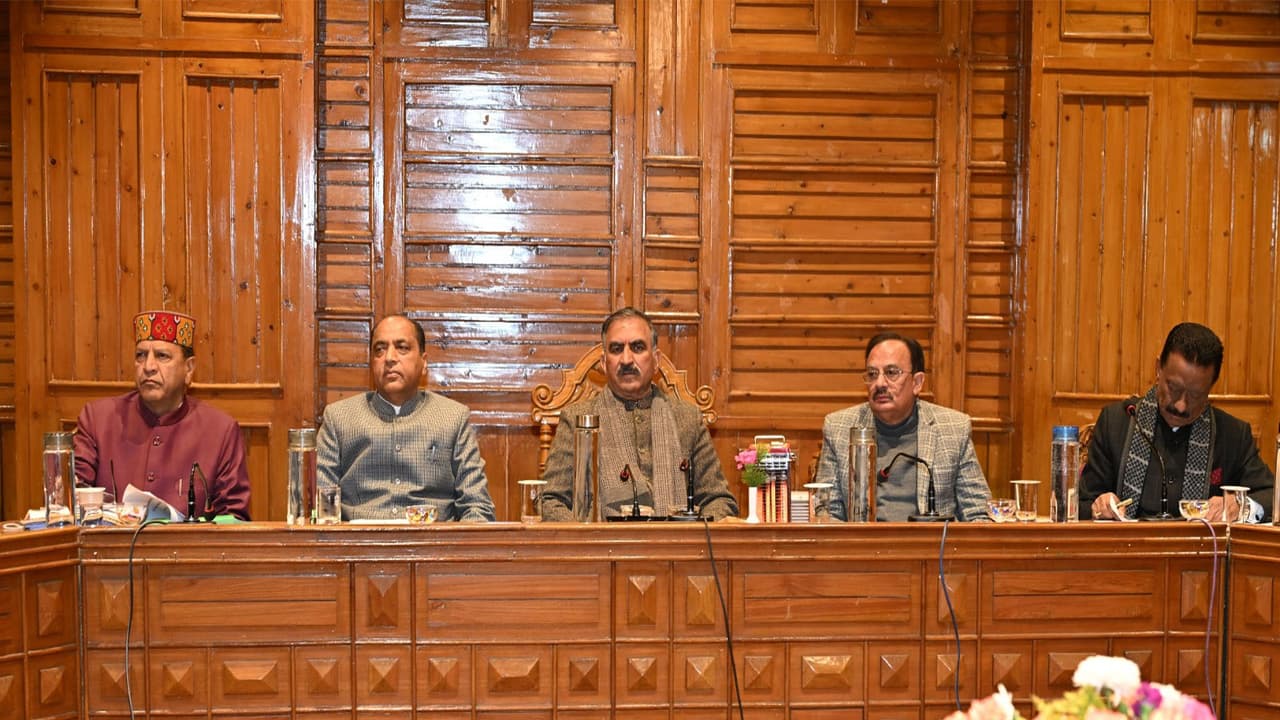
Himachal RDG Row: BJP Walks Out of All-Party Meet, Slams Congress
BJP leaders walked out of an all-party meeting in Himachal Pradesh on the Revenue Deficit Grant (RDG), accusing the Congress government of propaganda and fiscal mismanagement. Chief Minister Sukhvinder Singh Sukhu criticized the BJP for not supporting the state's demand to restore the crucial grant, stating they were in a 'tight position'.
Key Highlights
- BJP walked out of all-party meet on Revenue Deficit Grant.
- Accused Congress government of politicizing financial issues.
- CM Sukhu criticized BJP for not backing state's RDG demands.
- RDG withdrawal by 16th Finance Commission impacts state's finances.
- Himachal faces significant fiscal deficit without the grant.
- Meeting aimed to build consensus on pressuring the Centre for RDG.
An all-party meeting convened by Himachal Pradesh Chief Minister Sukhvinder Singh Sukhu to discuss the proposed discontinuation of the Revenue Deficit Grant (RDG) by the 16th Finance Commission ended abruptly with the main opposition Bharatiya Janata Party (BJP) staging a walkout. The incident, reported by The Indian Express and corroborated by multiple other credible news outlets, highlights a deepening political confrontation over a critical financial issue for the hill state.
The meeting, held on Friday, February 13, 2026, aimed to build a consensus among political parties to collectively press the Union government for the restoration of the RDG. However, BJP leaders, including state president Rajeev Bindal and Leader of Opposition Jai Ram Thakur, walked out midway, accusing the Congress-led state government of engaging in 'propaganda' and using the meeting for a 'political agenda.' They alleged that the Congress government was attempting to shift the blame for its own financial mismanagement onto the Centre.
Chief Minister Sukhu, in response, strongly criticized the BJP's actions, stating that their leaders were in a 'tight position' as they understood the negative implications of RDG discontinuation for the state but were unwilling to speak against the Centre. He emphasized that the issue concerned the rights and financial stability of Himachal Pradesh, transcending party lines. Sukhu highlighted that the all-party meeting was called on the insistence of the BJP itself and expressed disappointment that they left without offering constructive suggestions.
**The Revenue Deficit Grant (RDG) and its Impact:**
The Revenue Deficit Grant is a crucial post-devolution grant recommended by the Finance Commission to states whose revenue receipts fall short of their revenue expenditure, even after receiving their share of central taxes. It is a constitutional mechanism under Article 275(1) meant to help states, especially those with inherent structural disadvantages like Himachal Pradesh, bridge their fiscal deficit. Himachal Pradesh, being a special category hill state with difficult terrain, a limited industrial base, and high infrastructure costs, has historically relied heavily on RDG to fund committed liabilities such as salaries, pensions, and social sector schemes.
The 16th Finance Commission's recommendation to discontinue RDG beyond March 2026 has plunged Himachal Pradesh into a severe financial crisis. The state's Finance Secretary has warned of a 'catastrophic' situation, projecting a resource gap of around ₹6,000 crore for FY 2026-27, even after excluding development works and pending liabilities. Over the next five years, the state is estimated to lose between ₹40,000 to ₹50,000 crore due to this discontinuation, which amounts to approximately 25% of its revenue base.
**Arguments from Both Sides:**
The Congress government, led by CM Sukhu, views the discontinuation of the RDG as a serious threat to the state's financial backbone and a violation of its constitutional rights. Sukhu has stated that the state will fight this decision politically and legally, urging Prime Minister Narendra Modi's intervention to restore the grant. He pointed out that while Himachal is a 'producer state,' its tax collection growth has plummeted in the post-GST regime, further limiting its ability to generate internal revenue.
On the other hand, the BJP maintains that the reduction of RDG was a phased process outlined by previous Finance Commissions, and the state government should have prepared for it by strengthening its own revenue generation. BJP leaders accused the Sukhu government of failing to present Himachal's case effectively before the Finance Commission and attempting to mask its own financial mismanagement. They also objected to what they termed 'objectionable language' used against central government ministers and the Prime Minister during the meeting. Former CM Jai Ram Thakur emphasized that the discussion should rise above party lines, stating that the RDG was always meant as tapering support, not a permanent entitlement.
Despite the political squabble, representatives from other parties like AAP and BSP reportedly supported the need for financial assistance from the Centre and for the state to collectively raise its voice for its rights. The CPI(M) leader Rakesh Singha also echoed the need for unity, warning that losing the RDG would cripple the state's economy.
This incident underscores the complex financial challenges faced by certain Indian states and the political dynamics at play in the distribution of central grants and fiscal responsibilities.
Frequently Asked Questions
What is the Revenue Deficit Grant (RDG)?
The Revenue Deficit Grant (RDG) is a financial assistance provided by the central government to states whose revenue income is less than their revenue expenditure, even after receiving their share of central taxes. It is a constitutional provision under Article 275(1) aimed at helping states, especially those with inherent financial disadvantages, meet their essential expenses.
Why is the RDG crucial for Himachal Pradesh?
Himachal Pradesh, being a special category hill state with limited revenue-generating avenues and high developmental costs due to its geography, has historically been heavily dependent on the RDG to fund crucial government operations, salaries, pensions, and social welfare schemes. Its discontinuation is projected to create a significant fiscal gap of thousands of crores annually.
What are the key points of contention between the Congress and BJP regarding the RDG?
The Congress government blames the 16th Finance Commission's recommendation to discontinue the RDG as a severe blow to the state's finances and a violation of its constitutional rights, urging central intervention. The BJP, conversely, accuses the state government of fiscal mismanagement, politicizing the issue, and failing to adequately prepare for the phased reduction of the RDG, which they claim was outlined by previous Finance Commissions.
What are the financial implications for Himachal Pradesh if the RDG is discontinued?
If the RDG is discontinued as recommended, Himachal Pradesh faces an estimated annual resource gap of around ₹6,000 crore for FY 2026-27, with potential losses of ₹40,000 to ₹50,000 crore over the next five years. This could severely impact the state's ability to fund committed liabilities, maintain development works, and provide essential public services, potentially leading to 'peak austerity' measures.