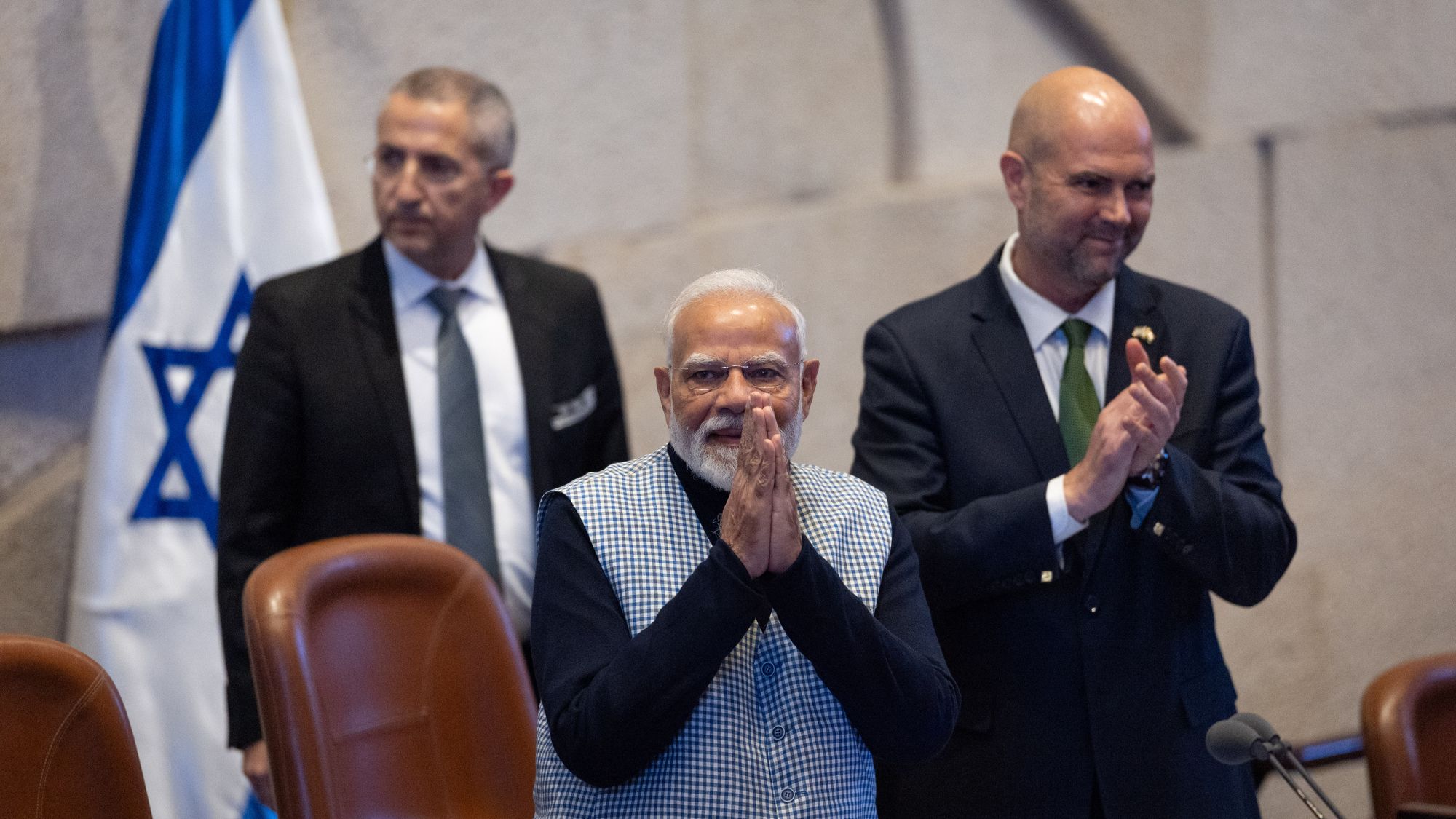
PM Modi Visits Yad Vashem in Israel, Deepening Strategic Ties
Prime Minister Narendra Modi visited Yad Vashem, the World Holocaust Remembrance Center, during his two-day state visit to Israel, paying homage to Holocaust victims. This marks his second visit, aimed at strengthening India-Israel strategic partnership, fostering cooperation in defence, technology, and trade, and addressing regional and global challenges. The visit underscores growing diplomatic and economic ties.
Key Highlights
- PM Modi paid respects at Yad Vashem during his two-day Israel visit.
- Accompanied by PM Netanyahu, he honored Holocaust victims.
- This is Modi's second visit to the Holocaust memorial.
- Visit included addressing Knesset and meeting President Herzog.
- Focus areas: defence, technology, trade, and regional stability.
- Underscores India-Israel's evolving strategic partnership.
Prime Minister Narendra Modi embarked on a significant two-day state visit to Israel from February 25-26, 2026, marking his second official trip to the Jewish nation. A central and deeply symbolic engagement of this visit was his solemn visit to Yad Vashem, the World Holocaust Remembrance Center in Jerusalem, on Thursday, February 26, 2026.
Accompanied by Israeli Prime Minister Benjamin Netanyahu and Yad Vashem Chairman Dani Dayan, PM Modi paid profound homage to the six million Jews who perished during the Holocaust. During the ceremony, he laid a wreath in the Hall of Remembrance, observed a moment of silence as the Kaddish prayer was recited, and toured the poignant Hall of Names, also known as the Book of Names Hall, which preserves the identities and testimonies of millions of victims. He also signed the visitors' book, reiterating the importance of preserving historical memory to prevent such tragedies from recurring and reaffirming a shared commitment to peace and human dignity.
This visit to Yad Vashem held particular significance as it was Prime Minister Modi's second, following his landmark first trip to Israel in July 2017, when he became the first sitting Indian Prime Minister to visit the country. His prior visit also included a deeply moving ceremony at the Holocaust memorial, where he had written in the guest book about being 'deeply moved' and how Yad Vashem serves as a mirror to society, urging humanity not to forget past injustices. The recurrence of this visit underscores the enduring importance India places on acknowledging shared historical sensitivities and strengthening its relationship with Israel.
The broader context of PM Modi's two-day itinerary encompassed a comprehensive agenda aimed at elevating the India-Israel strategic partnership. On Wednesday, February 25, 2026, he made history by becoming the first Indian Prime Minister to address a Special Plenary of the Knesset, Israel's Parliament. In his address, he delivered a powerful message of solidarity with Israel, unequivocally condemning the barbaric terrorist attack by Hamas on October 7, 2023. He emphasized India's consistent and uncompromising policy of zero tolerance for terrorism, highlighting that 'terrorism anywhere threatens peace everywhere' and called for sustained and coordinated global action against the menace. During this historic address, he was also conferred the 'Speaker of the Knesset Medal,' Israel's highest parliamentary honor.
Further cementing bilateral ties, Prime Minister Modi held a productive meeting with Israeli President Isaac Herzog on Thursday. Their discussions centered on deepening strategic cooperation across various sectors, including education, start-ups, innovation, technology, and connectivity. President Herzog underscored India's crucial role in the future of the Middle East, expressing keen interest in leveraging India's economic growth. PM Modi extended an invitation to President Herzog to visit India, fostering greater people-to-people exchanges.
High-level delegation talks were also held with Prime Minister Benjamin Netanyahu, focusing on critical areas such as defence cooperation, advanced technology partnerships, trade, and innovation. Both nations are reportedly on the cusp of signing landmark defence agreements, with a particular emphasis on the transfer of cutting-edge technologies like the Iron Dome, Iron Beam, and advanced missile systems, rather than mere arms sales. This aligns with India's 'Make in India' initiative, promoting joint development and production. Economic engagement was also a key agenda item, with discussions progressing on a Free Trade Agreement (FTA) between India and Israel. The first round of FTA negotiations had already commenced in New Delhi concurrently with the visit, aiming for a predictable and transparent framework for businesses.
The visit also included an interaction with the vibrant Indian diaspora in Israel and a tour of a technology exhibition in Jerusalem, showcasing Israel's advancements in artificial intelligence, quantum computing, cybersecurity, and healthcare. These engagements underscore the multifaceted nature of the India-Israel relationship, which has seen significant growth since the establishment of full diplomatic relations in 1992.
The visit is widely perceived as a move to elevate the relationship to 'special strategic relations,' a designation Israel typically reserves for its closest allies. This deepening partnership is rooted in shared values of democracy and a common resolve to confront global challenges, particularly terrorism. While the visit garnered widespread praise, it also drew criticism from some opposition parties in India regarding its timing and implications for India's traditional stance on the Palestinian issue, given the ongoing conflict in Gaza. However, Prime Minister Modi also expressed India's firm support for the Gaza Peace Initiative endorsed by the UN Security Council, balancing India's strategic interests with its long-standing commitment to peace and stability in the region.
Overall, Prime Minister Modi's visit to Israel, marked by his respectful homage at Yad Vashem and extensive diplomatic engagements, signifies a pivotal moment in India-Israel relations, charting a course for enhanced cooperation across critical sectors and reinforcing their enduring friendship on the global stage.
Frequently Asked Questions
When did Prime Minister Modi visit Yad Vashem during his latest trip to Israel?
Prime Minister Narendra Modi visited Yad Vashem, the World Holocaust Remembrance Center, on Thursday, February 26, 2026, as part of his two-day state visit to Israel.
What was the significance of PM Modi's visit to Yad Vashem?
The visit to Yad Vashem was a deeply symbolic gesture to honor the victims of the Holocaust and reaffirm a shared global commitment to peace and human dignity. It underscored the strengthening of India-Israel relations and acknowledged shared historical sensitivities.
Was this Prime Minister Modi's first visit to the Holocaust memorial?
No, this was Prime Minister Modi's second visit to Yad Vashem. He had previously paid homage at the memorial in July 2017 during his first landmark visit to Israel.
What other key engagements did PM Modi have during his Israel visit?
During his two-day state visit, PM Modi also addressed the Israeli Parliament (Knesset), becoming the first Indian Prime Minister to do so, met with Israeli President Isaac Herzog, and held delegation-level talks with Prime Minister Benjamin Netanyahu to discuss cooperation in defence, technology, trade, and regional stability.
What were the main outcomes expected from this state visit?
The visit aimed to further consolidate the India-Israel Strategic Partnership, with anticipated agreements and MoUs, particularly in defence cooperation (e.g., technology transfer for advanced missile systems) and the progression towards a Free Trade Agreement. The visit was also crucial for discussing regional developments and enhancing collaboration in innovation and technology.