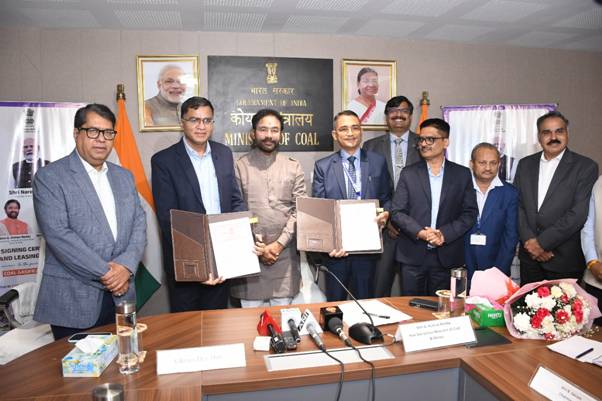
India Plans ₹37,500 Cr Coal Gasification to Boost Self-Reliance
India's Cabinet is set to approve a ₹37,500 crore incentive scheme for coal gasification projects. This significant push aims to reduce the country's dependence on imported LNG, urea, and other critical chemicals, fostering energy security and 'Atmanirbhar Bharat' (self-reliant India).
Key Highlights
- Cabinet approval imminent for ₹37,500 Cr coal gasification scheme.
- Aims to significantly cut imports of LNG, urea, and other chemicals.
- Scheme supports India's target of 100 million tonnes coal gasification by 2030.
- This new scheme is larger than previous ₹8,500 Cr initiative.
- Focus on converting domestic coal into high-value fuels and chemicals.
- Strengthens energy security amidst global supply chain volatilities.
India is on the verge of launching a substantial initiative to bolster its energy security and reduce reliance on critical imports, with the Union Cabinet poised to approve an incentive scheme worth ₹37,500 crore for coal gasification projects. Multiple credible sources reported this development on May 3, 2026, indicating that the Coal Ministry has already prepared a Cabinet note for the scheme. The proposed scheme represents a significant strategic pivot, leveraging India's vast domestic coal reserves to produce a range of fuels and chemicals, thereby lessening the country's vulnerability to global supply chain disruptions and price volatilities.
The primary objective of this ambitious program is to reduce India's import dependence on vital commodities such as Liquefied Natural Gas (LNG), urea, ammonium nitrate, ammonia, coking coal (via Direct Reduced Iron, or DRI), methanol, and Dimethyl Ether (DME). Currently, India imports a substantial portion of its energy and chemical needs, including approximately 83% of its crude oil, nearly 50% of its natural gas, and over 90% of key inputs like methanol and fertilizers. The strategic importance of this move is further highlighted by recent geopolitical tensions in West Asia, which have exposed India's vulnerabilities to disruptions in hydrocarbon supplies.
This new ₹37,500 crore scheme is distinct from, and substantially larger than, a previous ₹8,500 crore financial incentive scheme for the promotion of coal and lignite gasification projects, which was approved in January 2024. While the older scheme provided financial assistance under three categories with maximum incentives of up to ₹1,350 crore for public sector undertakings (PSUs) and ₹1,000 crore for the private sector, the upcoming ₹37,500 crore scheme is described as a 'unified scheme with no categories,' offering a maximum financial assistance of ₹3,000 crore for a single project. This indicates a broader and more substantial commitment to accelerating large-scale projects.
Indeed, the Ministry of Coal has already been actively implementing components of the earlier scheme. In late April 2026, the Ministry issued Letters of Award (LoA) under Category III of Round II of the ₹8,500 crore financial incentive scheme. For instance, an LoA was granted to Kartikay Vayunandana Private Limited to establish a coal-to-acetic acid small-scale plant in Gadchiroli, Maharashtra, with an investment of ₹793 crore. This project is expected to produce 75,900 tonnes of acetic acid per annum, contributing to indigenous production of downstream chemicals and reducing import dependence. Seven projects are already under implementation from Round One of the initial scheme.
Coal gasification is a thermochemical process that converts coal into synthesis gas, or 'syngas,' which is primarily a mixture of hydrogen and carbon monoxide. This syngas can then serve as a versatile feedstock for manufacturing various products such as synthetic natural gas, methanol, ethanol, ammonia (for fertilizers), petrochemicals, and hydrogen. By reframing coal from merely a combustion fuel to a valuable chemical resource, India aims for optimal utilization of its abundant domestic coal resources, estimated at around 400 billion tonnes.
The overarching national goal is to achieve 100 million tonnes of coal gasification capacity by 2030, supported by significant investments. This mission aligns with the government's 'Atmanirbhar Bharat' vision, aiming for self-reliance and enhancing the country's industrial ecosystem through cleaner and more efficient utilization of coal. Beyond import substitution, coal gasification is expected to generate significant investments, revenues, and employment, fostering regional economic prosperity by linking mining, energy, fertilizers, and petrochemicals into integrated industrial ecosystems. The move is also seen as a step towards cleaner energy production, as gasification can significantly reduce the environmental impact compared to direct coal combustion by allowing for the separation and capture of CO2 and other pollutants.
Frequently Asked Questions
What is the primary objective of India's new coal gasification incentive scheme?
The primary objective is to boost domestic production of fuels and chemicals through coal gasification, significantly reducing India's import dependence on critical commodities like LNG, urea, ammonia, methanol, and more, thereby enhancing energy security and self-reliance (Atmanirbhar Bharat).
How much financial support is proposed for this new coal gasification scheme?
The Indian Cabinet is poised to approve a substantial financial outlay of ₹37,500 crore for this new incentive scheme, making it a significant investment in the sector.
How does this new ₹37,500 crore scheme compare to previous government initiatives for coal gasification?
This new scheme is considerably larger than the earlier ₹8,500 crore financial incentive scheme approved in January 2024. While the previous scheme had categorized support, the new ₹37,500 crore initiative is a unified scheme with a higher maximum financial assistance of ₹3,000 crore for a single project.
What are the key benefits of coal gasification for India's economy and energy security?
Coal gasification offers multiple benefits, including reducing import bills for energy and chemicals, fostering domestic industrial growth, creating employment, utilizing abundant indigenous coal resources more efficiently, and providing a cleaner alternative to direct coal combustion by producing syngas for various applications.
What is India's national target for coal gasification capacity?
India aims to achieve 100 million tonnes (MT) of coal gasification capacity by the year 2030, a target that the current and previous incentive schemes are designed to support.