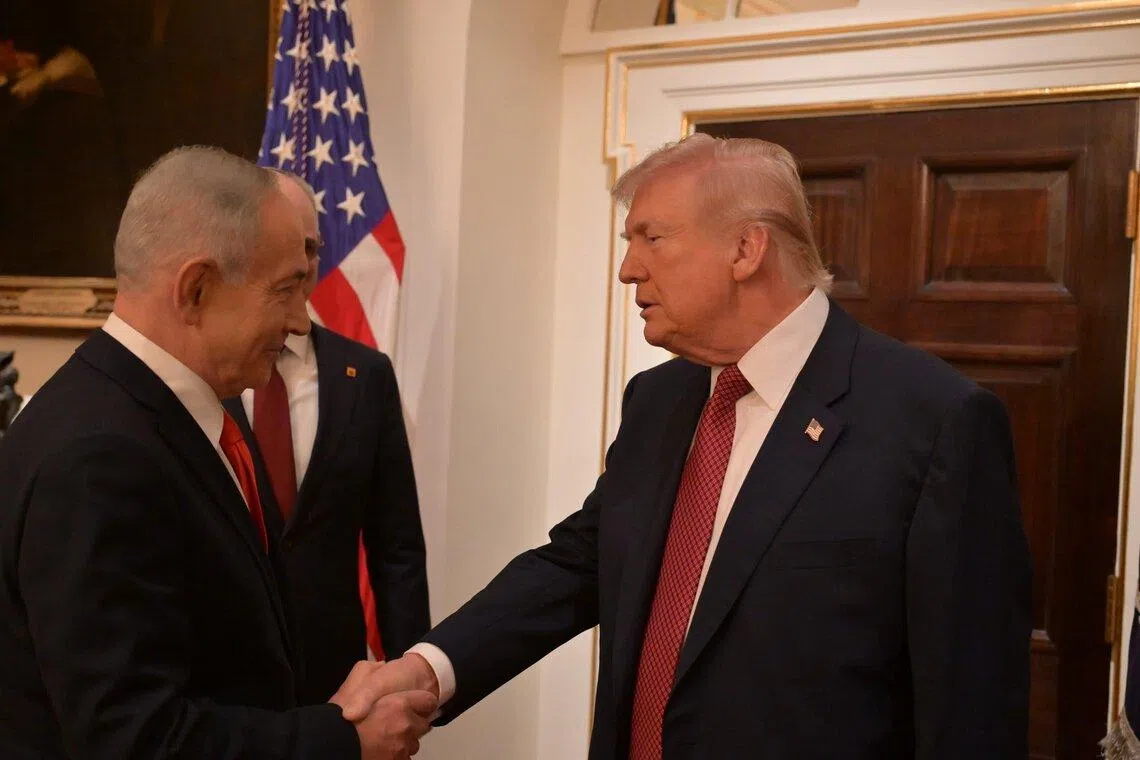
Trump Urges Iran Nuclear Talks Continuation, Vance Warns of Military Option
President Donald Trump urged Israeli Prime Minister Benjamin Netanyahu to continue nuclear negotiations with Iran, emphasizing a preference for a deal while warning of severe consequences if talks fail. Simultaneously, Vice President J.D. Vance issued a stern warning to Iran, stating that military force remains an option should diplomacy falter, citing concerns over nuclear proliferation. These developments follow recent indirect talks between US and Iranian officials in Oman.
Key Highlights
- Trump insisted on continuing Iran nuclear talks with Netanyahu.
- Vance warned Iran of military action if nuclear deal fails.
- US and Iran held recent indirect nuclear negotiations in Oman.
- Netanyahu sought to expand talks beyond nuclear program to missiles.
- Israel accused of attempting to sabotage ongoing US-Iran negotiations.
- Concerns rise over Iran's nuclear proliferation potential in the region.
In a significant diplomatic push amidst escalating regional tensions, former US President Donald Trump recently urged Israeli Prime Minister Benjamin Netanyahu to continue negotiations with Iran regarding its nuclear program. The appeal came during a three-hour meeting between Trump and Netanyahu on Wednesday, February 11, 2026, in Washington. Following the meeting, Trump conveyed his stance on social media, indicating that while no definitive agreement was reached, he 'insisted that negotiations with Iran continue to see whether or not a Deal can be consummated.' He further added that if a deal is possible, it would be 'a preference,' but cautioned Tehran with a veiled threat, stating, 'Last time Iran decided that they were better off not making a Deal, they were hit with Midnight Hammer – That did not work well for them.' This statement referenced the US strikes on Iranian nuclear sites in June 2025.
Israeli Prime Minister Netanyahu, during his visit, reportedly aimed to broaden the scope of these negotiations beyond Iran's nuclear capabilities to include its ballistic missile program and its support for regional militant groups like Hamas and Hezbollah. However, reports suggest that Trump, despite acknowledging Netanyahu's concerns, maintained a primary focus on the nuclear aspect of the talks.
Adding to the pressure on Tehran, US Vice President J.D. Vance issued a stark warning to Iran, emphasizing that military force remains 'another option on the table' if a nuclear agreement with Washington is not achieved. Speaking ahead of the Trump-Netanyahu meeting, Vance underscored the administration's singular objective: to prevent the current Iranian government from acquiring nuclear weaponry. He articulated that while the president seeks a diplomatic solution, he would 'continue to preserve his options' if a deal cannot be cut, citing the immense power of the American military. Vance also raised serious concerns about potential nuclear proliferation on a global scale, particularly in the Middle East, should Iran obtain nuclear weapons, suggesting that countries like Saudi Arabia might follow suit.
These high-stakes diplomatic and military posturing take place against the backdrop of recent indirect talks between US and Iranian officials held in Oman. These negotiations signaled cautious optimism in both capitals about potentially reviving stalled discussions. However, Iran's chief security official, Ali Larijani, accused Israel of actively attempting to sabotage these ongoing nuclear negotiations with the United States. Larijani, in an interview with Al Jazeera, claimed that Israel is fabricating pretexts to derail the talks and unleash a new war, warning that any US military action against Iran would be met with a direct response, targeting American bases in the region. He reiterated Iran's position that its missile program is not subject to negotiation and that Tehran has not received any concrete proposal from the United States thus far.
The overall status of Iran's nuclear program indicates that since May 2019, following the US withdrawal from the Joint Comprehensive Plan of Action (JCPOA) in 2018, Iran has continued to violate the terms of the agreement. It has increased its uranium enrichment activities to up to 60%, significantly beyond the 3.67% permitted, and expanded its enrichment capabilities. The International Atomic Energy Agency (IAEA) has expressed difficulty in inspecting and verifying Iran's nuclear stockpile for months. Despite these advancements, US intelligence assessments in November 2024 suggested that Iran is not currently pursuing the development of a nuclear device, but its activities 'better position it to produce a nuclear device, if it chooses to do so.'
The renewed focus on Iran's nuclear program and regional stability underscores the complex geopolitical landscape, with the US maintaining a bolstered military presence in the Middle East. Turkish Foreign Minister Hakan Fidan also indicated that both the US and Iran are showing flexibility, with Washington appearing willing to tolerate some Iranian enrichment within clear boundaries. This situation holds significant implications for global stability and directly impacts India's interests in energy security and regional trade.
Frequently Asked Questions
What was the primary outcome of the meeting between Trump and Netanyahu?
During their meeting on February 11, 2026, President Trump emphasized to Prime Minister Netanyahu the importance of continuing nuclear negotiations with Iran, stating his preference for a diplomatic deal while also hinting at potential military action if talks fail.
What warning did Vice President J.D. Vance issue to Iran?
Vice President J.D. Vance explicitly warned Iran that military force remains 'another option on the table' if the country fails to reach a nuclear agreement with the United States. He stressed the administration's commitment to preventing Iran from acquiring nuclear weapons.
What is Israel's stance on the US-Iran nuclear talks?
Israel, particularly Prime Minister Netanyahu, has sought to expand the scope of any nuclear deal with Iran to include restrictions on its ballistic missile program and its support for regional militant groups, beyond just its nuclear enrichment activities.
Where are the current US-Iran nuclear talks being held?
Indirect talks between US and Iranian officials have recently been held in Oman, indicating a cautious resumption of diplomatic efforts to address Iran's nuclear program.
What is the current status of Iran's nuclear program?
Since the US withdrawal from the JCPOA in 2018, Iran has significantly escalated its nuclear activities, enriching uranium to levels as high as 60%, far exceeding the limits set by the original agreement. While US intelligence suggests Iran is not currently building a nuclear weapon, its enhanced capabilities shorten the 'breakout time' should it choose to do so.