Why India Suffers So Many Deadly Fires | Quick Digest
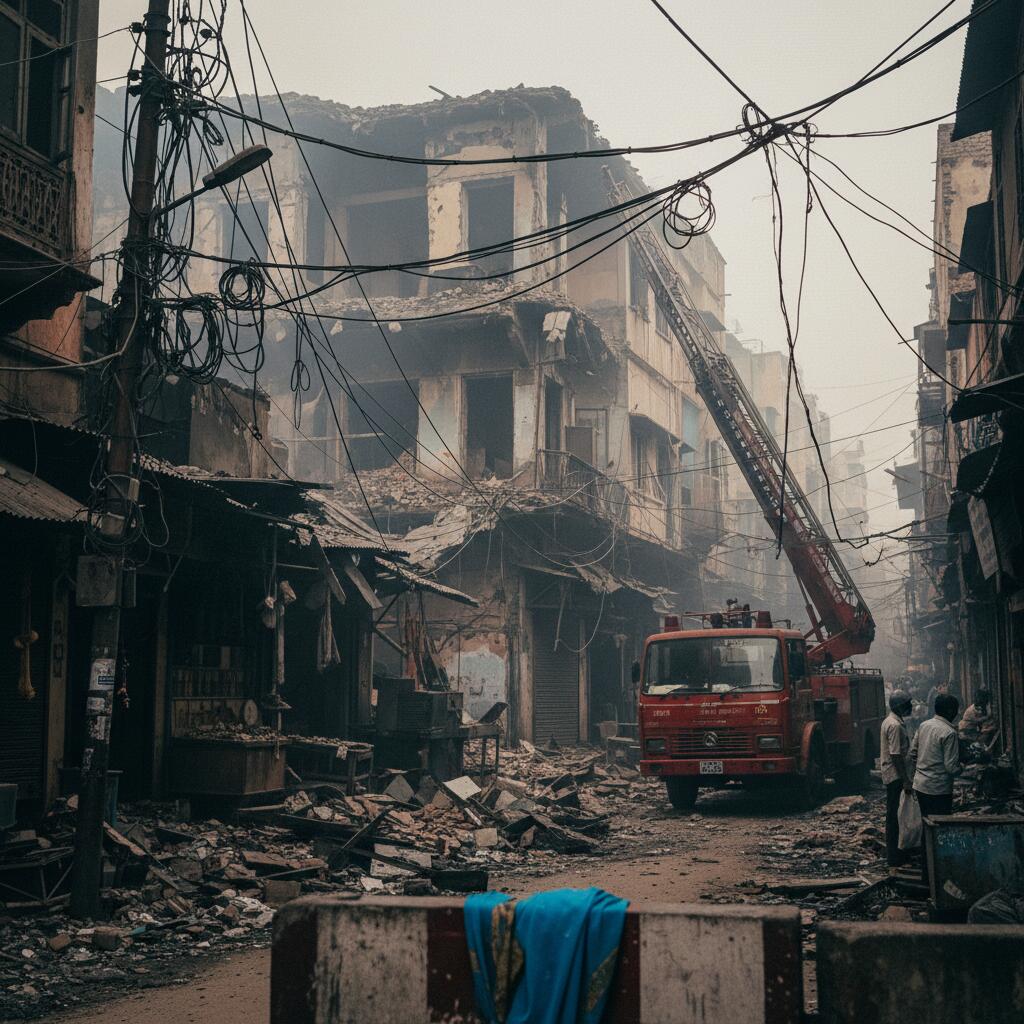
India faces frequent fire tragedies due to rapid urbanisation, overcrowded buildings, poor enforcement of fire safety norms, and overloaded electrical systems. Many structures lack proper exits, alarms and sprinklers, while agencies are under-resourced and slow to upgrade. These gaps turn small, preventable fires into large, deadly disasters across cities and rural areas.
Rapid urbanisation, denser buildings and mixed-use spaces have outpaced India’s fire safety infrastructure and enforcement.
Everyday ignition sources like careless smoking, faulty wiring and garbage burning drive thousands of preventable fires each year.
Inequality means slum residents and low-wage workers face the highest fire risks and the fewest protections or escape routes.
Where audits, awareness and better equipment are deployed, states like Jammu & Kashmir and cities like Delhi show that incidents and deaths can be reduced.
## Why India Suffers So Many Deadly Fires
India’s fire problem is not just about accidents or bad luck.
It is the result of **crowded cities, poor enforcement of safety rules, weak infrastructure, and low public awareness** coming together in dangerous ways.
Every year, tens of thousands of people die in fires across the country, from house blazes and factory infernos to forest and garbage fires.
Local data from several states in 2024–25 shows how widespread and persistent the crisis is, even when some regions manage short-term improvements.[1][2][3][4][5][6]
---
## The Scale of India’s Fire Crisis
There is no single national dashboard that captures every fire in real time, but state and city-level numbers paint a clear picture.
- In **Telangana**, fire services received **8,861 fire distress and rescue calls in 2025**, the highest since 2019, with at least **163 deaths** and property losses of around **₹880 crore**.[1]
- **Hyderabad city** alone recorded **835 fire accidents in 2025**, up from 801 in 2024 and 767 in 2023, a 9% increase over three years.[3]
- Fire deaths jumped from **1 death in both 2023 and 2024 to 51 in 2025**.[3]
- In **Delhi**, the fire department received **34,088 emergency calls** till early December 2025; **17,366 of these were fire-related**, though overall fire calls fell 14% compared to 2024.[5]
- **Jammu & Kashmir** reported **6,039 fire incidents in 2025**, but this was still a **25% drop** from 8,033 cases the previous year, after stronger audits and safety drives.[2]
- In **Pune**, garbage-burning fires rose by about **20% in 2025** (735 cases vs. 636 in 2024), and grass fires went up by nearly **33%**.[6]
- In **Uttarakhand**, forest fire alerts in December 2025 surged to **1,153**, almost triple the number recorded in December 2024.[4]
These numbers show two things at once: **local improvements are possible**, but **the overall risk environment remains very high**, especially in fast-growing urban areas.
---
## Key Reasons India Has So Many Deadly Fires
Here are some core drivers that repeatedly show up across incidents and regions:
- **Rapid urbanisation without matching safety infrastructure**
- **Weak enforcement of fire safety laws and building codes**
- **Common ignition sources: careless smoking, faulty wiring, and open flames**
- **High-density, low-income housing with few exits and little protection**
- **Climate stress: heatwaves, dry spells, and more flammable landscapes**
Each factor on its own is risky.
Together, they turn minor hazards into mass-casualty events.
---
## Urbanisation Outpacing Fire Safety
### Crowded Cities, Narrow Lanes, High-Rise Buildings
Indian cities are growing vertically and horizontally faster than fire services can keep up.
In Telangana, the state fire chief linked the sharp rise in fires and losses to **rapid urbanisation, higher power consumption, more electrical equipment, and denser commercial activity**.[1]
Fire officials there also admit they can **effectively respond only up to about 15-floor buildings**, even as cities like Hyderabad see many taller structures.[1]
Architects and safety experts warn that **preparing to fight fires in 50-floor buildings is now an urgent necessity, not a luxury**.[1]
Yet many city fire departments still rely on equipment and staffing patterns designed for smaller towns and mid-rise buildings.
### Informal and Mixed-Use Buildings
Many Indian buildings are **mixed-use**: shops on the ground floor, storage or small workshops above, and people living on top floors.
Electrical loads are high, wiring is often improvised, and flammable goods like textiles, plastics, or chemicals may be stored in what are technically “residential” buildings.
When fires break out in such settings:
- Exit routes are often blocked by goods or temporary structures.
- Staircases double as storage spaces.
- Windows may be barred for “security”, trapping residents inside.
This combination makes **even a small incident deadly**, especially at night.
---
## Weak Enforcement: Laws on Paper, Gaps on the Ground
India does have fire safety norms, National Building Code standards, and rules about extinguishers, exits, alarms, and occupancy limits.
But the core problem is **enforcement**.
### Safety Certificates vs Real Safety
Many buildings operate with outdated or irregular fire safety certificates.
Some never complete the full approval process, especially in informal or rapidly developing areas.
Periodic fire safety audits – where they happen – show how much difference enforcement can make:
- In Jammu & Kashmir, fire officials credited **3,728 fire safety audits and stronger preparedness** for a **25% drop in fire incidents in 2025** and huge amounts of property saved.[2]
This suggests that **when inspections are serious and continuous, fires and losses do fall**.
But in many other places, inspections are infrequent, under-resourced, or riddled with corruption.
### Penalties Too Low to Change Behaviour
For many commercial operators, small fines or temporary closures are simply a cost of doing business.
Unless penalties include **hefty fines, criminal liability for gross negligence, or permanent closure**, there is little incentive to deeply invest in safety.
As one Hyderabad-based architect group noted, the spike in incidents exposes a **widening gap between rapid urban growth and real safety preparedness**, and underlines the need to **turn regulatory intent into strict on-ground enforcement**.[1]
---
## Common Ignition Sources: Everyday Risks, Massive Damage
### Careless Smoking and Open Flames
In Telangana, **careless smoking** was the **leading cause of fires**, responsible for **3,578 incidents** in 2025.[1]
That is more than any individual technical fault.
Open flames from cooking, incense sticks, candles, and diyas – especially during festivals – also regularly ignite curtains, upholstery, or stored materials.
### Faulty Wiring and Overloaded Circuits
Electrical short circuits are another main trigger.
Telangana reported **2,244 incidents caused by electrical short circuits in 2025**.[1]
As households and businesses plug in more air-conditioners, fans, coolers, and appliances, older wiring and cheap extension boards take on loads they were never designed to bear.
### Outdoor Storage, Garbage and Grass Fires
Fires do not only start inside homes and factories.
- Telangana’s highest number of fire accidents were in **outdoor storage locations (2,006 incidents)**, followed by **agricultural lands (1,148)** and **residential buildings (1,378)**.[1]
- In Pune, **garbage fires** rose to **735 cases in 2025** and **grass fires** to **571**, a significant jump from 2024.[6]
Garbage burning is often a cheap, illegal waste-disposal shortcut.
These blazes can spread to nearby shanties, transformer boxes, or dry fields, quickly becoming much larger fires.
---
## Climate Stress: Heat, Drought and Forest Fire Alerts
India’s changing climate is adding another layer of risk.
### Hotter Cities, Drier Forests
Fire officials in Telangana noted that **severe heatwaves aggravated fire risks** in 2025.[1]
Heat dries out vegetation, makes trash and grass more flammable, and increases electricity demand for cooling – all of which feed into fire hazard.
In **Uttarakhand**, the Forest Survey of India recorded **1,153 forest fire alerts in December 2025**, compared with just **386 alerts in December 2024**.[4]
Officials largely blamed an **unusually dry December and farm stubble burning near forests**, which sometimes spread into forest land.[4]
Since late 2025, satellite data and government monitoring have also emphasised how shifts in the **timing and intensity of stubble burning** affect fire patterns and air quality in northern India.[7]
### Rural–Urban Fire Link
Rural practices like burning crop residue, grass, or garbage can send sparks into nearby settlements or forests.
When this happens near power lines, roads, or peri-urban belts filled with informal housing, **rural fires become urban disasters**.
---
## Inequality: Why the Poor Suffer the Most
Fire risk in India is deeply unequal.
### Slums and Informal Settlements
Millions of people live in **densely packed, informal homes** made from wood, tin sheets, tarpaulin, and other combustible materials.
There are often:
- No formal layouts or planned exit routes
- Shared electrical connections and illegal wiring
- LPG cylinders stored indoors with little ventilation
A single spark can wipe out an entire lane in minutes, long before fire engines can reach the spot.
Narrow, congested lanes and parked vehicles can delay fire trucks or keep them out completely.
### Unsafe Workplaces for Low-Wage Workers
From small garment units and plastic recycling sheds to illegal godowns in basements, many low-wage workers operate in spaces with:
- Blocked exits
- No extinguishers or alarms
- High fire loads (lots of burnable material)
Recent tragedies – including nightclub, factory, and warehouse fires – often reveal the same pattern: **locked exits, overcrowding, flammable interiors, and no functioning emergency systems**.[3][8]
When incidents happen at night, workers may be sleeping on-site, turning a workplace fire into a mass-casualty event.
---
## Response Capacity: Fire Services Under Pressure
### Too Few Stations, Too Little Equipment
Telangana has been trying to expand capacity – there are **36 fire stations within the Hyderabad municipal limits**, and the state has proposed upgrading 27 single-unit stations and adding equipment like fire-fighting robots.[1]
But urban growth has often outpaced such upgrades.
In many cities:
- Fire stations are too far from new suburbs.
- Ladders and snorkels cannot reach the top of modern high-rises.
- Water sources and hydrants are poorly maintained or illegally encroached.
### When It Works, It Saves Lives
Where capacity is higher, outcomes can improve.
- In Hyderabad, fire services reported **221 people rescued alive in 2025**, with **106 rescues in December alone**.[3]
- In Delhi, the fall in fire calls and deaths in 2025 compared to 2024 suggests that **better awareness, response, and possibly stricter compliance** can make a difference.[5]
- In Jammu & Kashmir, coordinated emergency response and temporary fire stations during events like the **Amarnath Yatra** helped manage risks for large crowds.[2]
The challenge is to **scale this level of preparedness nationwide**, not just during special events or in a few better-resourced cities.
---
## What Can Change the Story?
India’s fire crisis is not inevitable.
The data from Jammu & Kashmir, Delhi, and some city initiatives shows that **targeted action works**.[2][5]
Several priorities stand out:
### 1. Enforce Safety, Don’t Just Announce It
- Make **regular, independent fire safety audits** mandatory for all large residential, commercial, and industrial buildings, with results publicly posted.
- Raise penalties for non-compliance to levels that truly hurt – including closure of repeat offenders.
### 2. Upgrade Fire Services for the Cities We Actually Have
- Invest in **high-rise fire-fighting equipment**, advanced ladders, breathing apparatus, and training for vertical rescue.[1]
- Plan **more fire stations** in line with urban expansion, ensuring that response times stay within global best-practice limits.
### 3. Tackle Everyday Ignition Sources
- Run **mass campaigns** on safe use of electrical appliances, the dangers of illegal wiring, and the risks of careless smoking.[1]
- Crack down on **garbage burning** and promote safer, managed waste systems to reduce trash and grass fires.[6]
### 4. Protect the Most Vulnerable Communities
- Map high-risk slums and informal settlements, and prioritize them for **basic fire infrastructure**: hydrants, clear access lanes, and community extinguishers.
- Train **local volunteer fire wardens** in first response and evacuation.
### 5. Integrate Climate and Land-Use Planning
- Use **satellite alerts and early-warning systems** for forest and farm fires and act quickly to prevent spread.[4][7]
- Regulate and support alternatives to stubble burning to reduce both fire risk and pollution.
---
## Changing Public Attitudes to Fire
Many Indians still see fires as unfortunate “accidents” or acts of fate.
But as state data shows, they follow **clear, preventable patterns**: careless smoking, bad wiring, blocked exits, illegal storage, dry conditions.[1][3][4][6]
The more fire is treated as a **man-made, manageable risk** – like road safety or pollution – the more demand there will be for safer buildings, honest inspections, and better-equipped fire services.
India’s deadly fires are not just a test of infrastructure or governance.
They are a test of **how seriously the country is willing to protect everyday life** in a rapidly changing, warming, and increasingly urban nation.
Read the full story on Quick Digest