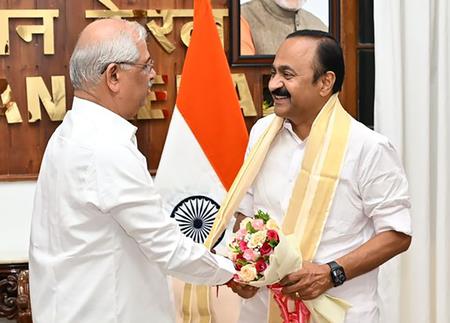
V.D. Satheesan sworn in as Kerala CM; West Bengal enacts policy shifts
V.D. Satheesan was sworn in as the Chief Minister of Kerala, leading a 21-member United Democratic Front (UDF) cabinet. Simultaneously, West Bengal's new BJP government, under CM Suvendu Adhikari, has made significant policy changes, including discontinuing religion-based welfare schemes and implementing the 7th Pay Commission for state employees.
Key Highlights
- V.D. Satheesan took oath as Kerala's new Chief Minister on May 18, 2026.
- A 21-member cabinet was sworn in alongside CM Satheesan.
- West Bengal's government will cease religion-based welfare schemes from June 1.
- The 7th Pay Commission is being implemented for West Bengal state employees.
- West Bengal's new government is reviewing the OBC list.
- New welfare schemes for women and free bus travel for women were approved in West Bengal.
On May 18, 2026, V.D. Satheesan was sworn in as the new Chief Minister of Kerala, marking the return of the Congress-led United Democratic Front (UDF) to power after a decade. The ceremony, held at the Central Stadium in Thiruvananthapuram, saw the administration of the oath of office and secrecy to Satheesan and his 20-member council of ministers by Governor Rajendra Vishwanath Arlekar. The UDF had secured a decisive victory in the recent Assembly elections, winning 102 out of 140 seats. The new cabinet comprises a mix of experienced leaders and 14 first-time ministers, with representation from the Indian Union Muslim League (IUML) and other coalition partners, reflecting a balance of regional and social demographics. Prominent Congress leaders, including Rahul Gandhi and Priyanka Gandhi Vadra, attended the event. Satheesan, a lawyer-turned-politician, has been a key figure in the Congress's revival in Kerala, having served as the Leader of the Opposition. His elevation signifies a new chapter for the party in the state. The formation of the cabinet was reportedly one of the fastest in Kerala's history. The new government is expected to focus on inclusive governance and the development of Kerala.
In parallel developments, West Bengal's new Bharatiya Janata Party (BJP) government, led by Chief Minister Suvendu Adhikari, has initiated significant policy shifts. The state cabinet has approved the implementation of the 7th Pay Commission for state government employees, a move aimed at bridging the pay gap with central government staff. This decision addresses a long-standing demand of employees and will apply to those working in state government offices, civic bodies, and educational institutions. Additionally, the West Bengal government has decided to discontinue all religion-based monetary schemes from June 1. These schemes, which provided monthly honorariums to imams, muezzins, and priests, were run by the Information and Cultural Affairs, Madrasah, and Minority Affairs departments. While these specific schemes are being phased out, the government has stated that existing projects will continue until the end of the current month.
Further policy changes in West Bengal include the approval of the 'Annapurna Bhandar' scheme, which will provide Rs 3,000 monthly financial assistance to women from June 1, fulfilling a key election promise. This scheme replaces the previous 'Lakshmi Bhandar' scheme, with existing beneficiaries automatically being transitioned. Applications for new beneficiaries will be opened through a new portal. The cabinet also granted in-principle approval for free bus travel for women in state-run buses starting from June 1. In a significant legal and political move, the West Bengal cabinet has decided to scrap the existing OBC list in the state, adhering to a Calcutta High Court judgment from May 22, 2024. This decision comes after the High Court invalidated the inclusion of 77 communities, predominantly Muslim, in the OBC list. The state government plans to conduct a fresh survey to identify genuinely backward communities and revise the OBC list accordingly, ensuring that reservation benefits reach eligible individuals through a legally valid process. The previous government's expansion of the OBC list had faced considerable political and legal challenges. These concurrent political developments in Kerala and West Bengal highlight a period of significant transition and policy recalibration in India's political landscape. The actions in West Bengal signify a clear departure from previous policies, aligning with the BJP's election manifesto and addressing key voter concerns.
Frequently Asked Questions
Who is V.D. Satheesan and what is his new role?
V.D. Satheesan is a prominent Congress leader who was sworn in as the new Chief Minister of Kerala on May 18, 2026. He leads the Congress-led United Democratic Front (UDF) government in the state.
What are the major policy changes announced by the new West Bengal government?
The new West Bengal government under CM Suvendu Adhikari has decided to discontinue religion-based welfare schemes, implement the 7th Pay Commission for state employees, introduce the 'Annapurna Bhandar' scheme for women, provide free bus travel for women, and review the state's OBC list.
When will the religion-based welfare schemes in West Bengal be discontinued?
The West Bengal government will discontinue religion-based welfare schemes from June 1, 2026.
What is the 'Annapurna Bhandar' scheme in West Bengal?
The 'Annapurna Bhandar' scheme is a new welfare initiative by the West Bengal government that will provide Rs 3,000 monthly financial assistance to women, replacing the previous 'Lakshmi Bhandar' scheme.