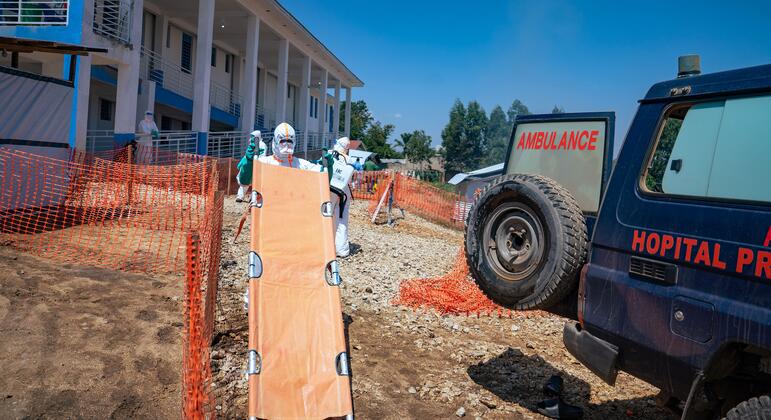
Ebola Outbreak in DRC and Uganda Caused by Bundibugyo Virus
The World Health Organization (WHO) has declared an Ebola virus disease outbreak caused by the Bundibugyo virus in the Democratic Republic of the Congo (DRC) and Uganda a Public Health Emergency of International Concern. This marks the 17th Ebola outbreak in the DRC. The virus has spread across five provinces in the DRC, leading to a significant number of cases and deaths, making it the largest Ebola outbreak recorded in the country's history.
Key Highlights
- Bundibugyo virus is causing a major Ebola outbreak in DRC and Uganda.
- The WHO has declared this a Public Health Emergency of International Concern.
- This is the largest Ebola outbreak in the DRC's history.
- The virus has spread to five provinces in the DRC, affecting numerous health zones.
- There is no approved vaccine or specific treatment for Bundibugyo virus disease.
The Democratic Republic of the Congo (DRC) is currently facing its 17th Ebola virus disease outbreak, caused by the Bundibugyo virus, which has also seen cases in Uganda. The World Health Organization (WHO) has declared this a Public Health Emergency of International Concern (PHEIC), highlighting the severity and potential for international spread. This outbreak has become the largest Ebola outbreak ever recorded in the DRC, surpassing the previous record set between 2018 and 2020. As of early August 2026, the outbreak has spread across five provinces in the DRC – Ituri, North Kivu, South Kivu, Haut-Uélé, and Tshopo – affecting 49 health zones. Transmission remains active in 33 of these zones, with ongoing reports of new cases. The cumulative number of confirmed cases in the DRC has reached over 3,600, with more than 1,500 deaths, resulting in a crude case fatality ratio (CFR) of approximately 44%. The Ituri Province is the most heavily impacted, accounting for a significant majority of the cases and deaths. The rapid pace of transmission, with the highest weekly numbers of cases and deaths recorded in late July 2026, underscores the escalating nature of the public health emergency. Several factors contribute to the rapid spread and difficulty in containment, including insecurity, population displacement, high mobility, and cross-border movements, particularly with Uganda. The virus is zoonotic, with fruit bats suspected as the natural reservoir, and human infection occurs through contact with infected animals or their bodily fluids. Person-to-person transmission happens through direct contact with the blood, secretions, organs, or other bodily fluids of infected individuals, or contaminated surfaces. Importantly, there is no approved vaccine or specific treatment for Bundibugyo virus disease, unlike some other Ebola virus species. Response strategies therefore heavily rely on comprehensive public health measures, including supportive care, early case detection, stringent infection prevention and control, contact tracing, safe burial practices, and community engagement. The WHO and its partners are working to scale up response activities, but challenges persist due to the complex environment, including ongoing armed conflict and humanitarian crises in affected regions. Uganda has declared the end of its Bundibugyo virus disease outbreak, with the last locally transmitted case having been discharged in mid-June 2026. However, the risk of re-introduction remains due to cross-border mobility. Imported cases have also been reported in Germany and France, highlighting the international dimension of the outbreak and the importance of global preparedness. The Bundibugyo virus was first identified in 2007 in western Uganda, and it has caused previous outbreaks in Uganda (2007-2008) and the DRC (2012). While its case fatality rate is generally lower than that of the Zaire ebolavirus, it remains a significant public health threat. The current outbreak's scale and rapid spread are of considerable concern, demanding intensified international coordination and robust response efforts to mitigate its impact.
Frequently Asked Questions
What is the Bundibugyo virus?
The Bundibugyo virus (BDBV) is a species of Ebola virus that causes severe and often fatal viral hemorrhagic fever. It was first identified in 2007 in western Uganda.
What is the current situation regarding the Ebola outbreak caused by Bundibugyo virus?
The Democratic Republic of the Congo (DRC) is experiencing its largest-ever Ebola outbreak, caused by the Bundibugyo virus, with cases also reported in Uganda. The World Health Organization (WHO) has declared it a Public Health Emergency of International Concern.
What are the symptoms of Bundibugyo virus disease?
Initial symptoms include fever, headache, and muscle pain, which can be mistaken for other endemic infections. As the disease progresses, symptoms can include vomiting, diarrhea, and in fatal cases, external and internal bleeding.
Is there a vaccine or treatment for Bundibugyo virus disease?
Currently, there is no approved vaccine or specific treatment for Bundibugyo virus disease. Response efforts focus on public health measures such as supportive care, infection control, and contact tracing.