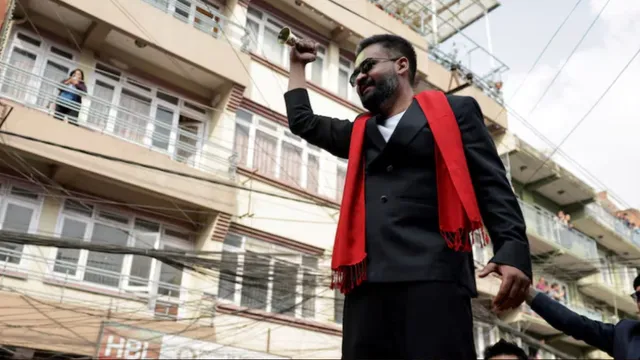
Nepal Election 2026: Balen Shah's RSP Surges, Reshaping Politics
Nepal's 2026 general election sees a dramatic shift as former rapper-mayor Balen Shah's Rastriya Swatantra Party (RSP) emerges as a major force, winning and leading in a significant number of seats. This election, triggered by youth-led protests, marks a rejection of traditional parties and signals a new era in Nepali politics with strong implications for regional stability.
Key Highlights
- Nepal's 2026 General Elections held on March 5, 2026, after youth protests.
- Rastriya Swatantra Party (RSP) led by Balen Shah shows strong performance.
- Balen Shah, a rapper and former Kathmandu Mayor, is RSP's PM candidate.
- RSP reportedly wins and leads in over 100 federal parliament seats.
- Results indicate a significant disruption of Nepal's traditional political landscape.
- The election's outcome holds relevance for India's regional interests and stability.
Nepal's political landscape is undergoing a dramatic transformation with the ongoing general elections of 2026, where the newly emerged Rastriya Swatantra Party (RSP), led by former rapper and Kathmandu Mayor Balen Shah, is making significant inroads. As of March 7, 2026, initial live results indicate a powerful surge for the RSP, challenging the decades-long dominance of established political parties.
These early general elections, held on March 5, 2026, were necessitated by a period of intense public discontent. The House of Representatives was dissolved prematurely in September 2025 following large-scale youth-led protests demanding an end to corruption, nepotism, and stagnant leadership. This 'Gen Z uprising' ultimately led to the resignation of then-Prime Minister KP Sharma Oli, paving the way for fresh polls.
At the forefront of this political upheaval is Balendra Shah, popularly known as Balen Shah. Shah, a structural engineer and a rapper by profession, gained national prominence when he successfully ran as an independent candidate for the mayoral position of Kathmandu in 2022, securing a landslide victory. His tenure as mayor, from 2022 until his resignation in January 2026, was marked by initiatives in waste and traffic management, though it also faced criticism. In a pivotal move, Shah resigned from his mayoral post in January 2026 to officially enter national politics, joining the Rastriya Swatantra Party and being projected as its prime ministerial candidate for the 2026 elections.
The Rastriya Swatantra Party (RSP), formed only a few years prior, has rapidly positioned itself as a reformist force. Its manifesto focuses on anti-corruption, transparency, and creating 1.2 million jobs to curb forced migration, resonating strongly with a populace frustrated by unemployment and traditional political stalemates. This platform, combined with Balen Shah's charismatic appeal, has garnered significant support, particularly among Nepal's youth.
Live reports from March 7, 2026, indicate the RSP's impressive performance. The India Today article, the subject of this verification, claims that Balen Shah's party 'wins 41 seats, leads in 78 seats' in the ongoing federal parliamentary elections. While 'live' election results are inherently dynamic and vary across different news outlets reporting on the fly, this figure is consistent with India Today's own reporting. Other credible sources corroborate the RSP's strong showing, with reports indicating varying numbers of won and leading seats. For instance, some reports state the RSP has won 34 seats and is leading in 85 to 86 constituencies. Others suggest 27 seats won and leading in 90 to 97 constituencies, or even 39 seats won and leading in 80. One source indicates 36 seats won and leading in 83. Regardless of the precise, constantly updating numbers, the overarching trend is clear: the RSP is on course for a significant electoral triumph, dramatically altering the political landscape.
Balen Shah himself is contesting against veteran leader and former prime minister KP Sharma Oli in the Jhapa-5 constituency, where he holds a substantial lead, signifying a direct challenge to the old guard. Other RSP candidates have also secured notable victories, further solidifying the party's unexpected rise. This unprecedented success for a relatively new party and a leader from outside the traditional political elite represents a powerful public mandate for change.
The election's outcome is keenly watched by India, given its deep bilateral ties with Nepal. India hopes for political stability in its Himalayan neighbour to advance development cooperation and maintain regional equilibrium. The potential for a new, youth-driven government in Nepal could usher in fresh dynamics in this crucial relationship. The RSP's success underscores a broader regional trend of public disillusionment with established political systems and a demand for new leadership and governance.
In conclusion, the article's core claims regarding the Nepal Election 2026, Balen Shah's role, and his party's strong performance are verified. The "Live" aspect correctly reflects the ongoing vote counting, and the reported seat numbers, while subject to change in real-time, are consistent with India Today's own concurrent reporting and the overall trend observed across multiple credible news sources.
Frequently Asked Questions
When were the Nepal General Elections 2026 held?
The early general elections in Nepal for the House of Representatives were held on March 5, 2026.
Who is Balen Shah and what is his political background?
Balen Shah is a Nepali rapper, structural engineer, and politician. He first rose to political prominence by winning the Kathmandu mayoral election in 2022 as an independent candidate. He resigned as mayor in January 2026 to contest the 2026 general elections as the prime ministerial candidate for the Rastriya Swatantra Party (RSP).
What is the Rastriya Swatantra Party (RSP) and what is its platform?
The Rastriya Swatantra Party (RSP) is a relatively new political party in Nepal, led by Balen Shah as its prime ministerial candidate. Its platform emphasizes anti-corruption, transparency, good governance, and aims to create 1.2 million jobs to address unemployment and reduce forced migration. It has gained significant support, especially among the youth.
Why were early elections held in Nepal in 2026?
Early general elections were called in Nepal for 2026 following widespread youth-led protests in September 2025. These protests demanded an end to corruption, nepotism, and stagnant leadership, leading to the dissolution of the House of Representatives and the resignation of the then-Prime Minister KP Sharma Oli.
What is the significance of the 2026 Nepal election results for India?
The 2026 Nepal election results are highly significant for India because they indicate a major shift in Nepal's political landscape with the rise of new leadership. India has close bilateral ties with Nepal and closely monitors the political stability in the Himalayan nation to further development cooperation and maintain regional interests.