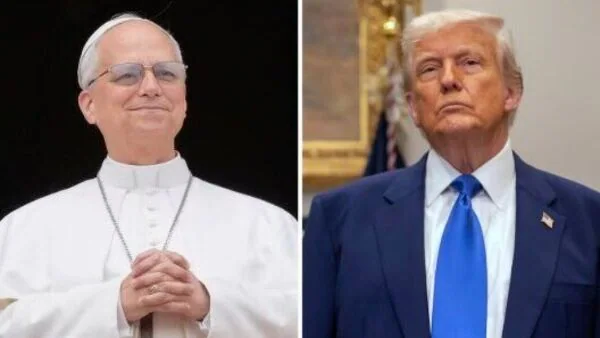
Pope Leo XIV challenges Trump's 'divinely sanctioned' war narrative on Iran
Pope Leo XIV has publicly countered Donald Trump's framing of the Iran war as 'divinely sanctioned,' emphasizing that 'God does not bless any conflict.' This stance highlights a significant moral and rhetorical clash between the presidential power and the papal moral authority, particularly concerning the conflict in Iran. The Pope's recent statements have intensified criticism of the war, urging leaders to pursue peace through dialogue and mediation. The Vatican's appeals are rooted in the Gospel, directly challenging the religious language used by some political figures to justify the conflict.
Key Highlights
- Pope Leo XIV criticizes the 'delusion of omnipotence' fueling the Iran war.
- The Pope insists that 'God does not bless any conflict.'
- Pope Leo XIV calls for leaders to prioritize dialogue and mediation for peace.
- The Vatican's peace appeals are grounded in the Gospel.
- This marks a clash between presidential rhetoric and papal moral authority.
The conflict between the United States and Iran has taken on a new dimension with Pope Leo XIV's strong denunciation of the war and its perceived religious justifications. The Pope has directly challenged Donald Trump's framing of the conflict as 'divinely sanctioned,' asserting that "God does not bless any conflict". This divergence in rhetoric signals a significant clash between presidential power and papal moral authority, particularly concerning the U.S.-Israel war in Iran.
Pope Leo XIV, the first American-born pope, has become increasingly outspoken against policies he views as detrimental to peace. In recent pronouncements, he has denounced the "delusion of omnipotence" that he believes fuels the war, urging political leaders to cease hostilities and negotiate peace. His appeals are deeply rooted in the Gospel, directly countering the religious language that some political figures, such as U.S. Secretary of Defense Pete Hegseth, have used to frame the conflict. The Pope has explicitly stated that Jesus "does not listen to the prayers of those who wage war".
These papal interventions come at a time of heightened tensions between the U.S. and Iran. During Donald Trump's first administration, relations were marked by the U.S. withdrawal from the Joint Comprehensive Plan of Action (JCPOA) and the imposition of "maximum pressure" sanctions. Tensions escalated with events such as the U.S. assassination of Iranian General Qasem Soleimani, which led to Iranian missile attacks on U.S. bases in Iraq, heightening fears of war. The current situation, as of April 2026, appears to involve renewed diplomatic efforts, with reports of face-to-face talks between American and Iranian delegations, mediated by Pakistan, amidst a fragile ceasefire agreement. However, these talks have faced significant challenges, including Iran's insistence on sanctions relief and security guarantees, and the U.S. demand for a new, more robust nuclear deal.
The Pope's stance is consistent with his broader advocacy for peace and dialogue. He has consistently called for an end to violence, emphasizing that peace can only be achieved through "reasonable, sincere, and responsible dialogue". He has also condemned the use of religious arguments to justify conflict, stating that "Even the holy name of God, the God of life, is being dragged into discourses of death". This position aligns with the Catholic Church's teachings, which, while acknowledging the concept of a "just war" under specific, stringent conditions, increasingly emphasizes non-violence and peacebuilding. Pope Francis, his predecessor, also consistently condemned war, stating that "God does not bless conflicts" and that "violence and war lead only to death".
The Vatican's engagement on the Iran conflict also touches upon humanitarian concerns. Pope Leo XIV has shown a progressive stance on social issues, championing migrants and those in poverty, and has also criticized U.S. immigration policies under Donald Trump. This broader humanitarian focus informs his strong opposition to the devastation caused by war.
The clash between Trump's rhetoric and Pope Leo XIV's moral pronouncements highlights the complex interplay between political power, religious authority, and international conflict. While Trump frames the war in terms of divine sanction and national interest, Pope Leo XIV appeals to universal moral principles and the Gospel's message of peace. The situation underscores the significant role the papacy can play in offering a moral counterpoint to political actions, particularly in times of international crisis. The ongoing diplomatic efforts, coupled with the Pope's fervent calls for peace, indicate a critical juncture in the U.S.-Iran relations and the broader landscape of global security..
The news article, published by NDTV, is a World News report. The primary countries involved are the United States and Iran, with Pakistan playing a mediating role. The conflict has global implications due to its impact on international relations, oil markets, and regional stability. The events described are recent, with key statements and actions occurring in early to mid-April 2026, making the news timely and relevant. Pope Leo XIV was elected on May 8, 2025, making him a relatively new pontiff whose voice on international affairs is gaining prominence. His background as the first American-born pope adds an interesting layer to his diplomatic engagements with the U.S. administration. The article's focus on the rhetorical and moral conflict between the President and the Pope places it firmly in the realm of political analysis and international relations, with religious undertones.
Frequently Asked Questions
Who is Pope Leo XIV?
Pope Leo XIV, born Robert Francis Prevost, is the 267th and current Pope of the Catholic Church. He is the first American-born pope, elected on May 8, 2025. He holds dual citizenship in the United States and Peru and is a member of the Order of Saint Augustine. He is known for his emphasis on peace, dialogue, and social justice.
What is the core of the conflict between Pope Leo XIV and Donald Trump regarding the Iran war?
The central conflict lies in their differing perspectives on the Iran war. Donald Trump has framed the war as 'divinely sanctioned,' implying divine approval. In contrast, Pope Leo XIV insists that 'God does not bless any conflict' and has denounced the 'delusion of omnipotence' fueling the war. This creates a clash between presidential rhetoric and papal moral authority.
What is the Catholic Church's stance on war?
The Catholic Church generally advocates for peace and non-violence. While historically it has recognized the concept of a 'just war' under strict conditions, recent teachings, particularly from Pope Francis and now Pope Leo XIV, emphasize that war is rarely a solution and that God does not bless conflicts. The Church calls for dialogue, mediation, and the pursuit of justice as paths to true peace.
What is the current state of U.S.-Iran relations as portrayed in the context of this news?
Relations between the U.S. and Iran have been historically tense, marked by sanctions and confrontations. As of April 2026, there are reports of fragile ceasefires and ongoing diplomatic efforts, including mediated talks. However, significant challenges remain regarding Iran's nuclear program, sanctions, and security guarantees, creating an unstable geopolitical situation.